
A brief story
A few years ago I was waiting at a crowded airport when two strangers struck up a conversation near the departure boards. One was a pediatrician returning from a global health conference, the other a defense engineer on his way to an arms expo. They agreed that war is senseless and that, in the twenty‑first century, humans should be able to resolve disputes peacefully. Yet the display behind them showed civil wars, invasions and refugee crises as if they were weather reports. One man asked the other, “If human beings are civilised and we understand the horror of war, why do we keep fighting?”
To answer that question, we need to look at our biology, our political institutions, our leaders’ incentives and the technologies we wield. The explanations below draw on historical cases and academic research to show why wars persist despite widespread revulsion.
Paleolithic emotions in a nuclear age
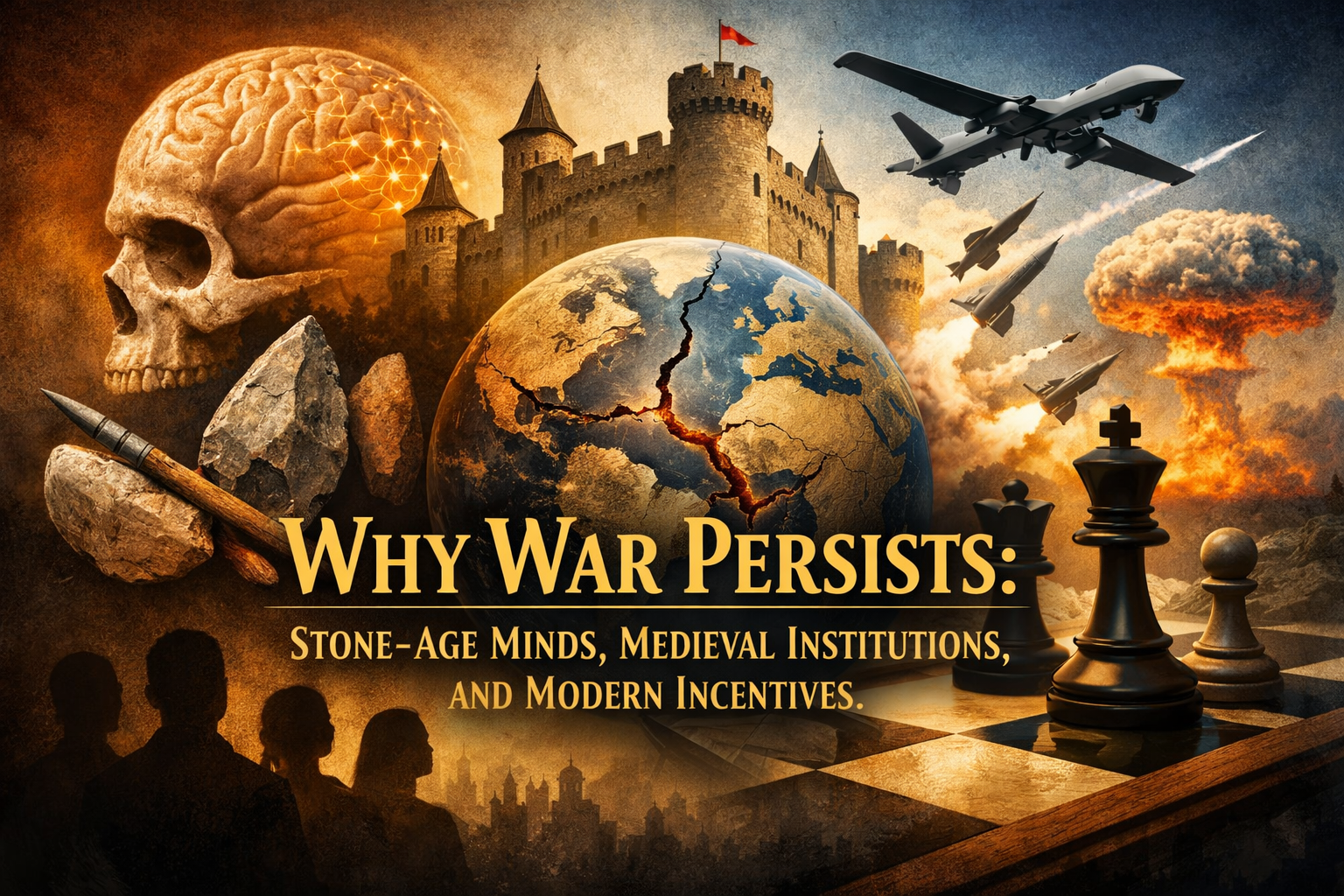
Biologist E. O. Wilson once described modern humans as an “evolutionary chimera” with Paleolithic emotions, medieval institutions and god‑like technology . Our brains evolved for survival in small tribes. Fast “threat circuits” react quickly to fear, anger and revenge, while our slower reasoning systems struggle to keep up. In modern politics those threat circuits are easily hijacked by propaganda or panic, narrowing our focus to us versus them and making extreme measures seem defensive rather than aggressive.
Group identity is also a powerful psychological drug. The State of Nationalism project notes that nationalists tend to believe their group’s values are superior and often perceive adversaries as inherently hostile. Survey research shows nationalism correlates with support for militarism—U.S. respondents who score higher on nationalism scales are more likely to endorse military action against other countries . When leaders frame conflict as defending “who we are,” compromise feels like betrayal.
Misperception and miscalculation
Many wars erupt not because leaders lust for violence but because they misread each other’s intentions or capabilities. A declassified study on the 2003 Iraq War argues that mutual misperceptions—U.S. leaders assumed Saddam Hussein was defying disarmament to hide weapons of mass destruction, while Hussein thought the U.S. was bluffing—closed off opportunities for de‑escalation . Both sides acted on bad information, and war became self‑fulfilling.
Historians describe the 1967 Six‑Day War as a “war of miscalculation.” Israeli‑inspired narratives emphasise that false Soviet intelligence reports of an imminent Israeli attack on Syria prompted Egyptian president Gamal Abdel Nasser to mass troops in Sinai, expel the U.N. peacekeeping force and close the Strait of Tiran, steps that Israel viewed as casus belli . Arab narratives blame Israeli threats. All sides agree that deceptions, miscalculations and misperceptions escalated the crisis .
These examples show how uncertainty and fear can turn crises into wars. Leaders rarely have perfect information; cognitive biases lead them to interpret ambiguous actions as hostile, and once blood is spilled the sunk‑cost fallacy makes compromise harder.
Institutions built for arms races
States and militaries are designed to prepare for worst‑case scenarios. Before the First World War, rapid technological change and alliance politics created a spiral of armament. The 1914–1918 Online Encyclopaedia notes that new weapons (dreadnoughts, heavy artillery) and a naval and land arms race among European powers increased tensions; German fear of Russia’s growing army and British anxiety about Germany’s naval build‑up were key drivers . British foreign secretary Edward Grey warned that “excessive expenditure on armaments must lead to a catastrophe” . Institutional inertia and alliance commitments meant that mobilisation schedules took on a life of their own, and when a regional assassination sparked crisis, mobilisation timetables pushed Europe into war.
Contemporary security policies still reflect Cold War logic: deterrence strategies assume that only military strength prevents aggression, so states view others’ build‑ups as threatening. Each side insists it is “just responding,” yet the result is mutual escalation. Bureaucracies favour caution over innovation; once doctrines are set, changing them is slow.
Leaders’ incentives and diversionary wars
War can be catastrophic for populations but useful for some leaders. Political scientists describe diversionary wars, in which embattled governments initiate foreign conflicts to rally domestic support. The War Prevention Initiative explains that leaders facing economic problems or political opposition may start a military crisis to “rally around the flag” or to “gamble for resurrection,” hoping a swift victory will restore legitimacy .
A famous example is the 1982 Falklands/Malvinas War. Argentina’s military dictatorship, presiding over an economic crisis and human rights abuses, invaded the British‑held islands in April 1982 hoping to distract from domestic turmoil . The initial invasion provoked a wave of patriotic fervour, but Britain counter‑attacked, defeated Argentina and the junta fell. The war temporarily boosted British prime minister Margaret Thatcher’s popularity and contributed to her re‑election.
Diversionary motives do not always succeed—leaders miscalculate domestic reactions and international responses. Yet the possibility of rallying support makes war a tempting option for authoritarian and democratic leaders alike.
A war economy and the military‑industrial complex
War is also sustained by economic incentives. The military‑industrial complex—the network of defense companies, lobbyists and government agencies—makes prolonged conflict lucrative. A Quincy Institute report on U.S. Pentagon spending found that between 2020 and 2024 private firms received $2.4 trillion in contracts, amounting to 54 % of the Pentagon’s discretionary spending . The five largest contractors—Lockheed Martin, RTX, Boeing, General Dynamics and Northrop Grumman—together received $771 billion . The report notes that arms transfers to Israel and Ukraine significantly increased these firms’ profits and that the industry uses lobbying and campaign donations to promote policies that sustain high military spending .
When billions of dollars and thousands of jobs depend on defense contracts, politicians have incentives to fund weapons systems whether or not they are needed. In some countries war also provides employment for soldiers and militias and income for black markets and smugglers. This war economy creates powerful constituencies who gain from continued conflict and resist peace agreements that threaten their livelihoods.
Technology that lowers the threshold for violence
Modern technology allows leaders to use force with fewer immediate costs. Unmanned aerial vehicles (drones) permit states to conduct strikes without risking their own pilots. A study by political scientist Erik Lin‑Greenberg notes that while drones have not by themselves provoked major escalation, they increase the number of situations in which leaders are willing to use force . Drones lower the human and political costs of military operations; decision‑makers become more willing to authorise strikes, and adversaries may retaliate less vigorously when a drone—not a manned aircraft—is shot down.
Similarly, cyber‑attacks and precision‑guided munitions enable remote warfare. Because these technologies minimize casualties among the attacker’s forces and often avoid media scrutiny, they reduce domestic opposition and make conflicts easier to start.
War is not inevitable—institutions and choices matter
Recognising these drivers does not mean war is unavoidable. History also provides examples where leaders restrained themselves or built institutions to manage disputes. After World War II, Europe created mechanisms—integrated markets, multilateral organisations and legal norms—that reduced the likelihood of war between former enemies. The success of arms control treaties during parts of the Cold War shows that adversaries can negotiate limits on dangerous technologies.
Reducing war requires addressing each level of the puzzle:
- Education and empathy to counter dehumanising propaganda and recognise common interests.
- Transparent institutions that constrain leaders and require public deliberation before the use of force.
- Economic diversification to reduce dependence on arms contracts and provide alternative employment for soldiers and defense workers.
- International law and arbitration to manage territorial disputes and prevent miscalculations.
- Technological ethics to ensure new weapons do not further lower the threshold for violence.
Human beings may still have Stone‑Age brains, but we are also capable of reflection. A pediatrician and a weapons engineer at an airport can agree that war is tragic; the challenge is to build societies that make those sentiments matter.
References
Brose, E. D. (n.d.). Arms race prior to 1914, armament policy. In 1914–1918-online: International encyclopedia of the First World War. https://encyclopedia.1914-1918-online.net/article/arms-race-prior-to-1914-armament-policy/
Cohen, A. (2017, June 3). The 1967 Six-Day War. Wilson Center. https://www.wilsoncenter.org/publication/the-1967-six-day-war
Dizikes, P. (2025, November 13). How drones are altering contemporary warfare. MIT News. https://news.mit.edu/2025/how-drones-are-altering-contemporary-warfare-erik-lin-greenberg-book-1113
Ko, J., & Powers, K. E. (2024). Nationalism and international conflict. The State of Nationalism. https://stateofnationalism.eu/article/nationalism-and-international-conflict/
Laurens, H. (2007, June). 1967: A war of miscalculation and misjudgment. Le Monde diplomatique (English edition). https://mondediplo.com/2007/06/09warofmiscalculation
Stieb, J. (2024, March 25). The Icarus Trap: Arrogance, misperception, and the U.S. invasion of Iraq. War on the Rocks. https://warontherocks.com/2024/03/the-icarus-trap-arrogance-misperception-and-the-u-s-invasion-of-iraq/
We are a complicated mix of paleolithic emotions, medieval institutions, and god-like technology. (2017, October 3). Big Think. https://bigthink.com/hard-science/eo-wilson-what-makes-us-human-paleolithic-emotions-medieval-institutions-god-like-technology/
Rally ’round the flag effect. (n.d.). In Wikipedia. Retrieved January 15, 2026, from https://en.wikipedia.org/wiki/Rally_%27round_the_flag_effect
Discover more from RETHINK! SEEK THE BRIGHT SIDE
Subscribe to get the latest posts sent to your email.