
Long before there were laboratories, there was a girl sitting by a riverbed in the Fertile Crescent. This was even before there were universities. It was also before there was a word for “science.” She noticed something peculiar. One season, a patch of wild wheat grew tall and dense. The next season, after a flood had deposited silt in a different spot, a new patch grew there. She did not know about soil nutrients or hydrology. She only knew a pattern: wheat grew well where the muddy water had been. She began to experiment, scooping water from the river to pour onto other patches of ground. Some flourished, some did not. She kept no notebooks, but she remembered. She told her children. And in that simple act of noticing, wondering, testing, and remembering, the engine of human progress was ignited. This was the magic of learning how to learn.
The story of civilization is the story of this engine’s evolution. For most of human history, learning was a slow, secretive process of trial and error, observation and oral tradition. The girl by the river could not have articulated a hypothesis. Yet, she was engaged in the fundamental scientific act. She used experience to predict and control the world. From this seed grew the first great pyramid of achievement.
Its base layer was the Neolithic Revolution. For tens of thousands of years, humans were at the mercy of their environment, following herds and foraging for plants. Then, through millennia of accumulated observation, they learned to manipulate the environment itself. They domesticated plants and animals, transforming themselves from passive participants in nature into active shakers of it. This required a staggering amount of practical knowledge: understanding seasonal cycles, soil properties, animal breeding, and water management. It was empirical science without the theory.
Agriculture laid the foundation. Upon this, a second layer emerged in the great river valleys of Mesopotamia, Egypt, and the Indus. This included written language and mathematics. Writing was the first external memory drive. It broke the bottleneck of the human brain, allowing knowledge to be stored with perfect fidelity and accumulated across generations. A farmer could make an observation about the stars and the floods. This observation could then be recorded, verified, and expanded by a scribe five hundred years later. Mathematics provided the first abstract language for describing the world, transforming the qualitative into the quantitative. You could now measure a field, calculate its yield, track the movements of planets, and, crucially, predict the future. The invention of zero in ancient India became a powerful conceptual tool in history. It served as a placeholder for nothingness and enabled everything.
The third layer was the Axial Age. This was a remarkable burst of philosophical inquiry. It spanned roughly the 8th to the 3rd century BCE in Greece, India, and China. Here, thinkers like Aristotle in the West and Mahavira in the East began to ask not just “how?” but “why?” They shifted from mythology to metaphysics, from stories of gods to principles of logic. They proposed that the universe was not a chaotic playground for divine whims. Instead, it was an ordered cosmos governed by natural laws. These laws were ones that the human mind could comprehend. Aristotle’s formal logic established the initial rules for valid reasoning. Euclid’s geometry showed that from a few simple axioms, an enormous and solid structure of truth could be built. This was the blueprint for all subsequent systematic knowledge.
For nearly two millennia, this pyramid stood, with scholars refining and debating the ideas of the ancient masters. But it was a static structure. Knowledge was about authority, not discovery. To question Aristotle was heresy. The engine was idling.
Then came the spark that ignited it: the formalization of the Scientific Method in the 16th and 17th centuries. Thinkers like Francis Bacon and Galileo Galilei proposed a radical shift: do not trust the ancients; trust your experiments. The method—observation, hypothesis, experimentation, analysis—was a meta-tool, a machine for generating knowledge. It was learning how to learn, elevated to a formal discipline. It replaced the authority of the past with the authority of evidence. It was self-correcting. An incorrect hypothesis was not a failure but a step closer to truth. This was the engine now running at full throttle, and it began to produce discoveries at an accelerating rate.
Newton synthesized the cosmos with his laws of motion and universal gravitation. He showed that the same force that pulled an apple to Earth held the planets in their orbits. The universe was a clockwork, predictable and knowable. The Industrial Revolution followed. This newfound understanding of physics and chemistry was harnessed to create steam engines. It led to the construction of factories and a new world.
But the deepest revolution was yet to come. It began in the mid-19th century with Darwin and Wallace. They proposed that the magnificent diversity of life was not a static creation. Instead, it was the product of a simple, elegant mechanism: natural selection. This was the first great blow to the idea of a special, ghost-like essence animating living things. Life, too, could be understood as a process, a grand, unfolding algorithm.
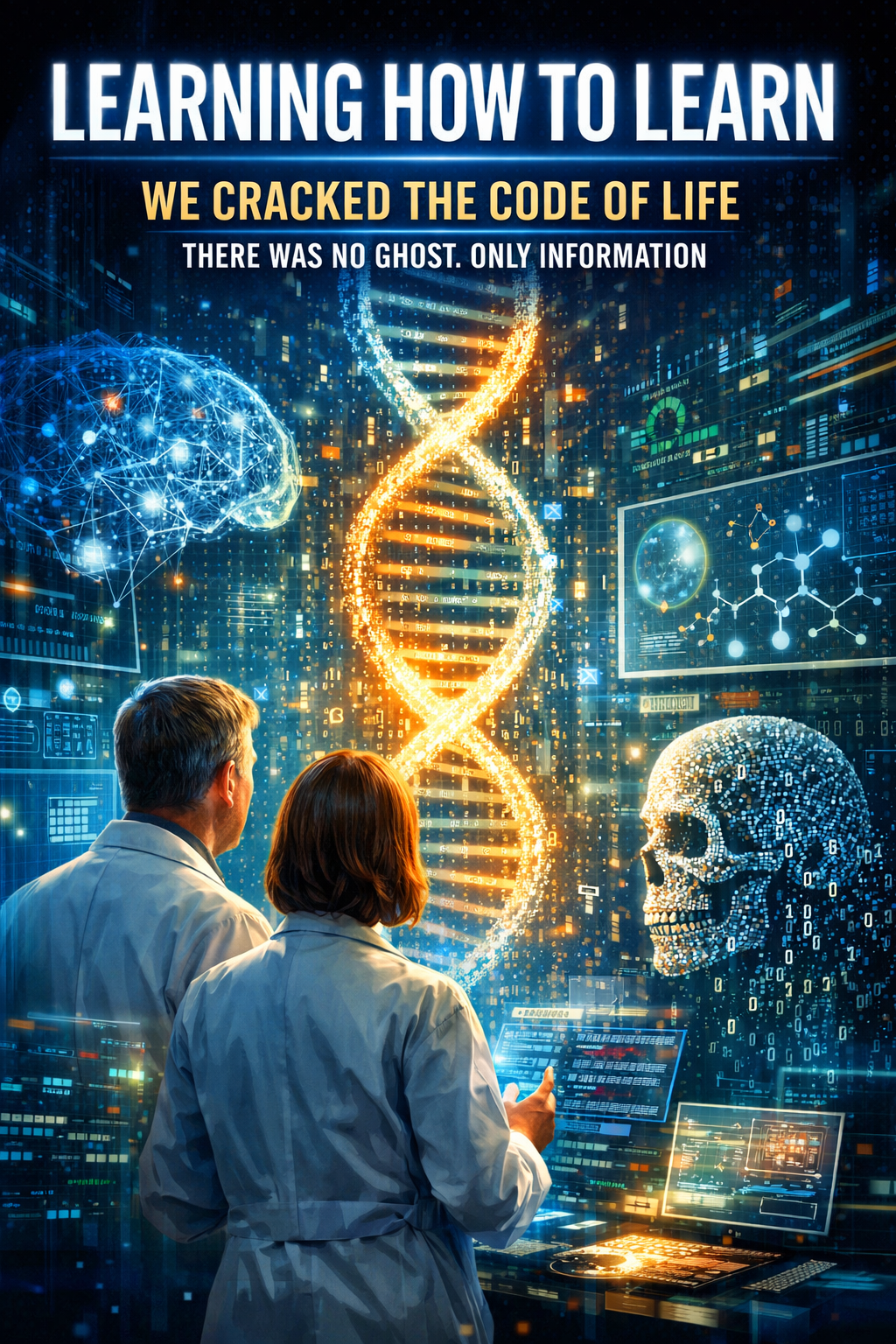
The final blow came in the 20th century, and it arrived from an unexpected direction: information theory. In 1944, Oswald Avery demonstrated that DNA was the molecule of heredity. In 1953, Watson and Crick, building on the crucial X-ray crystallography of Rosalind Franklin, deciphered its structure. The revelation was staggering: the secret of life was a code. A four-letter chemical alphabet—A, T, C, G—arranged in specific sequences, constituted the instruction manual for every living organism. Biology had become an information science. The “ghost in the machine,” the vital force that was supposed to animate matter, was nowhere to be found. There was only mechanism, data, and the elegant logic of the genetic code.
We learned the language of life. And once you know a language, you can begin to write in it. The discovery of restriction enzymes in the 1970s gave us the first scissors to cut and paste DNA. Then came the polymerase chain reaction (PCR), a copying machine for genes. The Human Genome Project, completed in 2003, gave us the complete reference text.
This set the stage for the current revolution. It is a remarkable transition from reading the code to writing it. With CRISPR-Cas9, we can now edit genes with precision. This tool is adapted from the bacterial immune system. Such precision was unimaginable a generation ago. We are no longer subject to the slow, blind process of natural selection. We have seized the controls. We can tweak the code to cure genetic diseases, to make crops more resilient, to design organisms that produce pharmaceuticals. We are beginning to control and accelerate evolution itself.
In 2010, the J. Craig Venter Institute announced the creation of the first synthetic bacterial cell. It has a genome designed on a computer and assembled in a lab. Life, built from scratch. We are moving from editing existing code to writing entirely new programs.
And this biological revolution is occurring in lockstep with a digital one. Artificial intelligence is a product of our understanding of logic and mathematics. Now, with neural networks, it is becoming our partner in discovery. AI models like AlphaFold can now predict the three-dimensional structure of proteins from their amino acid sequence. This achievement solves a grand challenge in biology that has persisted for half a century. AI is designing new enzymes, discovering novel antibiotics, and analyzing the vast datasets of genomics.
We are witnessing a synergistic feedback loop of unprecedented power. AI helps us understand biology; biology, with its efficient, low-power computational mechanisms, is inspiring new architectures for AI. We can now imagine a future where we design biological systems with the same fluidity we design software. AI will help us navigate the immense complexity of the living world.
The girl by the river could not have imagined this. But the spark that ignited her curiosity is the same one that now illuminates the double helix. The magic of learning how to learn was first practiced in the mud. Then it was formalized in philosophy. It was later systematized in science. This process has culminated in a species that is learning to rewrite its own source code. We have climbed the pyramid from observation to abstraction to method. Now, we stand at its apex. We look not just at the stars but into the very core of our own being. The ghost is gone. In its place is information, and we have become its editors.
References
Arnason, J. P., Eisenstadt, S. N., & Wittrock, B. (Eds.). (2004). Axial civilizations and world history. Brill.
Bertman, S. (2003). Handbook to life in ancient Mesopotamia. Oxford University Press.
Breasted, J. H. (1916). Ancient times: A history of the early world. Ginn and Company.
Darwin, C. (1859). On the origin of species by means of natural selection, or the preservation of favoured races in the struggle for life. John Murray.
Dobzhansky, T. (1973). Nothing in biology makes sense except in the light of evolution. The American Biology Teacher, 35(3), 125–129.
Gaudelli, N. M., Komor, A. C., Rees, H. A., Packer, M. S., Badran, A. H., Bryson, D. I., & Liu, D. R. (2017). Programmable base editing of A•T to G•C in genomic DNA without DNA cleavage. Nature, 551(7681), 464–471. https://doi.org/10.1038/nature24644
Gibson, D. G., Glass, J. I., Lartigue, C., Noskov, V. N., Chuang, R. Y., Algire, M. A., Benders, G. A., Montague, M. G., Ma, L., Moodie, M. M., Merryman, C., Vashee, S., Krishnakumar, R., Assad-Garcia, N., Andrews-Pfannkoch, C., Denisova, E. A., Young, L., Qi, Z. Q., Segall-Shapiro, T. H., … Venter, J. C. (2010). Creation of a bacterial cell controlled by a chemically synthesized genome. Science, 329(5987), 52–56. https://doi.org/10.1126/science.1190719
Gottlieb, A. (2000). The dream of reason: A history of philosophy from the Greeks to the Renaissance. W. W. Norton & Company.
Høyrup, J. (2024). “Before philosophy”: Ancient Mesopotamia. In From Hesiod to Saussure, from Hippocrates to Jevons: Volume I: Behind Western Europe (pp. 11–40). Springer Nature Switzerland. https://doi.org/10.1007/978-3-031-51506-4_2
Igamberdiev, A. (2025). Human-driven evolution of cultivated plants and the origin of early civilizations: The concept of Neolithic revolution in the works of Nikolai Vavilov. BioSystems, 247, 105359. https://doi.org/10.1016/j.biosystems.2024.105359
Jumper, J., Evans, R., Pritzel, A., Green, T., Figurnov, M., Ronneberger, O., Tunyasuvunakool, K., Bates, R., Žídek, A., Potapenko, A., Bridgland, A., Meyer, C., Kohl, S. A. A., Ballard, A. J., Cowie, A., Romera-Paredes, B., Nikolov, S., Jain, R., Adler, J., … Hassabis, D. (2021). Highly accurate protein structure prediction with AlphaFold. Nature, 596(7873), 583–589. https://doi.org/10.1038/s41586-021-03819-2
Koonin, E. V., Makarova, K. S., & Zhang, F. (2017). Diversity, classification and evolution of CRISPR-Cas systems. Current Opinion in Microbiology, 37, 67–78. https://doi.org/10.1016/j.mib.2017.05.008
Kramer, S. N. (1956). History begins at Sumer: Thirty-nine firsts in man’s recorded history. University of Pennsylvania Press.
Mark, J. J. (2018, March 14). Mesopotamia. World History Encyclopedia. https://www.worldhistory.org/Mesopotamia/
Metz, H. C. (Ed.). (2004). Iraq: A country study. Federal Research Division, Library of Congress.
Pennisi, E. (2010). Synthetic genome brings new life to bacterium. Science, 328(5981), 958–959. https://doi.org/10.1126/science.328.5981.958
Watson, J. D., & Crick, F. H. C. (1953). Molecular structure of nucleic acids: A structure for deoxyribose nucleic acid. Nature, 171(4356), 737–738. https://doi.org/10.1038/171737a0
Wiegand, T., Karambelkar, S., Bondy-Denomy, J., & Wiedenheft, B. (2024). From IscB to Cas9: Engineering and advances in the next generation of miniature gene editing tools. Biotechnology Advances, 86, 108743. https://doi.org/10.1016/j.biotechadv.2025.108743
)
Discover more from RETHINK! SEEK THE BRIGHT SIDE
Subscribe to get the latest posts sent to your email.