
Introduction – A Tale of Two Signs:
On a sweltering summer afternoon, crowds flood a city’s main square. Marisol, a young climate activist, hoists a hand-painted sign above her head. One side of the square rings with voices chanting for immediate policy fixes – a carbon tax, greener investments, incremental steps. On the other side, a different cry rises: “System change, not climate change!” Marisol’s sign echoes this call, depicting a planet in flames next to the bold demand. She stands between two older mentors – one urging her to lobby lawmakers for reforms, another urging her to join a radical campaign to overturn the status quo. In that moment, Marisol feels the weight of the choice faced by millions throughout history: do we mend the current system, or tear it down and start anew? The scene underscores what’s at stake – a world in crisis and a crossroads between two paths. The chants and placards, one set advocating tools of reform and another brandishing the fire of revolution, paint a vivid picture of a debate as old as social struggle itself.

Activists at a climate march hold signs reading “System change, not climate change,” a slogan capturing the revolutionary belief that only a fundamental transformation of the system can solve crises. This rallying cry has grown louder as global challenges like climate breakdown, economic inequality, and political instability intensify. But others in the same crowd carry messages about reforming laws and policies – for instance, calls to institute carbon pricing or strengthen international agreements – reflecting hope that our existing institutions can be repaired from within. The tension between these perspectives – reformist and revolutionary – defines a crucial debate of our times. Should capitalism, modern state institutions, and global governance structures be repaired and improved, or must they be replaced outright to avert catastrophe? In the sections that follow, we will explore both sides of this debate, examining what each side sees as “broken” in today’s world, how deep those problems go, and the different theories of change they propose. Along the way, we’ll look at real-world examples – from historical revolutions to policy reforms and social movements – to see what lessons they offer.
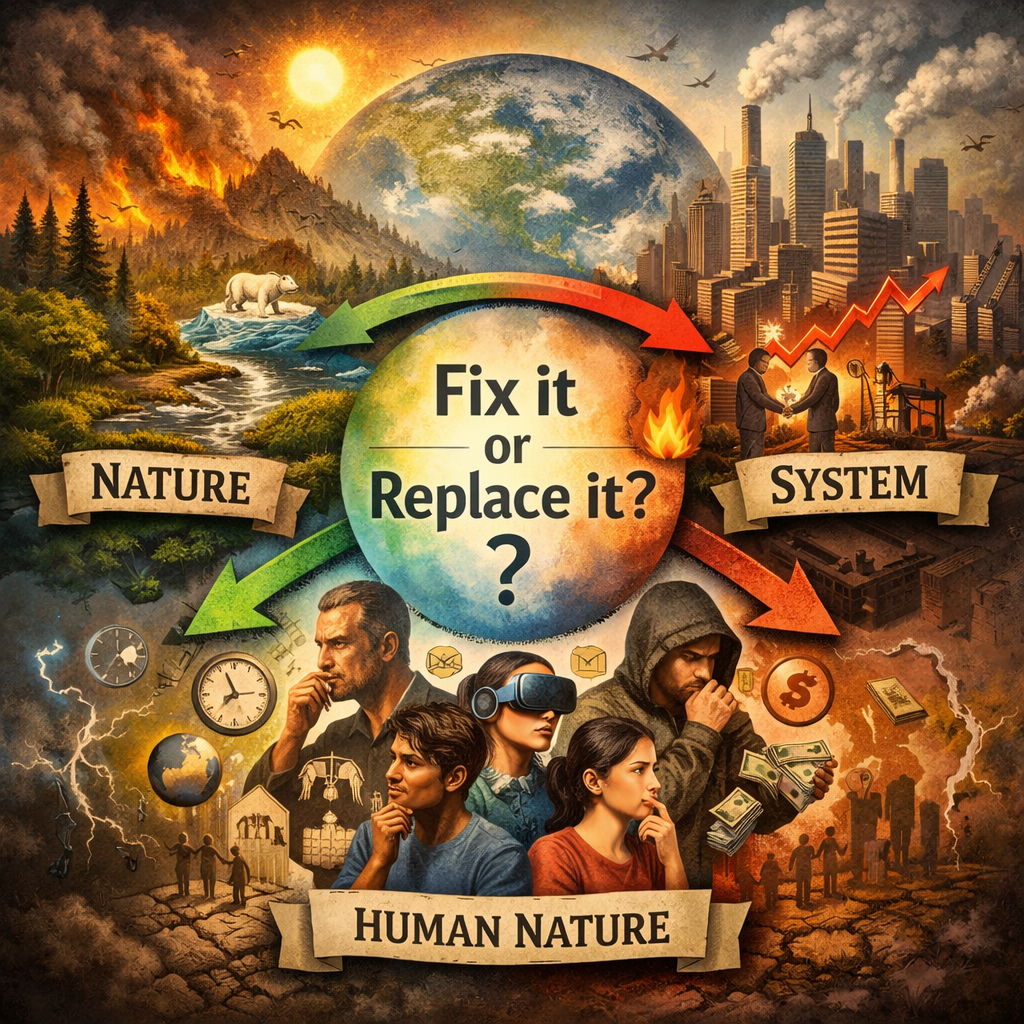
Before we argue “patch it” or “tear it down,” we have to do something more basic and more honest: identify the root cause at the most elemental level. That means treating the crisis as a three-player interaction, not a one-player blame game. Nature sets the hard boundaries (finite resources, ecological feedback loops, climate physics that doesn’t negotiate). Humans bring an ancient operating system: instincts shaped for survival in small groups, not for managing planetary-scale risk (we discount the future, follow status signals, copy the crowd, and treat threats as “not real” until they are immediate). And then systems (markets, states, global institutions) act like amplifiers: they can discipline our instincts into cooperation, or they can weaponize them into short-termism, rivalry, and extraction. When these three fall out of alignment, the result is predictable: our instincts chase near-term rewards, systems reward that chase, and nature sends the bill in the form of breakdown. So the real question becomes: Is the system merely poorly designed (so it can be repaired), or is it built around incentives and stories that inevitably collide with nature and human psychology (so it must be replaced)? This “three-player” diagnosis justifies the essay’s framework, because it forces us to evaluate reforms and revolutions by the same test: do they realign human behavior and institutional incentives with nature’s non-negotiable limits?
The Case for Reform: Fixing the System from Within
Reformists argue that while our global systems have serious flaws, they are not beyond repair. From this viewpoint, capitalism and current institutions can be guided or restrained to produce better outcomes without completely abolishing them. Reform advocates diagnose problems such as extreme inequality, corporate excess, climate change, and political corruption, but believe these issues can be addressed through strong policies, civic pressure, and incremental change. For example, many economists and business leaders have come to acknowledge that today’s capitalism is generating unjust outcomes – stagnating wages for the many, skyrocketing wealth for a few, and environmental destruction . Even some conservative thinkers have echoed what leftists warned about for generations: that unchecked globalized capitalism can hollow out communities and concentrate power in unaccountable hands . The reformist solution is not to scrap markets entirely, but to rewrite the rules of the market. They point out that market economies have taken vastly different forms in history, and with wise interventions, capitalism can be made fairer and more sustainable.
From a reformist perspective, the depth of problems in capitalism demands bold but not destructive action. “There is no quick fix for 21st-century capitalism: the entire system needs a makeover,” wrote a group of prominent economists in 2019 . They proposed an expansive list of policies – from reining in monopoly power and tax avoidance to embedding labor and environmental standards into trade deals . These ideas reflect a belief that regulated or “managed” capitalism can balance private enterprise with the public good, much as it did in the mid-20th century under the Keynesian welfare state. Indeed, they recall how the post-World War II New Deal reforms in the United States helped tame the worst abuses of unbridled markets. Historians note that President Franklin D. Roosevelt’s New Deal program “saved rather than transformed liberal capitalism,” building safeguards like Social Security and financial regulations that preserved the system during a period of turmoil . In Roosevelt’s own words, his administration “saved the system of private profit and free enterprise” from ruin during the Great Depression . The New Deal is often credited with pulling the U.S. back from the brink of social collapse and demonstrating that reform can avert revolution by addressing people’s urgent needs. Similarly, in many European countries after WWII, social safety nets and labor rights were expanded – not to overthrow capitalism, but to make it more humane and stable. These examples bolster the reformist case that through determined political will, existing systems can be redeemed and improved.
Reformists also see promise in modern state institutions if they are rejuvenated. Democracies around the world are straining under problems like money in politics, declining trust, and rising polarization. But rather than abandon the nation-state model, reform advocates push for democratic renewal: stronger campaign finance laws, anti-corruption measures, expanded voting rights, and more participatory governance. History provides encouraging examples. The civil rights movement in the United States during the 1950s–60s, for instance, achieved monumental reforms – dismantling legal segregation and securing voting protections – without overturning the constitutional system. Activists like Dr. Martin Luther King Jr. worked through protests and legal challenges to pressure the government into passing new laws (such as the Civil Rights Act and Voting Rights Act) that fundamentally improved the system’s fairness while keeping its basic structure. This illustrates how grassroots movements can leverage existing institutions to correct injustices. Reformists argue that even global governance structures like the United Nations, flawed as they are, can be reformed to better meet today’s challenges. They point to proposals for UN reform – such as creating a parliamentary assembly or other mechanisms to make global decision-making more democratic and effective . John Vlasto of the World Federalist Movement notes that the current UN is essentially “a congress of ambassadors” defending national interests, which leads to dysfunctional stalemates . A possible reform is to add a directly elected global parliament that represents “the common good of humanity” rather than just governments . This kind of innovation would work within the system (using the UN framework) but significantly overhaul its workings – a reformist path to stronger global cooperation.
Underpinning the reformist theory of change is an optimism about institutions. Reformists contend that systems like capitalism and nation-states are malleable. They believe crises can spur adaptation and improvement rather than total collapse. In their view, government policy and public pressure can redirect the course of capitalism – for example, by embedding markets in social restraints and environmental limits . They often invoke historical precedents: the fact that capitalism has taken different shapes (laissez-faire in the 1920s vs. regulated mixed economies after the 1940s) shows it is not monolithic or immutable. As one analysis put it, postwar social democracies “contained capitalism within a new set of rules and social norms,” disproving the notion that the only alternatives were socialism or barbarism . Those in the reform camp see today’s challenges – climate change, inequality, tech disruption – as requiring a similar retooling of the system. They advocate a “new managed capitalism” for the 21st century, one where governments guide markets more heavily to serve long-term human needs . Crucially, reformists emphasize building broad coalitions and using peaceful, legal means. They often warn that pursuing outright revolution can backfire or unleash chaos. Instead, gradual change allows society to avoid violence and preserve stability while making progress. As a recent commentary concluded, “Capitalism can be reformed: the challenge is to summon the will and the means to do it.” Reforms may be hard-won and slow, say proponents, but they are the safest path to addressing global crises without risking the upheaval that revolutions can bring.
The Case for Revolution: Replacing a Broken System Entirely
On the other side of this debate are the revolutionaries – those who argue that the current systems aren’t just malfunctioning but are fundamentally broken. To these critics, problems like rampant inequality, environmental collapse, and social injustice are not isolated bugs; they are features of the prevailing order of capitalism, the nation-state, and top-down governance. In their diagnosis, trying to patch up such systems with reforms is well-intentioned but ultimately futile. Revolutionary thinkers often liken reforms to putting band-aids on a deeply infected wound. They ask: what if the very logic of the system produces crises? For example, many eco-radicals point out that capitalism, by its nature, seeks endless growth and profit extraction, which inevitably clashes with the limits of a finite planet . As teenage climate activist Greta Thunberg admonished world leaders, “We are in the beginning of a mass extinction, and all you can talk about is money and fairy tales of eternal economic growth. How dare you.” Her fiery words capture the revolutionary view that incremental tweaks won’t stop climate change – instead, we need to abandon the “fairy tale” that economies can grow forever without wrecking the earth. In other words, system change, not climate change. This perspective holds that saving our environment requires overturning the capitalist system that treats nature and people as resources for exploitation.
Revolutionaries see the depth of the problem as reaching the core principles of today’s dominant systems. Take capitalism: socialist and anarchist critics have long argued that capitalism inherently generates class inequality, periodic crises, and exploitation of labor and nature. Any reforms (higher minimum wages, stricter regulations, etc.) will be resisted by those in power and can be rolled back when the pressure subsides. Indeed, they note that during the late 20th century, many gains of the reformist welfare state were reversed under neoliberal policies once capitalists regrouped. A Marxist economist vividly summarized this pattern: even if socialists win reforms, “if capitalism remains, regular crises in capitalism mean that capitalists will resist tooth and nail… not only to oppose reforms but to reverse those already won” . In this view, as soon as a reform (say, environmental regulation or labor protection) threatens profits, the system’s powerful interests will find ways to dilute or undo it . Revolutionary theorists thus contend that true solutions require removing the profit motive as the engine of society. For instance, rather than trust oil companies to suddenly become green through mild incentives, activists with a revolutionary bent might call for nationalizing energy industries or creating decentralized, community-owned renewable systems. They argue that only by uprooting the current economic system – whether replacing it with socialism, communal cooperatives, or a “degrowth” economy – can we avoid ongoing crises.
The revolutionary critique extends to modern state institutions and global governance as well. Many revolutionaries see the nation-state system as complicit in global problems. Borders and competing national interests often impede united action on issues like pandemics or climate. The structure of international bodies like the UN, dominated by sovereign states and great-power vetoes, is seen as incapable of delivering the drastic action humanity needs . One radical response is to envision entirely new forms of governance. For example, anarchist movements advocate for abolishing centralized state power in favor of local, horizontal networks of communities – essentially replacing hierarchical government with grassroots democracy. This was attempted in short-lived cases like revolutionary Catalonia in 1936 or more recently in certain autonomous zones (for example, the autonomous administration set up by Syrian Kurds in Rojava, which sought to govern through councils without a traditional nation-state framework). Other revolutionaries, like proponents of world socialism, argue that we need a global revolution that transcends nation-states altogether, uniting humanity under a new egalitarian order. While such worldwide upheaval has never fully materialized, history has seen national revolutions that drastically altered state structures: the French Revolution of 1789, for instance, overthrew an absolute monarchy that had ruled for centuries and proclaimed the first French Republic in 1792 . In one swift stroke, the old feudal order was abolished – Liberté, Egalité, Fraternité replacing the divine right of kings. Likewise, the Russian Revolution of 1917 swept away the czarist autocracy and, after years of civil war, brought in a socialist government, proving that capitalism and monarchy were not eternal . These examples are cited by revolutionaries as proof that entire systems can indeed be toppled and replaced when pressures climax.
Of course, revolutionaries are keenly aware that such upheavals come with tremendous risks and costs – but they often argue that the status quo is even more dangerous. In their theory of change, the enormity of suffering under the current system justifies a leap into the unknown. They point to moments in history when gradual reform proved inadequate or too slow, leading oppressed people to take more drastic measures. For instance, before the Russian Revolution, moderate reforms (like the short-lived provisional government) failed to pull Russia out of war and economic collapse, which bolstered the Bolsheviks’ case for a complete revolutionary seizure of power. Once in power, the revolutionaries instituted a radically different socio-economic order (state socialism) – an experiment that had huge repercussions for the 20th century. Critics note that the Russian case also underscores revolution’s perils: it descended into authoritarianism under Stalin, betraying many original ideals. Revolutionaries counter that all progress is fraught with dangers, and that fear of failure shouldn’t justify clinging to an unjust system. Revolutionary socialist Rosa Luxemburg famously warned against placing blind faith in liberal reformism. She observed that when faced with serious threats to the capitalist order, liberal “opportunists” (as she termed moderate left politicians) would sooner ally with reactionary forces than allow a socialist transformation . In fact, Luxemburg herself was murdered in 1919 during an aborted workers’ uprising in Germany, killed by right-wing troops tacitly backed by the liberal government . Her fate is often cited as evidence that the ruling elite will not relinquish power peacefully. Revolutionaries use such history to argue that attempting to only use the master’s tools (elections, reforms) may never dismantle the master’s house – more radical confrontation becomes necessary.
The revolutionary path, therefore, envisions mass mobilization and systemic rupture as the means of change. Rather than polite lobbying or small policy adjustments, revolutionaries call for tactics that range from huge strikes and civil disobedience to outright insurrection, depending on the context. They celebrate moments like the “Velvet Revolution” of 1989 in Czechoslovakia, where sustained popular protests led to the collapse of a communist regime in a matter of weeks – a largely peaceful revolution that showed rapid, non-violent change is possible. Conversely, they acknowledge that some revolutions involve violence and instability (the French “Reign of Terror” or China’s chaotic Cultural Revolution are sobering examples). The revolutionary argument is not that chaos is good, but that radical change is necessary and worth the risk when the alternative is continuing systemic violence (e.g., preventable poverty, climate devastation, or repression). Many revolutions are born from a sense of “nothing to lose.” As one 20th-century revolutionary slogan put it, “If not us, who? If not now, when?” – emphasizing urgency. Today, we see echoes of revolutionary ethos in movements like Extinction Rebellion, which declares that normal politics has failed to address the climate emergency and thus uses disruptive direct action to spur drastic measures. Likewise, some social movements against global capitalism (like the Occupy Wall Street protests or the Global Justice Movement of the early 2000s) framed their struggle not just as a plea for reform but as part of a worldwide uprising against neoliberal economic structures. The mantra “Another world is possible” captures the revolutionary faith that entirely new systems – beyond the imagination of the current order – can be created through collective action.
History’s Lessons: Stability, Change, and the Road Ahead
Both reformists and revolutionaries can draw on historical evidence to support their views, which is why the debate remains so complex. Reformist successes show that systems can evolve: we’ve seen constitutions amended, international treaties signed, and economic models adjusted in ways that improved millions of lives without starting from scratch. For example, the establishment of the United Nations and institutions like the World Bank and International Monetary Fund after World War II was essentially a massive reform of global governance – a conscious effort to replace the failed League of Nations and the economic chaos of the interwar period with a more cooperative framework. This didn’t abolish nation-states, but it did create new forums and rules (like the UN Charter, Bretton Woods financial system, etc.) that guided international relations for decades. Many credit these post-war institutional reforms with preventing another world war and reducing extreme poverty in some regions. On a national level, the peaceful transition from apartheid to democracy in South Africa in the 1990s is often held up as a triumph of reform-minded negotiation over what could have been a very bloody revolution. Under enormous grassroots pressure, the apartheid regime agreed to dismantle itself through a legal process, leading to a new constitution and elections. Figures like Nelson Mandela balanced revolutionary fervor with pragmatic reform, avoiding civil war and laying a foundation for a more just state. Such cases demonstrate that negotiated change – though slow and often incomplete – can channel revolutionary energy into stable outcomes.
Yet, revolutionary moments in history also highlight times when gradual reform was either blocked or too little, prompting dramatic breaks. The French Revolution mentioned earlier is one example where moderate reforms (like attempts at constitutional monarchy) failed and a more radical phase took hold, abolishing the old order entirely . While it brought liberty and equal citizenship to the fore, it also led to years of turmoil, including the Terror and Napoleonic wars. Similarly, the Russian Revolution began with a reformist phase (the February 1917 overthrow of the Tsar led to a liberal provisional government) that did not adequately address land reform or end the bloody world war. That opened the door for Lenin’s Bolsheviks in October 1917 to lead a second, far more radical revolution that pulled Russia out of WWI and attempted to construct a socialist economy . That revolutionary change had profound global impacts – inspiring workers and anti-colonial movements worldwide – but also precipitated a brutal civil war and the rise of an authoritarian state. Revolutions in China, Cuba, Iran, and other countries each had mixed legacies: they achieved a replacement of regimes and social structures (whether it was ending imperial rule in China or toppling a U.S.-backed dictator in Cuba), but many introduced new repressions or economic hardships of their own. These lessons are double-edged. To revolutionaries, they show the power of mass action and the possibility of defying “impossible” odds – tiny groups of determined people really can make history. To skeptics, they warn that tearing down a system entirely is like opening Pandora’s box: once unleashed, revolutionary forces can produce unintended consequences and suffering.
What about the present and the future? Are today’s global crises pushing us toward reform or revolution? We see signs of both. On one hand, there is a resurgence of reformist ideas: talk of a “Green New Deal” to combat climate change within the market system, proposals to rein in Big Tech and tax billionaires, and initiatives to reform global institutions (for instance, calls to democratize the UN or redesign the international financial system to be fairer to developing nations) . These efforts suggest many believe our existing frameworks, updated properly, can handle challenges like decarbonizing the economy or reducing inequality. On the other hand, frustrations are mounting. Young people especially are looking at a world of worsening heatwaves, job precarity, and political dysfunction and concluding that minor tweaks won’t cut it. The popularity of slogans like “system change not climate change” and the growth of movements openly questioning capitalism (e.g. democratic socialism’s rise in some countries, or indigenous movements insisting on fundamentally different ways of living with the earth) indicate a revolutionary current in the zeitgeist. Even some mainstream voices acknowledge the revolutionary pressure: for example, a 2020 analysis by billionaire investor Ray Dalio warned that if capitalism’s outcomes aren’t improved, it could pose an “existential threat” to social stability . In other words, failure to reform may lead to revolution by default, as suffering and anger reach a boiling point.
Conclusion: Reform, Revolution, or Something In Between?
The debate over reform vs. revolution is not about choosing one ideology over another in the abstract – it is a pragmatic question facing every society grappling with deep crises. Reformists offer a path of steady progress: they aim to harness the tools we have (laws, policies, institutions) to guide change and avoid the worst upheavals. Their approach has the appeal of continuity and control; it asks, “How can we make the system better step by step?” Revolutionaries respond that some systems are so unjust or unsustainable that tinkering is pointless; at certain historical junctures, only a clean break and foundational reimagining will do. Their approach carries the passion of righteous urgency; it asks, “How can we create an entirely new system that resolves these crises at the root?”
If history is our guide, the answer may not be one or the other exclusively, but a dance between the two. Reforms can build pressure and consciousness that pave the way for more radical changes down the line, and revolutions can sometimes institutionalize their gains into lasting reforms. Some thinkers talk of “non-reformist reforms” – changes that may seem moderate but actually empower people and open the door to further transformation in the future . For instance, establishing a public healthcare option or a worker-owned cooperative sector in the economy could be seen as reforms within capitalism, but they might sow seeds for a different kind of system eventually. Conversely, even the most revolutionary movements often have to implement practical policies (essentially reforms) the day after the barricades come down, to keep society functioning. In reality, societies frequently go through cycles: a period of reform, then perhaps a crisis that triggers a revolutionary leap, followed by consolidation with new reforms, and so on.
As we face unprecedented global challenges in the 21st century, from climate emergencies to pandemics to technological upheavals, the reform vs. revolution question will remain at the forefront. It may very well be that bold reforms are our best hope to avoid the horrors of violent revolution, as reformists argue. Or it may be that without the fire of revolutionary fervor, entrenched systems will never budge enough to truly solve these crises. Perhaps the most constructive view is to keep an open mind to lessons from both approaches: to pursue immediate changes that reduce harm and injustice (for we desperately need them), while not losing sight of the deeper structural shifts that might be required. After all, even as early as 1900, Rosa Luxemburg reminded us that choosing only timid reform could lead to stagnation or worse – but revolution without the support of the masses could be disastrous as well .
In Marisol’s story at the climate protest, the two mentors on her sides represent these dual paths. The truth is, the world likely needs people working inside and outside the system – those fixing it with wrenches and those ready with fire when necessary. Our global crises are urgent and complex. Perhaps the final lesson is that whether through reform or revolution, the key is collective action driven by a vision of a better world. The methods may differ, but the end goal of systemic change – a society that is equitable, sustainable, and humane – is something both reformists and revolutionaries ultimately seek. And as history continues to unfold, humanity will navigate between these strategies, hopefully learning to preserve the best of our institutions while courageously transforming those that no longer serve us.
The Takeaway
In the end, the real choice is not “reform or revolution” as a slogan. It is whether our solutions realign the three players: nature’s limits, human instincts, and the systems that shape incentives. Patchwork reforms fail when they leave the underlying reward structure untouched, and revolutions fail when they replace one set of rulers without redesigning the deeper logic of coordination and accountability. The takeaway is simple: whatever path we take must make it easier for ordinary people to do the long-term, cooperative thing, and harder for any group to profit from pushing the costs onto society and the planet.
References
Cassidy, J. (2025, May 8). “Outdated and unjust”: Can we reform global capitalism? The Guardian. https://www.theguardian.com/us-news/2025/may/08/can-we-reform-global-capitalism-trump-tariffs
Hedges, C. (2016, May 23). Reform or revolution. Truthdig. https://www.truthdig.com/articles/reform-or-revolution/
Roberts, M. (2023, October 11). On profitability and reforming capitalism. Spectre Journal. https://spectrejournal.com/on-profitability-and-reforming-capitalism/
The Editors of Encyclopaedia Britannica. (2025, December 10). New Deal. Encyclopaedia Britannica. https://www.britannica.com/event/New-Deal
The Editors of Encyclopaedia Britannica. (2025, December 7). Russian Revolution. Encyclopaedia Britannica. https://www.britannica.com/event/Russian-Revolution
The Editors of Encyclopaedia Britannica. (n.d.). The First French Republic. Encyclopaedia Britannica. https://www.britannica.com/place/France/The-First-French-Republic
Vlasto, J. (2023, December 2). Global governance: “It may take a crisis as big as the one that originated the system to produce the reform it needs” (Interview). CIVICUS. https://www.civicus.org/index.php/media-resources/news/interviews/6708-global-governance-it-may-take-a-crisis-as-big-as-the-one-that-originated-the-system-to-produce-the-reform-it-needs
Radic, I. (2021, September 24). Protester holding a banner with the message “System change, not climate change” (51525653745) [Photograph]. Wikimedia Commons. https://commons.wikimedia.org/wiki/File:Protester_holding_a_banner_with_the_message_%22System_change,_not_climate_change%22_(51525653745).jpg
Discover more from RETHINK! SEEK THE BRIGHT SIDE
Subscribe to get the latest posts sent to your email.