
The village of Kalamos had worshipped the same mountain for generations. It was not a mountain of particular beauty, nor exceptional height, but it was, according to their sacred scrolls, the axis of the world. The elders taught that the mountain’s stability was synonymous with the stability of their society; to question its nature was to question the very order of existence. Every spring, they performed elaborate rituals to appease the mountain’s spirit, interpreting every tremor as a sign of divine displeasure, every rockslide as punishment for moral failing.
One year, a young geologist from a distant university arrived, armed with strange instruments. She explained, with cautious respect, that Kalamos was not a mountain of solid rock, but a dormant volcano. Her seismic readings and mineral analyses predicted a significant eruption within decades. She presented maps showing how to divert lava flows, and blueprints for early warning systems. The village council listened in stony silence. Finally, the eldest elder spoke. “We know our mountain. It is the steadfast heart of our world. Your machines are lies, your ‘science’ is hubris.” They cast her out, doubling down on their rituals, convinced their faith alone would hold the mountain in check. Their certainty was a fortress, and they had just barred the gates against their only salvation.
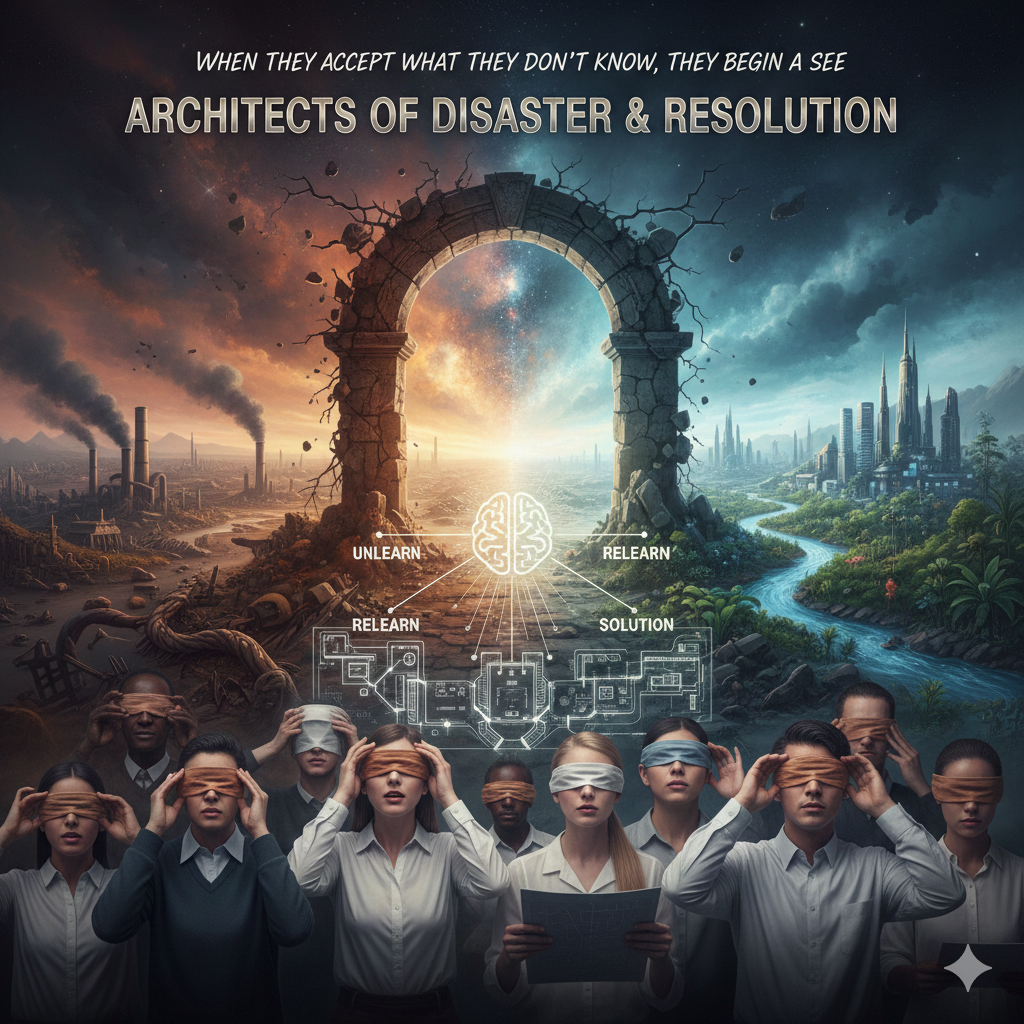
This parable, mirrored in countless forms throughout history, encapsulates the profound human paradox: our intelligence, which allows us to architect incredible civilizations, is often shackled by the very knowledge it creates. As the opening premise states, “When people believe they already know, they cannot be guided.” This is the tragedy of closed epistemology—a state where the map is mistaken for the territory, and the lens is confused for the view. Conversely, “When they accept what they don’t know, they begin to see.” This shift from knowing to questioning is the essential pivot, the moment we transition from being architects of disaster to architects of resolution.
History’s most grievous wounds are often inflicted not by a lack of knowledge, but by an overabundance of wrong knowledge, fiercely defended. Consider medicine before the germ theory. For centuries, physicians knew that illnesses were caused by imbalances in the four bodily humours or by miasmas—bad air. This certainty led to practices like bloodletting, which likely killed more patients than it saved, including George Washington. The medical establishment, entrenched in Galenic dogma, fiercely resisted new ideas. They could not be guided because they were certain they already held the map. It was only when pioneers like Ignaz Semmelweis and Louis Pasteur embraced a state of not knowing—asking why handwashing reduced childbed fever, or what truly caused fermentation—that they began to see. This humble acceptance of ignorance opened the door to the germ theory, a resolution that has saved hundreds of millions of lives. The disaster of pre-modern medicine was architected by rigid certainty; its resolution was architected by disciplined doubt.
This pattern repeats in our understanding of the cosmos. The Ptolemaic model, with Earth at the center, was a complex and certain edifice, defended by both scientific and religious authority for over a millennium. It explained the observed motions of planets with intricate epicycles. To believe otherwise was heresy and folly. When Copernicus, and later Galileo, suggested a heliocentric model, they were not merely proposing a new fact; they were demanding a catastrophic unlearning. They asked the learned to accept that their fundamental map of reality was wrong. The refusal of the establishment to entertain this not-knowing—epitomized by Galileo’s trial—was a defense of a collapsing architectural plan. The resolution came only when a new generation, willing to unlearn, could see the evidence through the telescopes their predecessors had refused to look through.
In the modern era, the climate crisis presents the starkest example of this duality. For decades, the architecture of our global industrial civilization was built on the certain knowledge that the atmosphere was a limitless sink, that fossil fuels were the unambiguous engine of progress, and that nature was a domain to be conquered. Warnings from scientists were met with the same dismissive certainty as the geologist in Kalamos: “We know our economy. We know what prosperity requires.” This ideological and economic certainty created a fortress against guidance, delaying action by decades and architecting a disaster of global scale.
Yet, within the same crisis lies the blueprint for our resolution, forged precisely through the acceptance of what we did not know. Climate science itself is a monument to humility—a vast, collaborative project built on constantly questioning, modeling, and revising our understanding of complex systems. The shift to renewable energy, circular economies, and sustainable agriculture represents a monumental act of societal unlearning and relearning. It requires us to dismantle old architectures of value and progress and build new ones. Humanity, having architected the disaster through rigid adherence to a flawed paradigm, must now architect the resolution through adaptive, evidence-based learning. The nations and companies now leading the transition are not those who clung most fiercely to old certainties, but those who were first to accept the new, unsettling knowledge and see the path it illuminated.
The challenge of “awakening that awareness” is therefore the central pedagogical task of our time. It is not merely about imparting new information, but about fostering what psychologist Carol Dweck calls a “growth mindset”—the belief that understanding can evolve. It requires creating the cognitive safety for people to say, “I was wrong,” without losing face or identity. In practical terms, this means education must shift from being a delivery system for facts to a gymnasium for critical thinking and intellectual humility. It means media literacy that teaches us to question our sources, and dialogue techniques that prioritize curiosity over conquest.
Ultimately, the journey from architecting disaster to architecting resolution is a journey inward, from the citadel of the known to the frontier of the unknown. The villagers of Kalamos, clutching their scrolls as the ground trembles, are in each of us whenever we prioritize defending our position over understanding the problem. But the geologist is within us too—the part that can lay down the old map, pick up a new instrument, and begin, with humble eyes, to truly see. Our greatest disasters are born of certainty; our finest resolutions are born of the courage to unlearn, the wisdom to question, and the collective will to build anew upon the shifting, fertile ground of what we have just begun to understand.
Discover more from RETHINK! SEEK THE BRIGHT SIDE
Subscribe to get the latest posts sent to your email.