
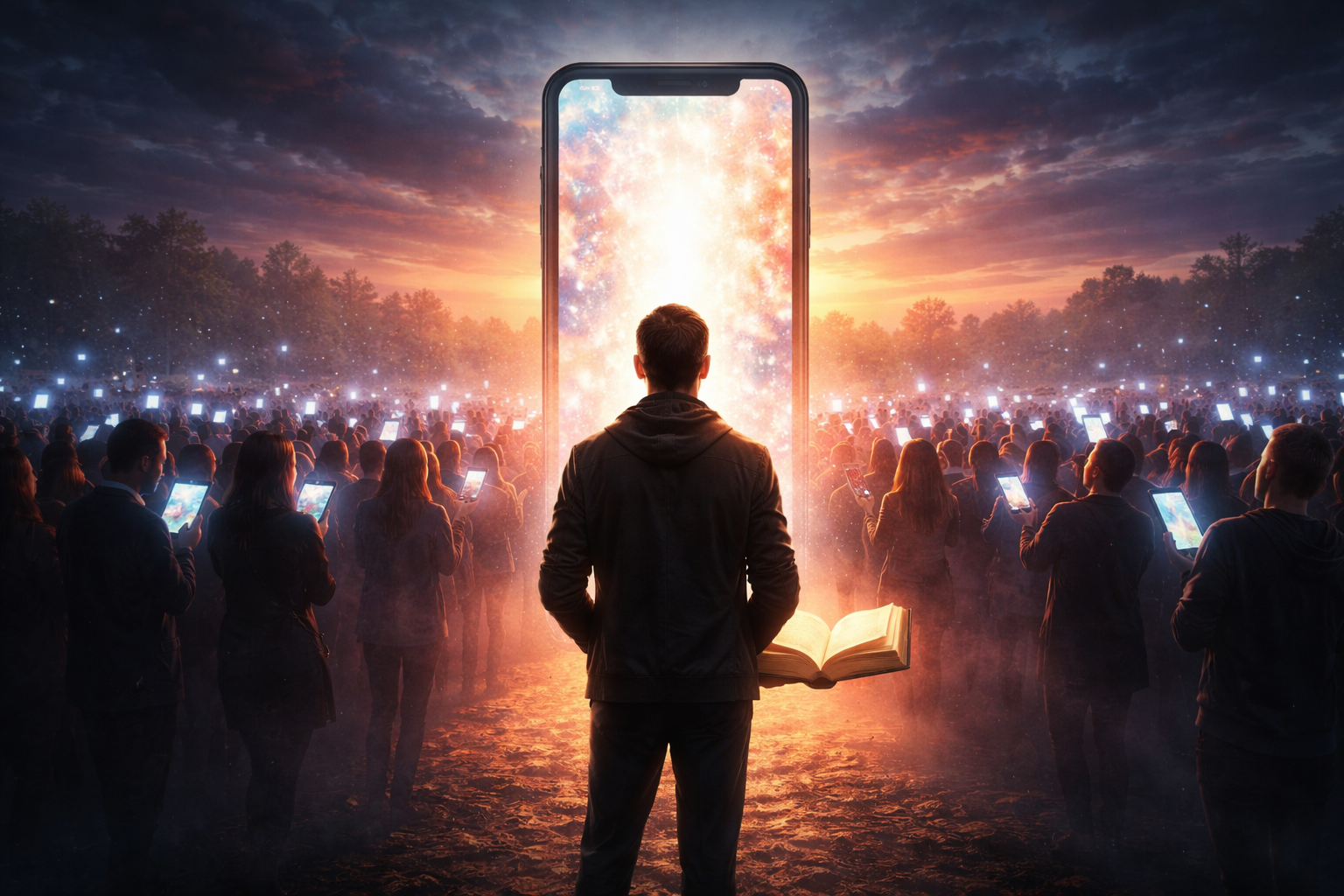
At dawn, the world is still gathering its shape. During this time, a man reaches for the small glowing screen beside his bed. He has not yet listened to his own mind. He has not yet met the silence within him. But the world has already entered his room. In a few swift motions, he receives outrage, amusement, and beauty. Fear, gossip, and desire soon follow. He is bombarded with tragedy, advice, and slogans. Lastly, advertisements masquerade as meaningful experiences. Before he has spoken a single honest thought to himself, thousands of voices have spoken into him. By the time he rises, he feels informed, connected, and alert. Yet something essential has already been taken from him: the chance to begin the day as a sovereign mind.
There was a time when people believed that knowledge would set humanity free. It was not information alone. It wasn’t literacy in the narrow sense. It wasn’t even technical skill for earning a wage. It was knowledge in the fuller sense. This meant the ability to see clearly. It involved judging wisely and understanding causes. It required separating truth from illusion and governing one’s own soul. That is the spirit behind the old idea that the sovereignty of man lies hidden in knowledge. It suggests that human greatness is not first a matter of force, wealth, or rank. It is a matter of inner rule. A person is truly sovereign when he is not dragged by every appetite. He is not deceived by every appearance. Nor is he led by every louder voice. He is sovereign when he can think.
And yet we live in a strange age, one overflowing with content and starving for wisdom. People have never had so many devices. Access is abundant. There are countless channels and voices. We maintain constant contact with the world. And still, beneath this dazzling abundance, something is thinning out. Attention is weaker. Reflection is rarer. Desire is less our own than we imagine. Curiosity is being bent into consumption. Opinion multiplies, but understanding does not keep pace. We are surrounded by signals of enlightenment, yet inwardly many feel more manipulated, more restless, and less free.
This is because what is often sold to us as enlightenment is no longer enlightenment in its deepest sense. It is a market version of enlightenment. It wears the clothes of freedom while quietly training obedience. It offers endless choice while shaping the chooser. It floods the mind with material but leaves the soul underfed. It tells us we are informed because we are constantly updated. It tells us we are expressive because we are always reacting. It tells us we are free because we can click, swipe, post, purchase, and perform. But none of these things, by themselves, amount to freedom.
Freedom is not endless exposure. Freedom is not endless stimulation. Freedom is not the right to drift from one manufactured want to another. Freedom begins in the power to ask, “Why do I want this? Who taught me to want it? What is this system rewarding in me? What is it weakening in me?”
That is where knowledge begins. And that is why sovereignty remains hidden. It is hidden not because it is mystical, but because it is difficult. It asks more of us than consumption. It asks attention. It asks patience. It asks courage. It asks that we stand back from the flow and question the stream itself.
The market does not merely sell goods anymore. It sells moods, identities, dreams, fears, and forms of belonging. It does not simply wait for desire; it helps manufacture desire. It examines what disturbs us and what attracts us. It investigates what keeps us clicking and what makes us compare ourselves with others. It determines what makes us angry enough to share and anxious enough to return. Human longing was once shaped by family, faith, place, craft, memory, and moral tradition. Now, systems increasingly shape it by knowing how to capture attention and turn it into profit.
This changes not only what we buy, but what kind of people we become.
Entertainment is one of the clearest examples. In its true form, entertainment can refresh life. It can bring laughter, beauty, relief, and even wisdom. A song can heal. A story can awaken conscience. A great film can deepen the heart. But when entertainment becomes above all a commodity, its purpose begins to change. It is no longer judged first by whether it enriches the human spirit. It is judged by whether it performs. It is assessed by whether it attracts. It is evaluated by whether it spreads. Its value comes from whether it keeps us watching and whether it can be monetized. Under these conditions, the loud often triumphs over the true, the sensational over the subtle, the immediate over the lasting. We begin to live in a culture where everything must entertain, even grief, even politics, even religion, even the self.
And once everything must entertain, serious thought begins to feel like an inconvenience.
Social media intensifies this condition. It is not evil in itself. It can connect distant people, expose injustice, spread beauty, and carry voices that would otherwise remain unheard. But its deeper logic is not wisdom. Its deeper logic is reaction. What is rewarded is often not what is most true, but what is most engaging. Engagement is frequently driven by powerful emotions. Anger, fear, vanity, outrage, tribal loyalty, and the thrill of public display often lead the charge. As a result, the person who is constantly online may begin to feel active while becoming inwardly passive. His hands move, his eyes scan, his mind reacts, his emotions flare, but his judgment grows tired. He speaks more, but thinks less. He feels surrounded by events, yet rarely reaches the center of any of them.
This is one of the great illusions of our time: activity without depth. Motion without direction. Noise without thought.
The condition grows even more serious when the wider economic order begins to shape the soul. In recent decades, a market-centered way of seeing the world has spread beyond economics into almost every corner of life. The language changes. A child becomes an investment. Education becomes a tool for competitiveness. Friendship becomes networking. Attention becomes currency. The self becomes a brand. Even rest must now justify itself in terms of productivity. In such a world, human beings are quietly trained to evaluate themselves by performance, visibility, and market value.
That is a dangerous spiritual reduction.
A human being is more than a producer and more than a consumer. A society that forgets this will eventually become efficient at the cost of being wise. It may generate wealth while corroding meaning. It may expand choice while shrinking character. It may become technically sophisticated while morally confused.
This confusion produces what might be called a zombie culture. Not a culture of literal death, but of half-awakeness. People continue moving, posting, buying, arguing, displaying, and consuming, but many do so in a fog of inward absence. They are overstimulated, yet underformed. They are full of input, yet lacking orientation. Their minds are crowded, but their inner center is weak. They know how to respond, but not how to judge. They know how to join the noise, but not how to seek the truth beneath it.
A zombie culture is not merely foolish. It is tragic. It is a culture in which many people are never given the conditions needed for real depth. They are not taught to love silence. They are not taught to endure difficulty in thought. They are not taught to read slowly. They are not taught to doubt fashion. They are not taught to resist the crowd. They do not learn to wait before speaking. They struggle to hold a question long enough for a deeper answer to form. Instead, they are trained to move with the current. They remain updated and stay visible. They fear missing out and interpret every pause as failure.
In such a culture, chaos itself becomes useful. Confusion keeps people dependent. Anxiety keeps them checking. Division keeps them engaged. A restless public is easier to direct than a thoughtful one. A fragmented public is easier to sell to than a grounded one. The crowd need not be forced into passivity if passivity can be dressed as pleasure, freedom, and self-expression.
This is where pseudo-pride enters the scene. People are given quick identities and ready-made certainties. They can feel grand without having gone deep. They can speak in the language of truth without having undergone the discipline that truth requires. They can mistake visibility for worth and reaction for understanding. The result is a peculiar combination of insecurity and arrogance. It creates a crowd both hungry for approval and deeply convinced of itself. That is fertile ground for manipulation.
Yet the deeper question remains: where are we going?
What human future are we building? Our greatest systems reward distraction more than wisdom. They prioritize image over substance and appetite over character. What do we hope to produce? A population efficient at consumption? A permanently entertained public? A clever but valueless crowd, informed in fragments, emotionally charged, and morally uncertain. They are endlessly reacting yet unable to answer the most basic questions of life?
What is a good life?
What is worth desiring?
What should a human being become?
What is knowledge for?
A civilization that cannot answer such questions does not become neutral. It becomes hollow. It drifts wherever power, profit, and appetite happen to push it.
The answer is not to reject modern life in panic, nor to romanticize the past as if it were pure. The answer is harder. It is to recover the human center inside the storm. We need to recover forms of life where knowledge is tied to inward freedom. This is opposed to mere utility. It is to build education that teaches judgment, not only skill. It is to build media that values truth above traffic. It is to create technologies that serve human flourishing rather than feed on human weakness. It is to restore spaces where silence is not feared. In these spaces, conversation is not performance. Thought can ripen without being interrupted every few seconds by the market’s demands.
Most of all, it is to recover the discipline of attention.
Attention is not a small matter. It is one of the deepest moral acts left to us. To attend carefully is to resist being ruled by every passing signal. To read a real book in silence is an act of resistance. To think slowly in a fast culture is an act of resistance. To refuse a manufactured desire is an act of resistance. To ask whether a thing is good, rather than merely popular, profitable, or shareable, is an act of resistance.
This is how sovereignty returns.
Not all at once.
Not through slogans.
Not through performance.
But through the rebuilding of inward rule.
The sovereign person is not the one who dominates others. He is the one who is not easily dominated by systems designed to colonize his attention and shape his desires. He is the one who can stand amid noise and still hear what is true. He is the one who can enjoy the world without becoming its captive. He is the one who refuses to become a product among products. He is the one who keeps alive the ancient and endangered power of asking real questions.
That is why the old saying still matters. The sovereignty of man does indeed lie hidden in knowledge, but knowledge must be rescued from its cheap imitations. It is not the glitter of information. It is not the pride of having opinions. It is not the possession of credentials alone. It is the hard-won clarity that leads a person to understand himself and his world. He recognizes the forces acting upon him and the good he ought to seek.
We need to recover that meaning of knowledge. Without it, we will keep mistaking stimulation for life. We will mistake branding for identity and consumption for freedom.
But if we recover it, even partially, another future becomes possible.
Then the human being need not sink into brainless motion, nor dissolve into a crowd without values. Then society can aspire to something better than a marketplace of restless appetites. Then education can become the awakening of judgment. Then culture can become the shaping of souls. Then freedom can mean more than choice. Then progress can be measured not only by what we produce, but by what kind of people we become.
And perhaps that is the question before us now, more than any other:
Do we want a civilization of managed wants, or a civilization of awakened minds?
Everything depends on how we answer.
If you want, I can turn this into a magazine-style version. It will include a subtitle, standfirst, and a slightly sharper ending for publication.
References
Celikates, R., & Flynn, J. (2023). Critical theory. In E. N. Zalta & U. Nodelman (Eds.), The Stanford encyclopedia of philosophy (Fall 2023 ed.). The Metaphysics Research Lab, Stanford University. https://plato.stanford.edu/archives/fall2023/entries/critical-theory/
McLoughlin, K. L., Brady, W. J., Goolsbee, A., Kaiser, B., Klonick, K., & Crockett, M. J. (2024). Misinformation exploits outrage to spread online. Science, 386(6725), 991–996. https://doi.org/10.1126/science.adl2829
OECD. (2024). Facts not fakes: Tackling disinformation, strengthening information integrity. OECD Publishing. https://www.oecd.org/content/dam/oecd/en/publications/reports/2024/03/facts-not-fakes-tackling-disinformation-strengthening-information-integrity_ff96d19f/d909ff7a-en.pdf
Tam, K. Y. Y., & Inzlicht, M. (2024). People are increasingly bored in our digital age. Communications Psychology, 2, Article 106. https://doi.org/10.1038/s44271-024-00155-9
The Editors of Encyclopaedia Britannica. (n.d.). Neoliberalism. Britannica Money. Retrieved March 26, 2026, from https://www.britannica.com/money/neoliberalism
Watson, J., van der Linden, S., Watson, M., & Stillwell, D. (2024). Negative online news articles are shared more to social media. Scientific Reports, 14, Article 21592. https://doi.org/10.1038/s41598-024-71263-z
The next useful step would be inserting these directly into the essay as APA in-text citations so the whole piece becomes publication-ready.
Discover more from RETHINK! SEEK THE BRIGHT SIDE
Subscribe to get the latest posts sent to your email.