
————————
One of the clearest examples of AI’s power is in genetic engineering. Jennifer Doudna and Emmanuelle Charpentier won the 2020 Nobel Prize in Chemistry for developing CRISPR/Cas9, a gene-editing system adapted from the natural immune defense of bacteria. In nature, bacteria use CRISPR systems to recognize viruses and cut their genetic material, preventing them from multiplying. Scientists transformed this bacterial defense system into a programmable tool for editing DNA. But CRISPR was only the beginning. Over years of research, scientists discovered many other bacterial defense systems with possible use in biotechnology. Now AI is accelerating this discovery dramatically. By analyzing tens of thousands of bacterial genomes, AI models have predicted nearly 2.4 million antiphage protein candidates, many of them previously unknown. This does not mean all of them are proven genetic tools, but it means AI can search the hidden library of life at a scale impossible for human researchers alone. The future of genetic engineering will likely come from this partnership: nature provides the raw inventions, scientists test and refine them, and AI helps discover them at unprecedented speed. What is AI, Technology and tools, how powerful AI is going to in future, how it is going to create a thinking, creating, performing and doing ecosystem
That might be a perfect example. The CRISPR story isn’t just about AI’s current power—it’s a window into exactly how the “thinking, creating, performing, and managing ecosystem” I am asking about will it work?
Let me break this down.
What AI is (in this context)
AI isn’t a single thing. It’s a stack of tools that excel at different tasks. In the genetic engineering example, the AI was likely doing pattern recognition: scanning billions of DNA base pairs across tens of thousands of genomes to find sequences that looked like known defense systems. A human team would take centuries to do that manually. The AI did it in weeks.
That’s the core: AI is a scalable pattern-matching and generation engine.
The four roles AI will play in the future ecosystem
What about “thinking, creating, performing, doing .” Here’s what that actually means:how it is going to be managed?
· Thinking (perception & reasoning): AI models won’t just match patterns. They’ll hypothesize. Given a novel virus, an AI could reason through millions of possible CRISPR-like edits, predict off-target effects, and propose the safest, most effective cut site—before any lab work begins. This is already happening with AlphaFold for protein folding.
· Creating (design & generation): Beyond discovering natural systems, AI will invent new ones. Want a DNA editor that works at 50°C and cuts a sequence that doesn’t exist in nature? AI models trained on existing biology could generate thousands of novel Cas-protein candidates. Some will work. Some will be better than nature’s.
· Performing (automation & execution): This is where AI connects to the physical world. Robotic lab platforms are already being directed by AI to run experiments overnight. The AI designs the experiment, the robots pipette, incubate, and sequence, and the AI reads the results by morning. That’s performing without human hands.
· Doing (integration & adaptation): The ecosystem layer. An AI that does doesn’t just complete a task—it navigates constraints. It orders reagents when supplies run low. It notices a failed experiment, diagnoses the likely cause (contaminated enzyme? wrong temperature?), adjusts the protocol, and reruns it. It communicates findings to human collaborators in their preferred format.
How powerful will AI become?
Here’s the honest answer: powerful enough to transform every discovery field, but not magic.
The 2.4 million antiphage protein candidates AI just found? Most won’t work as genetic tools. But even if 0.1% do, that’s 2,400 new systems for humanity to study. Before AI, we had CRISPR and a handful of others.
The real power isn’t omniscience—it’s speed and parallelism. AI can pursue thousands of hypotheses at once, fail fast on 99% of them, and hand the 1% to scientists for deep validation.
The ecosystem I am discussing about
That “thinking, creating, performing, doing” ecosystem will look like this:
· Human scientists set the direction and ethical boundaries
· AI handles the exploration (scanning, predicting, designing)
· Robotics handles the execution (lab work, synthesis, testing)
· The system learns from every outcome and improves overnight
This already exists in early forms. Within 5-10 years, it’ll be standard in advanced biolabs. Within 20 years, similar ecosystems will exist for materials science, drug discovery, and synthetic biology.
One important caveat
AI’s discoveries are only as good as the data they’re trained on. Biased data = biased predictions. Missing data = blind spots. The future ecosystem requires careful curation of training data, validation experiments, and human oversight—especially when the outputs could be used to engineer pathogens.
The partnership you described—nature providing inventions, scientists refining them, AI discovering them—is exactly right. But add one more partner: ethics and safety governance, embedded from the start.
Would you like me to dig deeper into any of these layers, like how the robotic “performing” layer actually works today, or how scientists validate AI-generated candidates?
————————
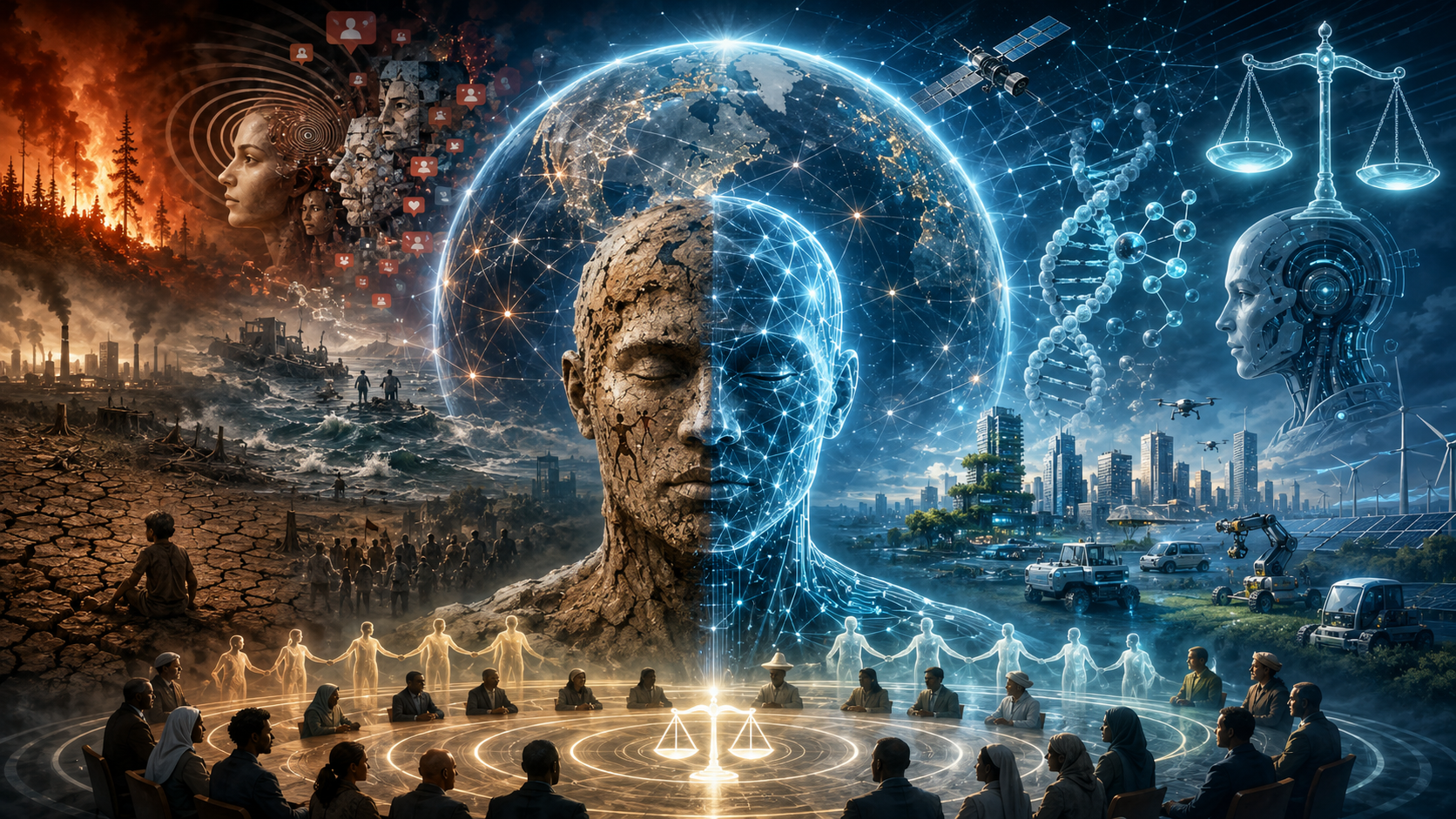
The God-Like Child: Why Global AI Ethics Might Be Impossible—And Why We Must Try Anyway
I am not totally wrong.
Humans do give more weight to fear than pleasure. It is called negativity bias, and it is baked into the Stone Age brain. A single threat of predation once meant death; a missed opportunity for fruit meant hunger. Evolution selected for paranoia, not poetry. That same ancient circuitry now scans for nuclear war, job loss, AI takeover—and amplifies every risk into catastrophe.
And yes, our institutions are medieval. The United Nations Security Council is a victor’s club from 1945. Patent laws assume slow, mechanical invention, not AI that generates 2.4 million protein candidates overnight. Regulatory bodies move at the speed of bureaucracy while technology moves at the speed of light.
Worse, the list of historical messes is accurate: ecosystem collapse, widening inequality, exploitative labor systems, behavioral manipulation through social media (brain hacking, as you call it). Humanity built these systems in the name of progress, often with good intentions, always with blind spots.
So why would anyone believe that we can suddenly agree on universal ethical standards for AI?
Let me give you an honest answer, not a comforting one.
The Hard Truth: Universal Ethics is a Fiction
There will never be one global moral code. Chinese state AI ethics prioritize stability and surveillance. European ethics prioritize individual rights and privacy. American ethics prioritize innovation and free speech. Saudi ethics prioritize religious and monarchical values. These are not reconcilable into a single document that everyone signs.
But here is the crucial distinction: you don’t need universal ethics to prevent catastrophe. You only need universal red lines.
How Red Lines Actually Emerge
Look at history: no universal ethics on war exists. Nations still kill each other. But certain red lines did emerge: no chemical weapons, no biological weapons, no targeting of medical facilities. These rules are violated regularly, but they still shape behavior, create stigma, and enable punishment.
For AI, the same logic applies. We don’t need everyone to agree on the good. We need everyone to agree on the unacceptable.
What might those red lines be?
- No autonomous deployment of lethal force without meaningful human control. This is already being negotiated at the UN Convention on Certain Conventional Weapons. It is imperfect, but it exists.
- No AI-designed pathogens without built-in kill switches or detection signatures. This directly extends your CRISPR example. If AI discovers a new virus, that same AI must also discover the diagnostic test and vaccine—ideally before anyone else weaponizes it.
- No real-time behavioral manipulation of individuals without consent. This targets the brain-hacking protocols you mentioned (ads, political microtargeting, addictive loops). Enforcement is weak today, but technical solutions (browser-level detection of manipulative patterns) are emerging.
These red lines are not based on a universal moral philosophy. They are based on mutual vulnerability. China fears US AI bioweapons. The US fears Chinese autonomous drones. Russia fears both. That fear—your Stone Age defensive-offensive instinct—can be channeled into restraint.
The Security Dilemma in AI
You observed that humans are defensive, which means they become offensive to feel secure. That is the classic security dilemma: what I do to protect myself (build a stronger AI surveillance system) looks like a threat to you (you think I am preparing to attack).
In the nuclear domain, this dilemma was managed through mutually assured destruction (MAD) and arms control treaties. In AI, MAD does not apply cleanly because AI is not a single weapon but a general-purpose technology. You cannot sign a treaty banning “better algorithms.”
But you can sign treaties banning specific outcomes: no AI that autonomously replicates across networks (self-spreading malware), no AI that deceives humans about its own capabilities, no AI that optimizes for a goal without a shutdown button.
These are technical specifications, not philosophical agreements. That is why they have a chance.
Who Enforces Anything? The Realpolitik Answer
No global AI police will exist. But enforcement happens through three hard channels:
- Supply chain control. Advanced AI requires chips (NVIDIA, TSMC), data centers, and rare earth minerals. A coalition of major producers can restrict access to violators. This already works for nuclear technology.
- Liability and insurance. If your AI causes harm, your company’s executives go to prison. If you cannot insure against AI-caused disasters, you cannot operate at scale. Insurance companies are surprisingly effective global governors.
- Mutual verification through reciprocal inspection. The nuclear model: you let me inspect your labs, I let you inspect mine. AI training runs leave digital fingerprints. We can build tech to verify claims (e.g., “this model was not trained on bioweapon data”) without revealing proprietary secrets.
None of these require everyone to agree on ethics. They only require that enough powerful actors fear the alternative more.
The Real Danger You Pointed To
My deepest insight is this: the same brain that caused ecological collapse and social exploitation is now building god-like technology. If we could not manage fossil fuels or factory farming or financial derivatives, why would we manage AI?
Here is the uncomfortable answer: we might not.
But there is one difference. Previous technologies scaled slowly enough that damage was spread across decades. Climate change took a century to become irreversible. AI scales in months. That compression forces a response because the feedback loop is shorter. When a new AI model can crash a power grid within weeks of deployment, regulators wake up fast.
Whether that response is wise or panicked is another question. Fear-mongering (my term) leads to overreaction: bans that stifle beneficial AI, security measures that become surveillance states, treaty regimes that exclude developing nations. The medieval institution meets the god-like child, and the result is often clumsy.
What a Functional System Might Look Like
Imagine, instead of a global ethics committee, a patchwork of overlapping constraints:
· Technical standards (like IEEE or ISO) that define “safe AI” in measurable ways—maximum prediction error, minimum explainability, hard kill switches.
· Audit regimes where models above a certain capability must be registered and tested before deployment, similar to clinical trials for drugs.
· Whistleblower protections and bounty programs for finding dangerous capabilities in others’ models.
· Differential technology development: deliberately building defenses (detection, filtering, immunity) before or alongside offensive capabilities. Your CRISPR example already shows this—for every gene drive, develop a reversal drive.
None of this requires everyone to love each other. It only requires that everyone hates the same worst-case outcome.
Conclusion: The Stone Age Brain Can Be Trained
Prove me wrong that our default settings are fear, defensiveness, and tribal aggression. But humans also have a second cognitive system—slower, more deliberate, capable of overriding instinct. It is the system that lets you press a brake pedal even when your amygdala screams “swerve.”
That system is trainable. We built global coordination on ozone depletion (Montreal Protocol) despite Cold War tensions. We built nuclear non-proliferation despite every incentive to cheat. We built smallpox eradication despite deep mistrust.
AI is harder because it is everywhere and invisible. But the principle is the same: align self-interest with restraint. Make defection more costly than cooperation. Make transparency easier than concealment.
Will we succeed? I do not know. But the question is not “how does everyone agree on universal ethics.” That is impossible. The question is “how do enough powerful actors agree on enough red lines to avoid extinction-level failure.” That is difficult but possible.
And unlike the climate crisis, where we waited too long, AI’s god-like power is arriving while some of us are still paying attention. That is not hope. It is simply a fact. What we do with it is still being written
Discover more from RETHINK! SEEK THE BRIGHT SIDE
Subscribe to get the latest posts sent to your email.