
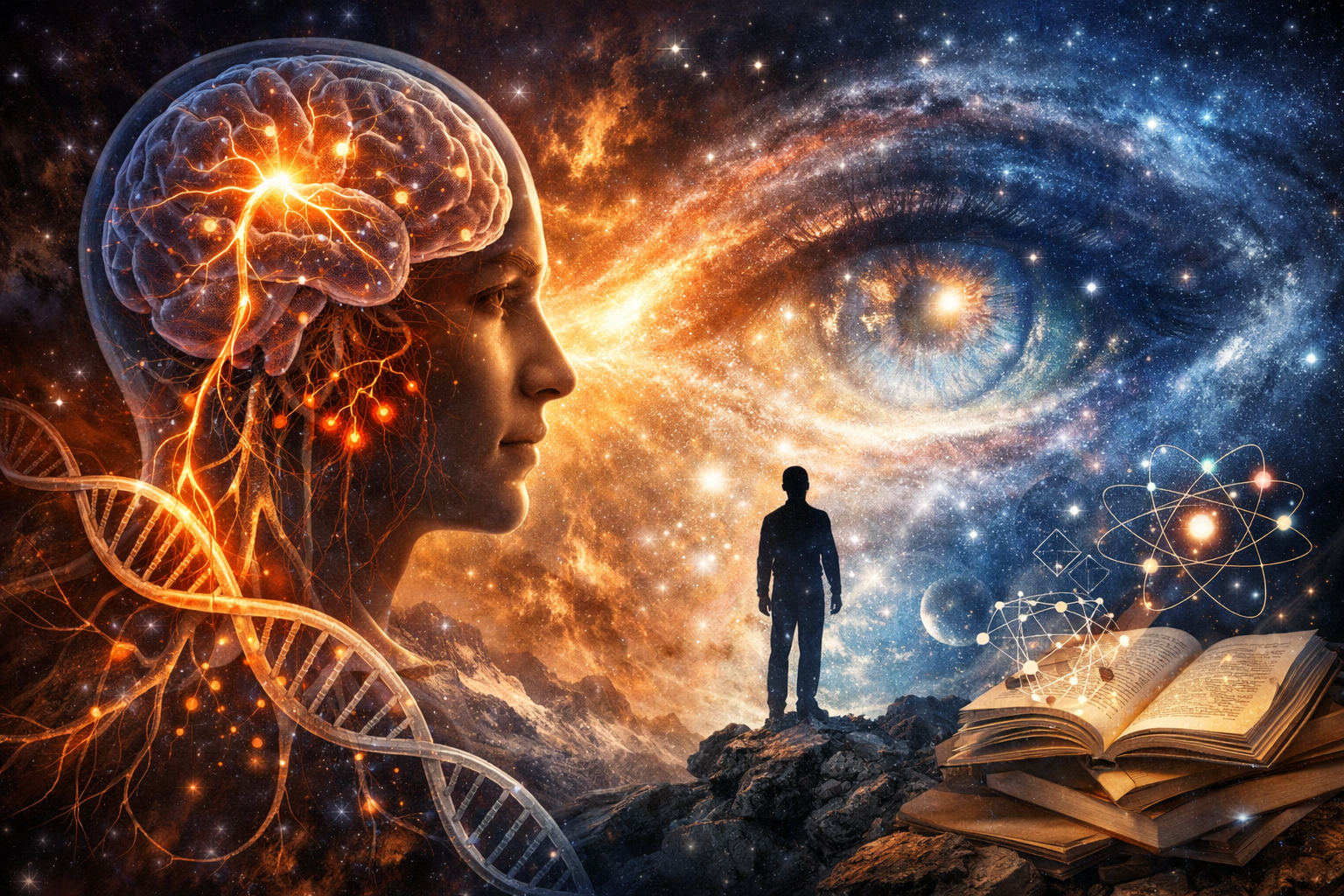
The Universe, the Brain, and the Missing “Ouch”
Naming, Knowing, Explaining, Understanding, and Experience
We spend our lives moving through five layers of contact with reality: naming, knowing, explaining, understanding, and experience. Naming gives a thing a label, a handle for conversation, but the handle is not the thing. Knowing gathers facts and patterns, enough to recognize and predict. Explaining builds a model of causes and mechanisms, the elegant map of how something works. Understanding goes further: it is the moment the map becomes inwardly coherent, when meaning clicks into place and the idea changes how you see. And then there is experience, the irreducible “what it is like” that no description can fully deliver. Pain makes this hierarchy impossible to ignore: we can name it, measure it, and even disable it with a single genetic change, yet the felt reality of hurting still seems to live in a dimension that mechanisms can approach—but not capture.
⠀

The Universe, the Brain, and the Missing “Ouch”
A boy in northern Pakistan grows up with a strange superpower. He can run barefoot over hot stones. He can cut his skin and keep smiling. Adults praise his toughness. Other kids dare him to do stunts. He becomes, briefly, a local marvel.
Then the marvel turns grim.
He bites his tongue without noticing. He breaks bones and keeps walking on them, grinding joints into damage that will never heal properly. Infections arrive like silent fires. The family learns the cruel truth: pain is not merely misery. Pain is maintenance. Pain is the body’s emergency language.
Years later, scientists mapped the cause in families like his to a mutation in SCN9A (a gene that helps build a specific electrical channel in pain-sensing neurons). That channel is Naᵥ1.7 (a voltage-gated sodium channel that allows pain nerves to fire). Remove the channel and the alarm system cannot ring. The world still touches you, warms you, presses on you, but it cannot hurt you in the way that normally forces learning and avoidance. (Cox et al., 2006)
This single gene, quietly doing its molecular job, opens a door to the whole conversation we have been circling: panpsychism, the brain as reality-builder, and the difference between explaining something and understanding it. Pain is a perfect thread to weave them together because pain has two faces. One is measurable and mechanical. The other is intimate and undeniable.
How pain becomes pain

To “feel pain” is not one event. It is a relay race that starts in the body and ends in conscious experience.
First come nociceptors (pain-sensing nerve endings). They respond to dangerous heat, crushing pressure, tearing, and inflammatory chemicals. When triggered, they convert tissue trouble into electrical signals. Those signals travel along peripheral nerves toward the spinal cord. In the spinal cord, they meet a gatekeeper: local circuits can amplify the signal or dampen it based on context. Rubbing a bruised shin can reduce pain partly because competing touch signals and spinal “gates” change what gets transmitted upward.
Then comes the ascent. Signals travel through pathways such as the spinothalamic tract (a major spinal highway for pain and temperature) to the thalamus (the brain’s relay hub). From there, the message fans out into multiple brain regions that together assemble the experience: sensory areas map location and intensity; the insula (a region involved in internal body feelings) contributes the visceral “this is happening to me” quality; the anterior cingulate cortex (involved in distress and motivational salience) contributes the unpleasantness and urgency; frontal regions supply meaning, prediction, and narrative.
Pain, in other words, is not a single “thing” stored in a single place. Pain is a construction, distributed across systems that interpret a body signal into an experience with meaning.
Now zoom back to the gene. If Naᵥ1.7 cannot function properly, the very first relay fails. The nociceptor cannot reliably fire. The spinal cord never receives the right message. The brain never gets the right input. And what never arrives cannot be assembled into the felt “ouch.” (Cox et al., 2006)
That is the mechanistic story. It is an explanation, and it is powerful.
But notice what it does not do.
It tells you how pain signals move. It does not tell you why pain feels like this rather than like a neutral beep on a dashboard. It explains the wiring. It does not deliver the inner light.
This is where the sentence returns with teeth: explanation is not the same thing as understanding.
Why do explanation and understanding diverge
An explanation lives in public space: models, diagrams, causal chains, measurements. Understanding, when the topic is consciousness, has an extra ingredient: it must include what the phenomenon is like from the inside.
You can explain color by wavelength and retinal cones. But a person blind from birth will not “understand red” as an experience through explanation alone. You can explain pain by nociceptors and sodium channels. But a description cannot inject the raw sting of a burn into the reader’s mind.
This gap is one reason philosophers and scientists keep bumping into what David Chalmers calls the “hard problem of consciousness” (the problem of why and how physical processes are accompanied by subjective experience). We can make progress on functions and mechanisms, he argues, but experience itself is the stubborn remainder. (Chalmers, 1995)
Pain is a beautiful example because it is both a signal and a feeling. The signal is public. The feeling is private. And both are real.
The brain as a reality-constructor
Now we widen the lens.
If one gene can erase pain, it becomes harder to pretend that experience is a simple “window” opened directly onto the world. It looks more like a model the brain builds. Not a lie, but an interface.
Your brain never touches “reality raw.” It receives fragments: light, vibration, pressure, and chemistry. From these, it constructs a coherent world of objects, surfaces, people, dangers, and meanings. That construction happens so smoothly that we forget it is happening.
A useful way to think about this is prediction. The brain is not a passive camera. It is closer to a scientist running a continuous experiment. It makes guesses about what is out there, compares them to incoming signals, and updates the guesses.
This general approach is captured in frameworks like the free-energy principle (a proposal by Karl Friston that, very roughly, brains and living systems act to reduce prediction error and avoid surprising states). (Friston, 2010)
In this view, perception is not just receiving data. It is controlled hallucination, constrained by sensory evidence and corrected by feedback from the world. The world pushes back. The brain adjusts. Reality is not invented at random, but it is never encountered unfiltered.
Pain fits neatly here. Pain is not only a report of damage. It is also a prediction about threat and bodily risk, shaped by attention, expectation, memory, mood, and culture. Placebos can reduce pain not because pain is imaginary, but because the brain’s interpretation of the body signal is part of the construction. Meaning enters the wiring.
So yes, it is valid to say: the reality we live in is brain-mediated. But it is not valid to conclude: therefore reality is only in the brain. The simplest honest statement is this:
Reality exists independently, but our access to it is always through brain-built models.
Gravity does not care what you believe. Infection does not negotiate. The external world constrains your internal model with consequences.
Where this runs into the wall called consciousness
Now we arrive at the point where the conversation becomes philosophically radioactive.
If perception is a model, and pain is a constructed experience, and our knowledge is mediated by brain processes, then what is “reality” in itself?
Physics gives exquisite descriptions of relationships: forces, fields, probabilities, symmetries. But many philosophers point out that physics often tells us what matter does more than what matter is intrinsically. The equations work. The ontology remains slippery.
This is where panpsychism walks onstage, not as a mystical slogan, but as a proposed way to close a particular explanatory gap.
Panpsychism says: maybe consciousness is not something that appears out of nowhere when matter gets complicated. Maybe something experiential is already present in the building blocks, and complex brains organize it into rich, unified minds.
That move is motivated by discomfort with the idea that experience pops into existence as a late-stage miracle. If you start with matter that is utterly non-experiential, it is hard to see how you ever get experience at all. Panpsychism says: stop trying to summon experience from a universe defined as experience-free.
You can see echoes of this in some contemporary theories that take consciousness seriously as a fundamental feature of certain physical organizations. Integrated Information Theory (IIT) [a theory proposed by Giulio Tononi that links consciousness to integrated causal information in a system] explicitly aims to connect the structure of experience to the structure of its physical substrate, using a quantity often labeled Φ (phi). (Tononi, 2004; Tononi et al., 2016)
IIT is not identical to panpsychism, but it flirts with a panpsychist implication: if consciousness is tied to certain forms of integration, then consciousness might exist in many systems, at many levels, not only in humans.
The hard trade: panpsychism’s cost
Panpsychism pays a price for its elegance. It inherits the combination problem: if tiny units have tiny proto-experiences, how do they combine into a single unified field like your present awareness?
This is not a trivial problem. It is the sharpest thorn in panpsychism’s side.
But notice the symmetry: materialism has a mirror-thorn. If matter is totally non-experiential, how does experience ever appear at all? Saying “emergence” is not an explanation unless we can show why emergence should produce subjectivity rather than just more complicated behavior.
So we have a strange situation. Panpsychism risks being too generous with the mind. Materialism risks being too stingy with it. Both can explain lots of behavior. Neither, so far, dissolves the mystery of experience.
Returning to the boy, and to us
The boy who cannot feel pain teaches a brutal lesson: consciousness is not a decorative luxury. It is an evolved interface for survival. Pain is one of the interface’s sharpest tools.
At the same time, his case also reveals something almost poetic and unsettling: experience is fragile. Not fragile emotionally. Fragile mechanically. A single molecular component can silence an entire dimension of lived reality.
This should humble anyone who thinks the mind is “just” a story the brain tells. It is a story, yes, but it is a story written in ion channels, synapses, and feedback loops, and it is constrained by the world’s refusal to cooperate with delusion.
It should also humble anyone who thinks explanation finishes the job. You can map the pain pathway from the nociceptor to the cortex. You can name the gene. You can describe the sodium channel. You can even design drugs that target it.
And still, the inner “ouch” remains an ontological jewel that does not turn into a circuit diagram when you stare at it hard enough.
That is why the distinction matters:
Explanation is the skeleton.
Understanding is the living animal.
Science gives us the skeleton with astonishing precision. The lived world gives us the animal from the inside. A complete worldview has to honor both, or it becomes either soulless machinery or ungrounded mysticism.
The deepest, most honest position might be this: our brains construct the reality we experience, but the construction is anchored to a real world that pushes back. Consciousness is part of that world, but its place in the world is still not fully understood. Panpsychism is one plausible attempt to place it, not a proven fact, and not a joke.
In a universe that can build minds out of chemistry, humility is not a surrender. It is good epistemic hygiene.
————————
References (APA 7)
Chalmers, D. J. (1995). Facing up to the problem of consciousness. Journal of Consciousness Studies, 2(3), 200–219.
Cox, J. J., Reimann, F., Nicholas, A. K., Thornton, G., Roberts, E., Springell, K., … Wood, J. N. (2006). An SCN9A channelopathy causes congenital inability to experience pain. Nature, 444, 894–898.
Friston, K. (2010). The free-energy principle: A unified brain theory? Nature Reviews Neuroscience, 11(2), 127–138.
Tononi, G. (2004). An information integration theory of consciousness. BMC Neuroscience, 5, 42.
Tononi, G., Boly, M., Massimini, M., & Koch, C. (2016). Integrated information theory: From consciousness to its physical substrate. Nature Reviews Neuroscience, 17(7), 450–461.
Discover more from RETHINK! SEEK THE BRIGHT SIDE
Subscribe to get the latest posts sent to your email.