
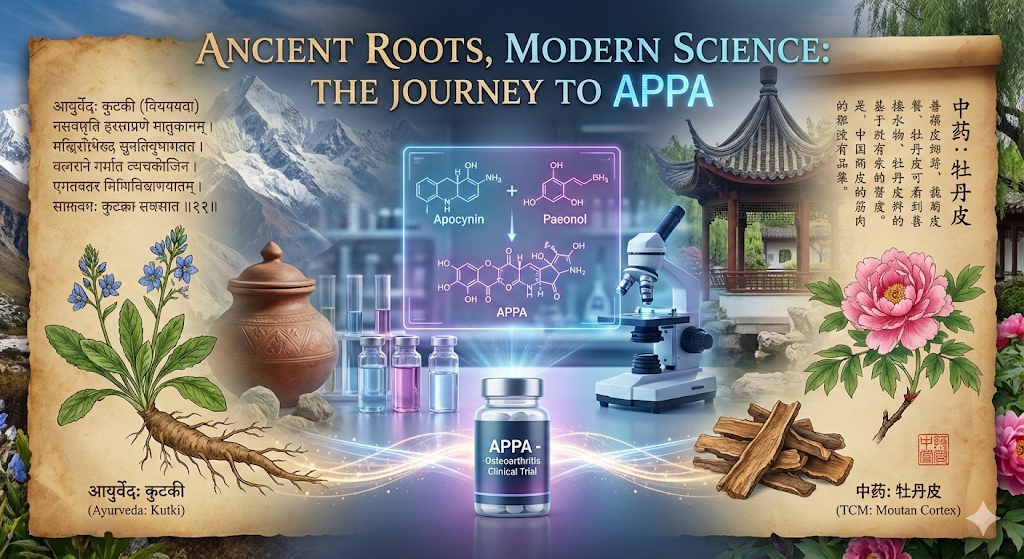
How Himalayan and Chinese Herbs are Shaping the Future of Arthritis Treatment
The history of medicine is not a straight line of progressively better inventions, but rather a spiral that often loops back to ancient wisdom to find solutions for modern challenges. Today, pharmaceutical research is increasingly turning to ethnopharmacology—the study of traditional medicines—to discover potent bioactive compounds. This fascinating convergence of ancient tradition and cutting-edge science is exemplified by the development of a new investigational drug for osteoarthritis known as APPA.
The story of APPA starts not in a modern laboratory, but in the high-altitude ranges of the Himalayas and the traditional gardens of China. By isolating active compounds from revered herbs in Ayurveda and Traditional Chinese Medicine (TCM), researchers are creating targeted therapies that may succeed where conventional drugs have fallen short.
The Himalayan Guardian: Kutki and Ayurveda
In the rugged terrain of the Himalayas grows a small, perennial herb known scientifically as Picrorhiza kurroa. In Ayurveda, the traditional medicine system of India, it is known as Kutki or Katuka. For millennia, the bitter roots and rhizomes of this plant have been prized as a powerful “hepatoprotective” agent—a guardian of liver health.
In Ayurvedic theory, Kutki is celebrated for its intensely bitter taste and cooling energy, properties essential for pacifying excess “Pitta” (heat/fire) in the body. Excess Pitta is often manifested as inflammation, fevers, and liver disorders like jaundice.
Evidence in Tradition: Arogyavardhini Vati
The traditional evidence for Kutki’s efficacy is best seen in classical Ayurvedic formulations. Kutki is a primary, indispensable ingredient in Arogyavardhini Vati. The name itself is telling: Arogya means “health,” and Vardhini means “enhancer.” This complex herbo-mineral formulation has been used for centuries to treat severe liver diseases (Kamala), skin disorders, and chronic fevers. The presence of Kutki in this premiere formulation underscores its historical status as a potent anti-inflammatory and detoxifying agent.
Modern science identified several active compounds in Kutki responsible for these effects, including iridoid glycosides (picrosides) and a phenolic compound called Apocynin. Apocynin acts as a powerful antioxidant, specifically inhibiting an enzyme complex called NADPH oxidase, thereby reducing the production of damaging reactive oxygen species (ROS) in tissues.
The Chinese Peony: Clearing Heat and Moving Stasis
Simultaneously, thousands of miles away in China, another plant was establishing itself as a cornerstone of medical practice: the tree peony (Paeonia suffruticosa). In Traditional Chinese Medicine (TCM), the root bark of this plant is known as Moutan Cortex.
TCM views health through the lens of flowing energy (Qi) and blood. Disease often arises from “heat” (inflammation) or “stasis” (stagnation of blood or energy). Moutan Cortex is renowned for its ability to “clear heat,” “cool the blood,” and “invigorate blood circulation to remove stasis.” These traditional concepts translate medically into regulating inflammation, improving circulation, and alleviating pain.
Evidence in Tradition: Classical Formulas
The importance of Moutan Cortex is evidenced by its inclusion in countless foundational TCM formulas.
• It is a key component of Liu Wei Di Huang Wan (Six-Ingredient Rehmannia Pill), used to nourish the body’s foundational energies while clearing “deficiency heat”—a low-grade, chronic inflammatory state often associated with aging.
• It is also vital in Gui Zhi Fu Ling Wan, a primary formula used in gynecology to “move blood stasis,” addressing conditions like uterine fibroids and painful menstruation by improving circulatory dynamics.
The primary active bioactive compound isolated from Moutan Cortex responsible for these cooling and circulatory effects is Paeonol. Modern research confirms Paeonol has significant anti-inflammatory and analgesic properties.
The Modern Synthesis: APPA and Osteoarthritis
While Ayurveda utilized Apocynin (via Kutki) for liver heat, and TCM utilized Paeonol (via Peony bark) for circulatory stasis, modern biopharmaceutical researchers saw a different potential. They recognized that the mechanisms of these two compounds—one a potent antioxidant, the other a strong anti-inflammatory regulator—could be combined synergistically to tackle a modern epidemic: Osteoarthritis (OA).
Osteoarthritis is a degenerative joint disease characterized by chronic inflammation and the breakdown of cartilage. Current treatments, primarily NSAIDs (like ibuprofen), focus on symptom management (pain relief) but come with significant gastrointestinal and cardiovascular side effects when used long-term. Furthermore, NSAIDs do not stop the disease progression.
This led to the development of APPA, a patented, fixed-dose combination of synthetically produced Apocynin and Paeonol.
Evidence in Modern Trials: Mechanisms and Results
The development of APPA is based on rigorous scientific evidence demonstrating how these ancient compounds work together at a cellular level:
- Synergistic Mechanism: APPA works by modulating key inflammatory pathways. Paeonol downregulates NF-\kappaB (a “master switch” for inflammation), while Apocynin powerfully scavenges free radicals that damage cartilage. Furthermore, recent research suggests APPA may have “senotherapeutic” effects—meaning it helps clear out or suppress harmful “senescent” (aging zombie cells) that accumulate in arthritic joints and drive inflammation.
- Clinical Trial Success: APPA has moved successfully through early clinical trials. A completed Phase 2a clinical trial showed that APPA was safe and well-tolerated. Crucially, it demonstrated a significant reduction in pain compared to a placebo in a specific subset of patients—those suffering from more severe knee osteoarthritis.
Based on this evidence, APPA is currently undergoing a larger Phase 2b clinical trial (as of late 2024/early 2025), specifically targeting patients with severe OA, with results expected later in 2025.
Takeaways
The journey of APPA is a compelling testament to the value of ethnopharmacology. By respecting the empirical evidence accumulated over thousands of years by Ayurvedic and Chinese healers—embodied in formulations like Arogyavardhini Vati and Liu Wei Di Huang Wan—modern science was able to identify Apocynin and Paeonol. By combining them, researchers are not just creating another painkiller; they are developing a potential disease-modifying drug that targets the root causes of inflammation and cellular aging in joints, offering new hope based on very old roots.
References
- APPA Drug Development & Clinical Trials
• AKL Therapeutics. (n.d.). Scientific Rationale. Retrieved from akltherapeutics.com
• Source for mechanism of action (NF-κB/Nrf2 modulation) and development pipeline.
• Crossfield, S. S., et al. (2023). “Safety and efficacy of APPA, a novel apocynin and paeonol combination, in patients with osteoarthritis of the knee: a randomised, double-blind, placebo-controlled, phase 2a trial.” The Lancet Rheumatology, 5(6), e340-e350.
• Primary source for the Phase 2a trial results mentioned.
• Larkin, J., et al. (2020). “APPA, a novel NF-κB inhibitor and Nrf2 activator, reduces inflammation and cartilage degradation in a rat model of osteoarthritis.” Osteoarthritis and Cartilage, 28(1), S280-S281.
• Opperman, L. A., et al. (2020). “Apocynin and Paeonol (APPA) modulates senescence and inflammation in human chondrocytes.” International Journal of Molecular Sciences, 21(16), 5707.
• Source for the “senotherapeutic” and “senolytic” effects mentioned.
- Ayurveda: Kutki (Picrorhiza kurroa) & Apocynin
• Sharma, P. V. (2005). Dravyaguna Vijnana (Vol. 2). Chaukhambha Bharati Academy.
• Standard authoritative text on Ayurvedic pharmacology detailing Kutki’s properties.
• Kumar, G., et al. (2013). “Arogyavardhini Vati: A theoretical analysis of traditional claims.” Journal of Ayurveda and Integrative Medicine, 4(3), 164–170.
• Source for the formulation “Arogyavardhini Vati” and its uses for liver disease.
• Engels, F., et al. (1992). “Effect of apocynin, a drug isolated from the roots of Picrorhiza kurroa, on arachidonic acid metabolism.” FEBS Letters, 305(3), 254-256.
• Scientific confirmation of Apocynin’s isolation from Kutki.
- Traditional Chinese Medicine: Moutan Cortex & Paeonol
• Bensky, D., Clavey, S., & Stoger, E. (2004). Chinese Herbal Medicine: Materia Medica (3rd ed.). Eastland Press.
• Standard authoritative text on TCM herbs detailing Moutan Cortex’s use for “clearing heat” and “cooling blood.”
• Scheid, V., et al. (2009). Chinese Herbal Medicine: Formulas & Strategies (2nd ed.). Eastland Press.
• Source for the formulas “Liu Wei Di Huang Wan” and “Gui Zhi Fu Ling Wan.”
• Zhang, L., et al. (2019). “Paeonol: Pharmacological activities and mechanisms of action.” International Immunopharmacology, 72, 413-421.
• Review of Paeonol’s modern pharmacological profile
Discover more from RETHINK! SEEK THE BRIGHT SIDE
Subscribe to get the latest posts sent to your email.