
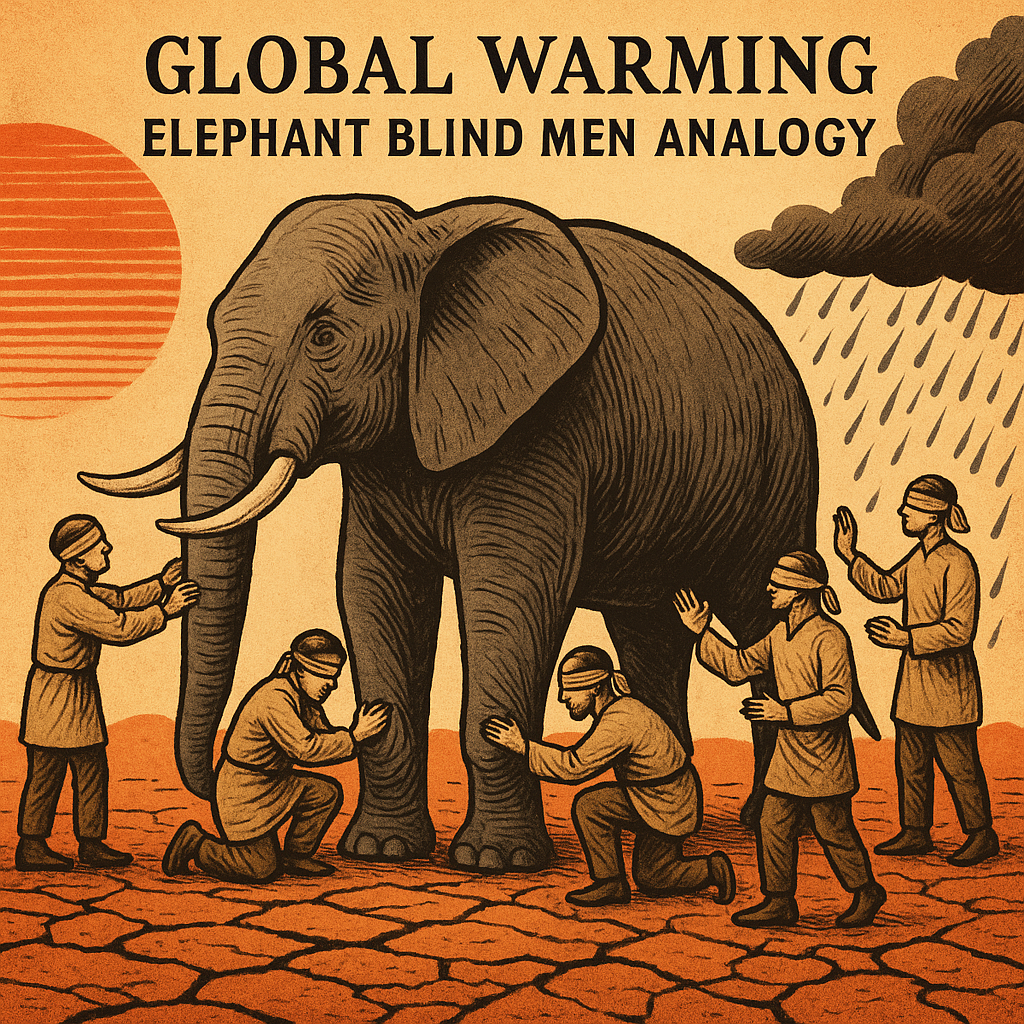
Human‑made global warming is often compared to the parable of the blind men and the elephant: each observer touches a different part of the animal and describes a completely different creature. In the same way, people in different regions encounter different facets of climate change. A farmer in the Sahel experiences drought and blistering heat, a coastal community in Bangladesh sees rising seas and severe storms, while a New Yorker remembers flooded subways. Media reports sometimes amplify single events, making it hard to grasp the global picture. The reality is an interconnected system driven by the physics of heat, moisture and circulation; warming adds energy to this system, making it more volatile and amplifying extremes . Below is a comprehensive overview of global warming’s current state, its regional manifestations and its consequences for humans.
A planet already in unfamiliar territory
Recent data show how quickly the climate system is changing. According to the European Union’s Copernicus Climate Change Service, 2024 was the warmest year since records began, with a global average temperature about 1.55 °C above the 1850‑1900 baseline and the first calendar year clearly exceeding the 1.5 °C threshold . The World Meteorological Organization (WMO) projects that 2025 will likely end as the second or third warmest year on record, with the three‑year average temperature for 2023–2025 expected to exceed 1.5 °C . The WMO notes that the past eleven years (2015‑2025) are the eleven warmest in the 176‑year record, that near‑surface temperatures in January‑August 2025 were ~1.42 ± 0.12 °C above pre‑industrial levels and that greenhouse‑gas concentrations and ocean heat continue to rise . Model projections indicate an 86 % chance that at least one year between 2025–2029 will exceed 1.5 °C and a 70 % chance that the five‑year average will be above 1.5 °C .
These values depend on the baseline used to define the “pre‑industrial” temperature. Some recent research, such as a Nature Climate Change study using Caribbean sclerosponges as natural thermometers, argues that instrumental records may underestimate early warming. The study suggests that industrial‑era ocean warming began in the mid‑1860s, implying a pre‑industrial baseline ~0.5 °C cooler than previously assumed. With this adjustment the authors estimate that global temperatures were already 1.7 ± 0.1 °C above pre‑industrial levels by 2020, meaning the 1.5 °C limit may have been breached years ago . The result remains controversial; however, it illustrates how different methods can lead to different interpretations, adding to public confusion.
Why warming drives volatility
Heating the planet does more than raise average temperatures—it alters the entire energy and moisture balance. A warmer atmosphere holds more water vapour; for every 1 °C of warming, air can carry about 7 % more moisture, increasing the potential for intense rainfall . Simultaneously, higher temperatures increase evaporation from soils and water bodies, accelerating droughts. The Arctic is warming two to four times faster than the global average. The resulting reduction in the temperature gradient weakens and “wavers” the polar jet stream—the high‑altitude river of air that normally corrals cold polar air. A weaker jet stream develops larger loops, causing persistent weather patterns. Regions under a warm loop can experience prolonged heatwaves and droughts, while neighbouring areas under a cold loop may suffer sudden cold snaps or heavy snowfall . This phenomenon explains paradoxical events like the 2021 Texas freeze, when a weakened jet stream allowed Arctic air to plunge southward .
Impacts across continents
The table below summarises key climate‑change impacts by region. The keywords are concise; further discussion follows.
| Region | Key impacts and evidence (short phrases) |
| Africa | Record warmth (2024 warmest or second warmest); severe droughts in southern Africa causing crop losses and power shortages; floods in East, West and Central Africa; North Africa sees poor cereal harvest due to drought |
| Asia | Warming nearly twice global average; record high sea‑surface temperatures; sea‑level rise above global mean; severe mass loss of Himalayan and Tian Shan glaciers; extreme rainfall, droughts and destructive tropical cyclones |
| South‑West Pacific | Unprecedented ocean warming and marine heatwaves; rising sea level; extreme heat and intense rainfall; historic cyclone season; Indonesia’s last tropical glacier near extinction |
| Latin America & Caribbean | Dying glaciers; earliest Category 5 hurricane on record; intense wildfires, droughts and floods; Venezuela loses its last glacier |
| Europe | Warming twice global average; frequent and severe heatwaves; widespread droughts in southern Europe; melting glaciers; more intense extreme rainfall and flooding |
| United States & Caribbean (NCA5) | *Northeast: heavy downpours up ~60 % since 1950s ; Southeast: rising sea levels, more heatwaves and floods ; Caribbean: warmer oceans fuel stronger hurricanes and sea‑level rise harming health and infrastructure ; Midwest: rising temperatures and extreme rainfall lower crop yields ; Northern Great Plains: severe droughts and floods, with flooding damages projected to rise ~20 % ; Southwest: chronic water stress, drought and wildfires causing billions in damages ; Alaska: warming 2–3 × global average, permafrost thaw, melting glaciers ; Hawaii/Pacific islands: sea‑level rise and ocean acidification degrade coral reefs, threatening fisheries (projected 40 % decline by 2050) |
| West Asia (2020–2025) | Five‑year drought in Iran and the Tigris–Euphrates basin—the driest since 1933; rainfall deficits (up to 70 %) cripple rain‑fed farmland; water levels drop by ~27 % ; human‑induced climate change increased drought risk more than ten‑fold |
Africa
Africa experienced its warmest or second‑warmest year in 2024, with record sea‑surface temperatures. Southern Africa endured its worst drought in decades, reducing crop yields and causing power outages because hydropower reservoirs were depleted . East Africa suffered severe flooding due to intense rainfall, while West and Central Africa were hit by devastating floods that affected millions . In North Africa, drought produced a poor cereal harvest for the third consecutive year . These extremes illustrate how warming intensifies both drought and flood risk, undermining food security and economies.
Asia
Asia is warming nearly twice as fast as the global mean . The Himalayan and Tian Shan glaciers are losing mass at unprecedented rates, leading to glacial‑lake outburst floods and threatening long‑term water supplies for hundreds of millions . Sea‑level rise in the Indian and Pacific Oceans is higher than the global average , raising risks for low‑lying deltas and island nations. Meanwhile, extreme rainfall events and droughts are causing deadly landslides and water shortages . In 2025 the West Asian drought intensified, with rainfall up to 70 % below normal and water levels in the Tigris and Euphrates down around 27 %, forcing millions to face water scarcity . The World Weather Attribution study found that human‑induced climate change made such droughts over ten times more likely .
South‑West Pacific
The South‑West Pacific region has experienced unprecedented ocean warming, marine heatwaves and rising sea levels, which are eroding coastlines and damaging coral reefs . Extreme heat and intense rainfall have become more frequent, contributing to a historic cyclone season; the last tropical glacier in Indonesia is near extinction . Low‑lying island nations face existential threats as even small increases in sea level inundate freshwater lenses and arable land.
Latin America and the Caribbean
In 2024, Latin America and the Caribbean recorded their warmest or second‑warmest year. Glaciers continued to disappear, and the region experienced record‑breaking hurricanes, widespread wildfires, drought and catastrophic floods . Venezuela lost its last remaining glacier, symbolising the loss of water storage for communities that depend on glacial melt . A Category 5 hurricane formed earlier in the season than ever before . In late 2025, heavy rainfall in eastern Mexico caused floods and landslides that disproportionately affected Indigenous and socially vulnerable communities .
Europe
Europe has been warming twice as fast as the global average . Heatwaves are increasingly frequent and severe; the summer of 2022 alone resulted in over 61 000 heat‑related deaths . Southern Europe suffers from widespread droughts, reducing water availability and hurting agriculture, while glaciers in the Alps and Scandinavia continue to melt . The continent also experiences more intense extreme precipitation, leading to devastating floods . In 2025, Spain and Portugal experienced extreme fire‑weather conditions, showing that prolonged drought and heat are making mega‑fires more common.
United States and neighbouring islands
The Fifth U.S. National Climate Assessment highlights varied regional impacts. The Northeast has seen a roughly 60 % increase in heavy downpours since the 1950s , contributing to urban flooding. The Southeast faces sea‑level rise, more frequent heatwaves and increased risk of wildfires , while the Caribbean endures warmer oceans that strengthen hurricanes and rising seas that inundate infrastructure . The Midwest contends with rising temperatures and more extreme rainfall, reducing crop yields and stressing livestock . The Northern Great Plains deals with severe droughts and floods, with flooding damages projected to rise by 20 % . The Southwest experiences chronic water scarcity, intense drought and large wildfires; from 2018–2023, the region suffered 31 climate disasters costing over US$67 billion and >700 deaths . Alaska is warming two to three times faster than the global average, leading to melting permafrost and shrinking glaciers . Hawaii and U.S.‑affiliated Pacific islands face ocean warming, sea‑level rise and acidification that threaten coral reefs and may reduce fisheries catches by up to 40 % by 2050 .
Human consequences
Global warming translates into direct and indirect threats to human well‑being:
- Heat‑related illness and mortality. Prolonged heatwaves strain the human body, increasing the risk of heat exhaustion, cardiovascular stress and death. A study of the European heatwave of 2022 estimated 61 672 heat‑related deaths . Globally, the World Meteorological Organization notes that heatwaves cause more deaths than any other extreme weather .
- Water scarcity and food insecurity. Droughts reduce streamflow, empty reservoirs and desiccate soils. In West Asia’s ongoing drought, rainfall deficits of up to 70 % crippled farmland and water levels in major rivers dropped by 27 %, leaving millions facing shortages . In southern Africa, drought lowered crop yields and triggered power outages . Climate change is projected to reduce crop yields in the Midwest and globally , while rising sea levels cause saltwater intrusion that contaminates groundwater and farmland.
- Extreme rainfall, floods and storms. Warm air holds more moisture, leading to torrential downpours. The U.S. Northeast has seen a 60 % increase in heavy rainfall . In 2025, torrential rain and cyclones in Southeast Asia caused catastrophic flooding and landslides . Sea‑level rise, which has nearly doubled in rate from about 2.1 mm/year (1993–2002) to 4.1 mm/year (2016–2025) , intensifies storm surges and chronic coastal flooding.
- Wildfires and air quality. Hotter, drier conditions increase wildfire frequency and severity. Canada’s 2024 wildfire season was one of the worst on record . Smoke travels thousands of kilometres, degrading air quality and causing respiratory illness. Fire‑weather conditions are becoming common in parts of Europe and the western United States.
- Ecosystem disruption. Warmer oceans and higher atmospheric CO₂ levels lead to ocean acidification, which dissolves the calcium carbonate shells of marine organisms, threatening coral reefs and fisheries . Melting glaciers reduce summer water supplies and raise sea levels. The loss of glaciers in Venezuela and the imminent loss of Indonesia’s last tropical glacier are stark warnings .
- Vector‑borne diseases. Warmer temperatures expand the ranges of mosquitoes and ticks, increasing the risk of diseases such as dengue, malaria and Lyme disease . As previously cool regions warm, they become more hospitable to disease vectors .
- Displacement and inequality. Extreme events and gradual changes drive people from their homes. Floods and storms displace millions in Asia and Africa, while water shortages contribute to migration from rural areas in Iran and the Sahel . The WMO warns that each year above 1.5 °C will deepen inequalities and inflict irreversible damage if emissions are not curtailed .
⠀
Conclusion: seeing the whole elephant
Global warming is not a distant abstraction; it is a cascade of physical changes already altering every continent. Like the blind men describing the elephant, communities experience different aspects—heatwaves, drought, floods, sea‑level rise, glacier loss or storms—and media coverage can create a fragmented picture. The science shows, however, that these phenomena share a common driver: a rapid increase in greenhouse‑gas concentrations that is heating the planet, changing the circulation of air and water, and intensifying extremes. The WMO warns that temperatures above 1.5 °C will “hammer economies, deepen inequalities and inflict irreversible damage,” and emphasises that we must act swiftly to limit the overshoot and bring temperatures back down . A comprehensive response involves both mitigation—rapidly reducing greenhouse‑gas emissions—and adaptation, such as building early‑warning systems, climate‑resilient infrastructure and sustainable water and food systems. Only by recognising the whole “elephant” can humanity respond effectively to the climate crisis.
References
Global Temperature, Thresholds & Warming Acceleration
Burgess, S., & Copernicus Climate Change Service. (2025). 2025 on course to be joint-second warmest year, with November third-warmest on record. European Centre for Medium-Range Weather Forecasts (ECMWF). https://climate.copernicus.eu
McCulloch, M., et al. (2024). 300 years of sclerosponge thermometry shows global warming has exceeded 1.5 °C. Nature Climate Change. https://www.nature.com
World Meteorological Organization. (2025). 2025 set to be second or third warmest year on record, continuing exceptionally high warming trend. WMO Press Release. https://wmo.int
NASA Goddard Institute for Space Studies. (2024). Global temperature update and climate trends. https://climate.nasa.gov
United Nations Environment Programme. (2023). Emissions Gap Report 2023. UN Publications.
————————
Extreme Weather & Climate Dynamics
Francis, J. A., & Vavrus, S. (2015). Evidence for a wavier jet stream in response to rapid Arctic warming. Geophysical Research Letters, 42(10), 4523–4532.
World Weather Attribution. (2025). Multiple extreme events in 2025: Drought, heatwaves, storms, and flooding. https://www.worldweatherattribution.org
Copernicus Climate Change Service. (2024). Global climate highlights 2024. https://climate.copernicus.eu
World Meteorological Organization. (2024). State of the Climate 2024 Update for COP29. https://wmo.int
National Oceanic and Atmospheric Administration. (2025). Global Climate Report – June 2025. NOAA National Centers for Environmental Information. https://ncei.noaa.gov
————————
Regional Impacts — Africa, Asia, Europe, Americas
World Meteorological Organization. (2024). State of the Climate in Africa 2024. WMO, Geneva.
World Meteorological Organization. (2024). State of the Climate in Asia 2024. WMO, Geneva.
Copernicus Climate Change Service. (2024). European State of the Climate 2024. https://climate.copernicus.eu
World Meteorological Organization. (2024). State of the Climate in Latin America and the Caribbean 2024. WMO, Geneva.
U.S. Global Change Research Program. (2023). Fifth National Climate Assessment (NCA5). https://globalchange.gov
————————
Heat-Related Mortality
Ballester, J., et al. (2023). The 2022 European summer heatwave caused more than 60,000 heat-related deaths. Nature Medicine, 29, 1–9.
World Health Organization. (2023). Climate change and health fact sheet. https://www.who.int
————————
Sea-Level Rise, Ocean Heat, Ice Loss
NASA Jet Propulsion Laboratory. (2024). Sea level rise data and global trends. https://sealevel.nasa.gov
World Meteorological Organization. (2025). State of the Global Climate Update 2025. https://wmo.int
IPCC. (2021). Sixth Assessment Report (AR6), Working Group I: The Physical Science Basis. https://www.ipcc.ch
————————
Paleoclimate & Deep-Time Temperature Variations
Westerhold, T., et al. (2020). A Cenozoic record of Earth system variability. Science, 369(6509), 1383–1387.
Hunter, S. J., et al. (2024). Phanerozoic climate reconstruction and Earth system sensitivity. Earth-Science Reviews, 245, 104802.
————————
Health Impacts, Disease Spread, Vector Expansion
Centers for Disease Control and Prevention. (2024). Climate effects on health: Vector-borne diseases. https://cdc.gov
Rocklöv, J., & Dubrow, R. (2020). Climate change: An enduring challenge for vector-borne disease prevention and control. Nature Reviews Microbiology, 18, 495–496.
————————
Agriculture, Water Security & Food Systems
Food and Agriculture Organization of the United Nations. (2023). Climate change and food security report. FAO Publications.
World Bank. (2023). Water security in a changing climate. World Bank Group.
————————
Ocean Acidification & Ecosystem Impacts
NOAA Pacific Marine Environmental Laboratory. (2024). Ocean acidification: Causes, impacts, and research. https://pmel.noaa.gov
Hoegh-Guldberg, O., et al. (2018). Impacts of 1.5°C global warming on natural and human systems. In IPCC Special Report on 1.5°C.
————————
Displacement, Migration & Societal Impacts
International Organization for Migration. (2023). Global Report on Internal Displacement: Climate Change Edition. IOM Publications.
United Nations Office for Disaster Risk Reduction. (2024). Global Assessment Report on Disaster Risk Reduction 2024. UNDRR.
Discover more from RETHINK! SEEK THE BRIGHT SIDE
Subscribe to get the latest posts sent to your email.