
Introduction
On a cold night over ten thousand years ago, a small family huddles around a flickering fire. They live day-to-day by hunting game and gathering wild plants, never sure if tomorrow’s hunt will stave off hunger. Conflict with rival tribes over food and shelter is a constant threat. Life is simple and harsh, defined by nature’s whims and the imperative of survival. For millennia, this was the human story. It was an age of subsistence. There was little improvement in living conditions from one generation to the next. Yet humanity did not remain in this uncertain state. Over time, our ancestors discovered new ways of harnessing resources and organizing society. We are going to see how a series of revolutionary transitions occurred. These transitions range from the dawn of agriculture to the rise of industry and, finally, to the digital age. Each transition transformed human life. Each transition brought new opportunities. They also brought challenges. They set the stage for what is argued to be happening today: the biggest transformation in history. This transformation could lead us to a world of abundance “beyond scarcity, conflict, or need”. This essay will journey through those pivotal eras. It will cover prehistory, the agricultural revolution, the industrial age, and the digital revolution. Finally, it will explore the coming “world without limits” envisioned in this essay. Along the way, we’ll see the common threads that weave through each transition, and why I believe a profound paradigm shift is now at hand, bringing both bright hopes and cautions for our future
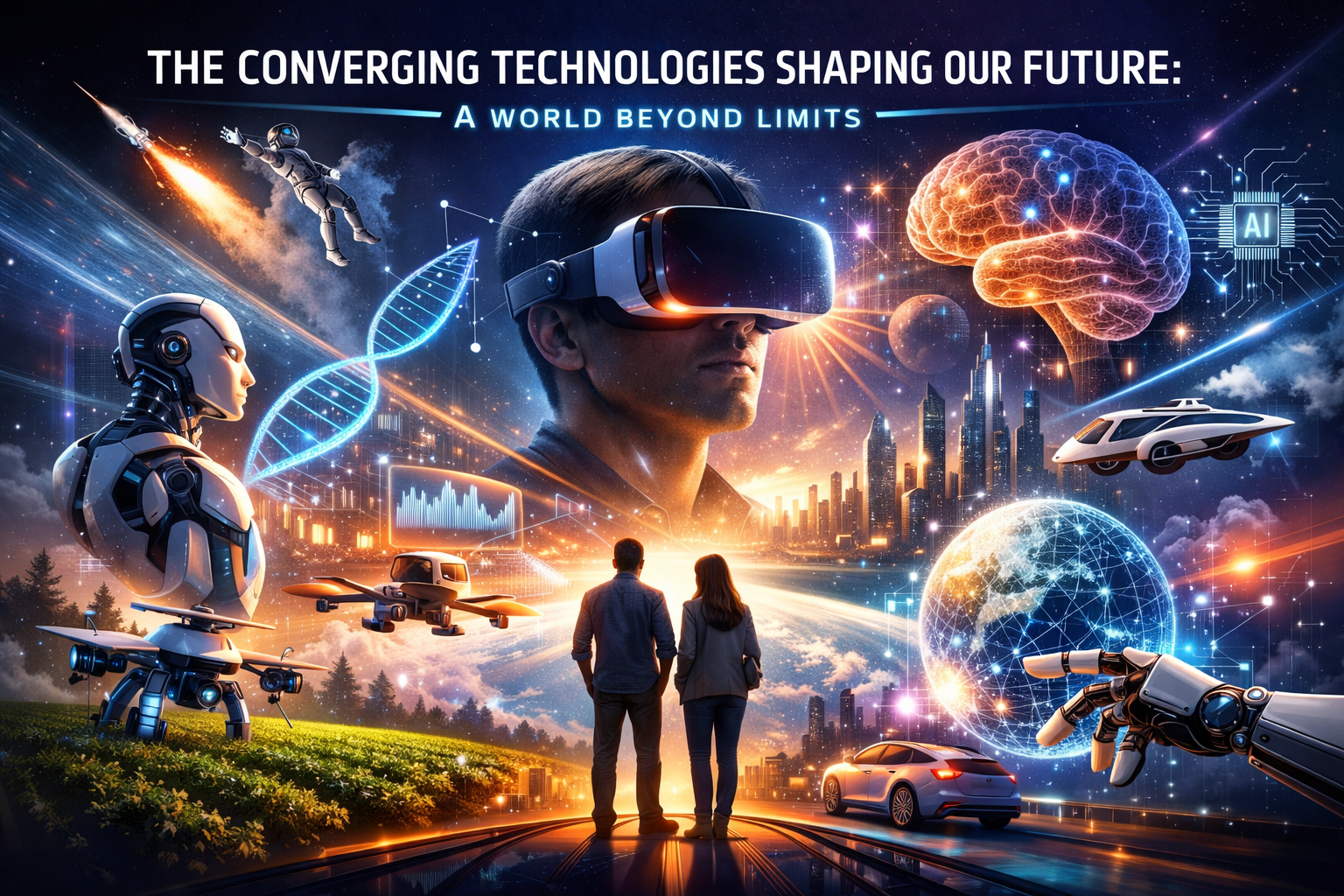
Innovation today is being driven not by isolated breakthroughs, but by the convergence of multiple technologies across industries. In the past, society celebrated singular inventions like the steam engine or the transistor. Now, progress emerges from weaving together advances in fields like artificial intelligence (AI), biotechnology, robotics, quantum computing, and more. These once-distinct domains are intersecting and compounding each other’s impact in a self-reinforcing “flywheel” of innovation. Improvements in one area—like faster computer chips—boost progress in other areas, including healthcare. Smarter algorithms enhance advancements in sectors like energy. As a result, technological convergence is redefining how value is created in the economy. It is also changing how solutions to global challenges are developed .
This new paradigm is unfolding rapidly. What seemed like science fiction just a few years ago is becoming reality across sectors. Fundamental transformations in technology are occurring for the first time in history within a single generation. Many are struggling to keep up. Midst this whirlwind of change, a clear pattern emerges. The future will be shaped not by any one technology alone. It will be defined by how technologies converge and work together. In the sections below, we explore how convergence is already driving breakthroughs in various industries. These include manufacturing, medicine, energy, and transportation. We also examine the main players and partnerships that are casting our shared future. We will understand that this is about more than just forecasting future possibilities. It involves recognizing what is already practiced today as different threads of innovation weave into a new reality.
A New Era of Technological Convergence
Convergence is more than a buzzword; it marks a structural shift in innovation. We now see combinatorial innovation. Instead of linear progress in siloed fields, novel combinations of technologies unlock capabilities no single one achieve alone . The World Economic Forum’s Technology Convergence Report 2025 describes a “3 cC Framework.” This framework includes Combination, Convergence, and Compounding to illustrate this process . First, distinct technologies are joined (for example, integrating AI with an existing product or process). Next, deeper convergence occurs as these combinations restructure value chains and blur traditional industry boundaries. Finally, as convergent innovations reach scale, compounding effects ignite. Network effects and cost declines accelerate adoption. They spark new waves of innovation .
In practical terms, convergence means technologies are evolving each other. Advances no longer happen in isolation – progress in one domain directly enables leaps in another. For instance, improvements in advanced sensors and computing power fuel better AI. In turn, AI helps scientists design new materials or drugs. These can then be manufactured with autonomous robots. Each feedback loop tightens the next. This is why leaders now emphasize intersections over individual tech trends. According to the World Economic Forum, organizations that strategically invest in technology intersections can capture disproportionate value. They can also drive cross-sector transformation. In short, convergences – not isolated innovations – will define the next era, reshaping industries, institutions and even societal structures.
Artificial Intelligence: The Catalyst Across Domains
If one technology can be called the “connective tissue” of this convergence era, it is artificial intelligence. AI has emerged as a primary catalyst that enhances nearly every domain it touches. AI optimizes industrial operations. It also advances scientific research. AI’s ability to analyze data, recognize patterns, and make predictions is supercharging other technologies. In effect, AI is integrating into all other threads of innovation. It powers smart algorithms in finance. It guides robots in factories. AI accelerates drug discovery in biotech. It also manages energy grids in real time. The World Economic Forum notes that AI is central to convergent trends. It enables digital twin simulations of physical environments. It also supports decentralized decision-making in autonomous systems. These capabilities are transforming static processes into dynamic, adaptive systems that learn and improve over time.
One vivid example is the recent boom in generative AI – AI systems that can create content and designs. In just a few years, generative AI evolved from a curiosity. It is now a mainstream tool. It assists human workers in coding, writing, and design tasks. This has already begun to redefine knowledge work and creative industries, and it’s increasingly being integrated with other technologies. For instance, in healthcare research, AI can generate molecular structures for new drugs. In engineering, it can propose optimized designs. These designs are for parts that 3D printers then build. AI is also moving from the cloud to the edge. Lightweight AI models embedded in devices and sensors provide real-time responsiveness. These models also offer privacy-preserving analytics. Thanks to such edge AI and techniques like federated learning, even devices like phones and wearables can operate with a degree of intelligence on-site, only syncing with the cloud when needed. The cumulative effect is an environment of “living intelligence.” It consists of systems of devices, algorithms, and networks. They continuously sense, learn, and adapt in a seemingly organic way .
Crucially, AI’s convergent power comes from combining with other fields. For example, merging AI with advanced sensors is producing autonomous machines. These machines can perceive and act in the world, including self-driving cars, drones, and warehouse robots. Blending AI with biotech gives rise to new forms of “living” systems. These systems include AI-guided gene editing. They also encompass bioengineered solutions that respond to environmental changes. Even in the realm of personal gadgets, AI is turning passive tools into proactive partners. Smart devices are evolving from assistants to advisors. Today’s smartphones and wearable can track their users’ behavior and health signals. They can not just respond to requests but also anticipate needs. Additionally, they make recommendations. For instance, a smartwatch now does more than count steps. AI algorithms analyze its sensor data. This analysis can help detect irregular heart rhythms. It can even identify early signs of heart disease that previously required hospital tests. This kind of capability illustrates AI’s role as the common enabler. It learns from data gathered by devices and systems. Then, it drives smarter decisions in virtually every arena of life. In short, AI is the connecting thread. It stitches through all others and binds technologies together. This binding forms something greater than the sum of their parts.
Industry 4.0: Smarter Manufacturing and Digital Twins
In the industrial sector, convergence is at the heart of the “Industry 4.0” revolution – the blending of information technology and operational technology in manufacturing and infrastructure. Robotics, Internet of Things (IoT) sensors, cloud computing, and AI now cohabit on factory floors and supply chains. These technologies create smart systems often referred to as cyber-physical systems. This convergence is dissolving traditional industry boundaries and reshaping value chains, enabling companies to redefine their roles and offerings. A company that once made only physical products can now offer integrated digital services around those products. They can also use their skill in one domain to enter a completely new market.
One notable trend is the rise of digital twins – virtual, real-time replicas of physical assets or processes. Digital twins allow businesses to simulate operations in a virtual environment. They achieve this by combining IoT sensor data, physics-based simulation models, and AI analytics. The result is dramatic gains in efficiency and innovation. For instance, Siemens is developing immersive physics-based digital environments with partners like NVIDIA, AWS, and Sony. These environments model everything from factory production lines to entire infrastructure systems. In these virtual test beds, engineers can experiment with designs. They can forecast maintenance needs. They are also able to improve energy usage before implementing changes in the real world. This industrial metaverse of interconnected digital twins is already improving energy efficiency. It is speeding up product development. It is reducing waste. It is also making supply chains more resilient. It exemplifies how converging sensor networks, AI simulations, and cloud computing are transforming manufacturing and industrial operations.
Another area where convergence is evident is next-generation robotics. Traditional industrial robots have been powerful but relatively dumb tools, confined to fixed repetitive tasks. Now, with advances in AI (especially computer vision and machine learning), modern robots are becoming cognitive and autonomous collaborators. Breakthroughs in vision-language-action models and spatial computing help robots understand and navigate human environments . In fact, robots are increasingly moving beyond factory assembly lines into unstructured settings like warehouses, hospitals, and even homes. Companies across sectors are leveraging their diverse capabilities. These companies range from drone manufacturers to consumer electronics firms. The goal is to build humanoid robotic platforms for such environments. A striking example is China’s tech industry pivoting to humanoid robots. Xiaomi, known for smartphones and gadgets, uses its strengths in miniaturization and user-interface design. The company also leverages smart devices to create human-shaped robots. These robots integrate seamlessly into home ecosystems. These robots can make autonomous decisions. They perform basic caregiving or logistics tasks. They intuitively interact with people. This effectively expands Xiaomi’s business into personal robotics.
This kind of cross-industry move underscores how convergence erases boundaries. A consumer electronics company can become a robotics player; a car company can become a software or AI company. We also see startups and incumbents collaborating. Bosch, a manufacturing and electronics giant, has partnered with IBM, a computing and AI leader. They are developing a hybrid quantum-classical computing system. This system models new materials with high accuracy. Their goal is to leverage quantum algorithms for problems like battery chemistry and magnets. They rely on classical computing for stability. This convergence could advance renewable energy technology. It could also enhance electric mobility through better materials. All these examples show that Industry 4.0 is fundamentally about convergence – merging sensors, data, AI, and new computing paradigms to create intelligent, adaptive production systems. Businesses that master this shift are already evolving from product manufacturers into solution providers. They invest early in integrating emerging tech with mature platforms. By doing so, they gain a competitive advantage as this new industrial landscape takes shape .
Healthcare and Biotech: A New Frontier of Life Sciences
Perhaps nowhere is the convergence of technologies more life-changing than in healthcare and biotechnology. The fusion of AI, big data, genetic engineering, and biomedical science is enabling breakthroughs that promise longer, healthier lives. We are witnessing the emergence of precision medicine. These are treatments tailored to an individual’s genetic makeup and physiology. Such advancements are made possible by converging advances in DNA sequencing. They also rely on bioinformatics and AI analytics. Artificial intelligence is accelerating drug discovery and biomedical research in ways that were unimaginable before. For example, researchers at Novartis used large-scale AI simulations. They rapidly identified new therapeutic targets for chronic kidney disease. The AI sifted through genetic and cellular data far faster than any human-led effort could. In under a year, AI helped pinpoint a set of gene candidates and pathways for treating the disease. Researchers then validated these in the lab using bioengineered “mini-kidneys.” This is a stunning demonstration of how AI mixed with lab biology can crack problems that resisted traditional approaches.
On the drug design front, generative AI models are now creating novel molecules for pharmaceuticals. Chemists no longer need to physically test tens of thousands of compounds at random. Instead, AI systems can generate millions of candidate molecules and virtually screen them in silico. In one case, scientists used generative AI to design 15 million potential compounds. These compounds targeted a protein involved in a neurodegenerative disease. Scientists then evaluated their properties with predictive models. From that massive AI-generated library, they synthesized only about 60 molecules for testing. They successfully identified a potent drug candidate that penetrates the brain. This process, which traditionally takes many years, was shortened to months. Similarly, AI-driven protein folding predictions (like DeepMind’s AlphaFold) now solve structures that help researchers design drugs and vaccines faster. During the COVID-19 pandemic, mRNA biotechnology, cloud computing, and AI modeling converged. This combination enabled vaccines to be developed and tested at record speed. Countless lives were saved. This serves as a vivid example of convergent tech in practice.
Beyond drug development, converging technologies are transforming diagnosis and patient care. Advanced medical imaging now blends high-resolution hardware with AI analysis. This combination allows earlier detection of diseases. Diagnoses are more accurate for illnesses ranging from cancer to neurological disorders. In everyday healthcare, wearable biosensors and smartphones combined with AI are turning into health monitors that can catch problems early. We already see smartwatches equipped with single-lead ECG sensors. When paired with AI algorithms, they can detect atrial fibrillation. They can also identify structural heart diseases like valve damage without a doctor’s exam. Such capabilities indicate a future focused on continuous health monitoring. Predictive analytics will help prevent illness instead of just treating it. AI assists doctors in making sense of the vast amount of health data. This includes medical literature, patient records, and genomics. As a result, it guides personalized treatment choices.
Moreover, the cumulative convergence in life sciences is bridging into other sectors. For instance, biotechnology meets agriculture and energy through synthetic biology. Scientists are engineering microbes and enzymes to create sustainable materials, fuels, and food. Startups are using geoengineering to convert agricultural waste into valuable chemicals. They are also capturing carbon dioxide and turning it into useful products like textiles. This is a circular economy approach enabled by biotech and chemistry. AI is optimizing the processes. In agriculture, AI-driven robotics and sensors help farms increase yields with fewer inputs. One company has built robotic pollinators with computer vision. These pollinators adapt to greenhouse conditions in real time, autonomously boosting crop yields. All of these illustrate a bio-digital convergence: biology is becoming an information science, and digital tech is becoming biologically inspired. As AI and biotech continue to intertwine, we can expect tailor-made therapies and gene-editing cures for genetic diseases. Additionally, lab-grown organs and sustainable bio-manufacturing of materials are anticipated breakthroughs. The healthcare and biotech sector shows perhaps the most humane promise of convergence. This sector envisions a future where medicine is smarter, faster, and more preventive. It aims to improve quality of life on multiple fronts.
Clean Energy and Environmental Sustainability
Solving our planet’s energy and environmental challenges requires a multi-faceted approach. Converging technologies also provide cause for optimism. The push for clean energy has greatly benefited from advancements in materials science, AI, and industrial scaling. Take electric vehicles (EVs) as an example of convergence and compounding effects. At first, EV adoption was slow. High battery costs were a barrier. The limited range and sparse charging infrastructure also contributed to the slow adoption. But over the past decade, battery technology has improved with scaling facilitated by better materials and manufacturing automation. This progress has dropped battery costs by about 90%. Simultaneously, digital technologies helped optimize charging networks and vehicles’ energy management. These compounding advances led to a tipping point. Now EVs are becoming mainstream. Early movers who invested in battery supply chains and charging networks reaped huge advantages as the market expanded . It’s a case where convergence (in chemistry, electronics, and software) plus timing yielded an exponential adoption curve.
Today’s renewable energy systems likewise merge multiple innovations. Solar and wind power are paired with smart grids managed by AI, which balance supply and demand more efficiently. High-tech energy storage is being developed. Solutions range from advanced battery packs to novel options like osmotic energy generators. These are coming online to provide round-the-clock renewable power. For instance, one startup has developed a system that captures solar heat. This system stores the heat for on-demand use. Another startup is generating electricity from the energy released when freshwater meets saltwater. These kinds of solutions combine breakthroughs in material engineering. They also tackle challenges in thermodynamics and industrial control. The International Energy Agency warns that meeting climate targets will demand faster innovation through such convergences.
Another critical piece is the circular economy. It involves designing products and processes so that resources are reused. This also means that waste is minimized. Here technology convergence plays a role in everything from recycling to product design. AI and robotics are being used to improve recycling systems by automatically sorting materials and identifying contaminants. Blockchain is helping track materials through supply chains. Sensor tagging aids in this process. This tracking ensures that products can be designed for easier disassembly and recycling. Meanwhile, 3D printing (additive manufacturing) allows spare parts to be produced on demand. This technique extends the life of equipment. It also reduces waste. Major companies are now focused on design for longevity. They emphasize repairability. For example, some electronics manufacturers use modular designs. This allows broken components to be easily swapped. They also employ AI to predict maintenance needs. These changes are not just theoretical. The European Union has been introducing regulations to enforce right-to-repair and recycling targets. These regulations are pushing companies to innovate in how products are built and recovered. As a result, tech firms are showcasing phones or appliances. These can be upgraded instead of discarded. They use AI-optimized logistics to take back used products and recover materials.
Environmental monitoring is another area greatly enhanced by convergence. Earth observation satellites are now used with AI analytics. This combination allows us to monitor deforestation, pollution, and climate patterns in near real-time. This information guides policymakers and businesses. Datasets from drones, remote sensors, and ground-based IoT devices all feed into cloud-based AI models. This integration provides a comprehensive picture of environmental health. For example, precision agriculture platforms use satellite imagery and on-the-ground sensor data. AI analyzes this data to guide farmers on where to irrigate. It also helps them decide how to adjust fertilizer use. In Southeast Asia, a data-driven farming app helped rice farmers adopt water-saving techniques. These include methods like alternate wetting and drying of paddies. It cut water use by 30% and reduced methane emissions. This illustrates tech-enabled sustainable practice. In summary, the quest for sustainability is catalyzing a convergence of clean tech, digital tech, and scientific insight. We are applying AI and advanced engineering to energy and environmental problems. As a result, we are seeing greener solutions. These solutions are more efficient and scalable. They include smart grids, climate-resilient agriculture, carbon capture, and circular product lifecycles. The combined force of these innovations offers a path to a more sustainable and resilient future economy.
Transportation and Smart Cities
Transportation is undergoing its most significant transformation since the automobile, driven by converging advancements in electrification, automation, and connectivity. Autonomous vehicles are a prime example. They unite AI for perception and decision-making. Sensors like cameras and LiDAR are used for environment sensing. High-performance computing is employed for real-time control. Wireless networks enable vehicle-to-vehicle communication. Companies such as Waymo (an offshoot of Google) have deployed self-driving taxis on city streets. Tesla has integrated advanced driver-assistance AI in its electric cars. These are early glimpses of how convergence can reshape mobility. An autonomous car is essentially a robot on wheels. It is connected to a cloud brain. It relies on breakthroughs in machine learning, edge computing, battery tech, and even mapping data. Full autonomy is still being refined. However, partial automation is already in practice on highways. It is also used in controlled environments to reduce accidents and optimize traffic flow. Going forward, the line between carmakers and tech companies is blurring. Partnerships between automotive manufacturers and AI or chip firms are common. Each provides pieces of the autonomous driving puzzle.
Meanwhile, the shift to electric vehicles is picking up speed globally. This transition is supported by converging progress in energy and digital infrastructure. Many governments and cities are now installing smart charging stations. They use IoT sensors and AI to manage loads on the grid. They also schedule charging at off-peak times and communicate with vehicles. This turns cars into active nodes in the energy network rather than passive appliances. In parallel, public transportation is becoming smarter. City buses and trains employ AI for predictive maintenance. They also use AI for optimized routing. Ride-sharing services use algorithms to dynamically pool trips. All these help reduce congestion and emissions in urban centers.
The concept of smart cities extends convergence to urban planning and services. Imagine city infrastructure where traffic lights, environmental sensors, power grids, and emergency services are interconnected. This is increasingly real. Cities are deploying networks of sensors to monitor air quality, noise, traffic, and energy use. AI platforms analyze the data to adjust city operations in real time. For example, traffic control systems can now use real-time data to adjust signal timings. They can also re-route flows. This eases jams and reduces fuel waste. City planners are using digital twin models of cities to simulate new developments. They test infrastructure changes before committing to them. This helps anticipate problems and optimize design. In practice, city managers can integrate 5G communications with IoT devices and AI analytics. This integration allows them to respond quickly to utility outages. They can also address natural disasters efficiently. Some cities have started using autonomous drones for various tasks. These tasks include surveying infrastructure damage. Drones are also delivering medical supplies across town. This strategy combines robotics, networks, and GPS in the urban airspace.
Even the realm of logistics and delivery is transforming via convergence. E-commerce giants and startups alike are experimenting with drone deliveries and sidewalk delivery robots. These innovations depend on navigation AI, lightweight materials, and regulatory adaptation. The supply chain behind everyday goods is becoming a high-tech web: warehouses use swarms of robots managed by AI to sort and fetch items (e.g., Amazon’s robotic fulfillment centers), and blockchain is being tested to ensure provenance and efficiency in tracking goods from factories to consumers. For the public, these changes mean faster, more reliable services and potentially less congestion and pollution. The broader vision is a holistic urban ecosystem. Within this system, energy, transportation, and communication systems work in concert. This essentially represents a convergence of infrastructure, aiming to improve quality of life. While challenges like cybersecurity and privacy need careful handling, many elements of the smart, connected city are already in pilot stages or active use around the world, signaling that the long-forecast future city is finally coming into view.
Frontier Technologies: Quantum Computing and Space
At the forefront of convergence are domains that seemed like pure science fiction not long ago. These domains include quantum computing and space technology. These frontiers are now very much part of the multi-sector innovation tapestry, thanks to progress in multiple supporting technologies. Quantum computing, for instance, relies on advances in physics, nanotechnology, and computer science. In recent years, companies like IBM, Google, and several startups have built quantum processors. These processors exploit quantum physics. They potentially solve certain classes of problems exponentially faster than classical computers. While still in early stages, quantum computers have begun to show their capabilities. They are making strides in areas like complex optimization. They are also advancing in materials science. Notably, the approach now emerging as most practical is a hybrid quantum-classical model. In this setup, quantum systems tackle the hardest computational kernels. Meanwhile, classical systems handle the rest. This convergence allows organizations to start using quantum’s strengths immediately. They can apply it to modeling molecular interactions for drug discovery or new materials. They don’t need to wait for fully mature quantum machines. For example, as mentioned, Bosch and IBM’s collaboration uses a hybrid setup. This setup helps to model chemical reactions and material properties more accurately. The potential payoffs include developing better batteries for electric vehicles. It could also lead to improved medical imaging technologies (MRI). In the financial industry, experiments are underway. They use quantum algorithms to optimize investment portfolios. They are also used for risk analysis. These systems work hand-in-hand with classical supercomputers. Each time quantum hardware improves, it leads to better classical algorithms. This feedback loop happens through inspiration for new techniques. Once again, this highlights convergence in R&D.
Quantum technology isn’t limited to computing; it includes quantum communication and sensing. These also benefit from convergence. For instance, quantum encryption for secure communications relies on quantum physics. It also depends on modern telecom infrastructure. Governments and companies are collaborating to launch quantum-secure communication satellites, blending aerospace engineering with cutting-edge cryptography. Likewise, quantum sensors that can detect subterranean minerals or navigation signals without GPS are being integrated into next-gen devices. The main players pushing quantum’s frontier include tech giants like IBM, Google, and Microsoft. Others are specialized startups and government research programs in the U.S. It also includes efforts in Europe and China. They all recognize that leadership in quantum technology could transform sectors ranging from healthcare to national security.
In space technology, convergence is literally expanding humanity’s horizons. The cost of launching payloads to orbit has plummeted. This is thanks to innovations like reusable rockets, which were pioneered by SpaceX, and 3D-printed rocket components. This manufacturing convergence (combining advanced materials, automation, and software-driven design) has led to a wave of private space companies. Now, startups can build orbital launch vehicles. They are deploying constellations of mini-satellites. They even plan missions to mine asteroids. Agnikul is an Indian startup. It uses 3D printing to produce rocket engines. They create entire small launch vehicles. These vehicles aim to make access to space affordable and flexible. Astroforge is a venture developing spacecraft. Their goal is to mine asteroids for rare minerals. This audacious plan merges advancements in robotics, autonomous navigation, and mining technology for use in space. We also see projects such as Starcloud. It proposes putting data centers in orbit. In orbit, cooling is easier and solar power is abundant. While experimental, this idea combines cloud computing architecture with aerospace tech. This is a radical convergence. It could one day address Earth-based data centers’ energy demands. This goal is attainable by relocating them off-planet.
Crucially, the space economy is tied into other sectors. Satellites provide the backbone for global communications, GPS navigation, and Earth observation. These features are integrated with terrestrial networks. They are also connected with AI systems. Modern agriculture, disaster response, climate science, and even finance (think timing signals for transactions) all lean on space infrastructure. As costs fall and tech improves, many more industries will leverage space-based services. The forecasted rapid growth of the space economy reflects this interdependence: space tech isn’t a silo, but a platform that interacts with energy (e.g. space-based solar power research), logistics (satellite-guided shipping and autonomous drones), and even tourism and entertainment (emerging commercial space travel and satellite broadband for remote areas). The main players here range from legacy agencies (NASA, ESA, etc.) to NewSpace companies (SpaceX, Blue Origin, Rocket Lab) and a host of startups targeting niche areas like microsatellites, space habitats, or in-orbit manufacturing. In all cases, they draw on converged advances. They utilize improved materials. They integrate AI for navigation and data analysis. They employ miniaturized electronics. Finally, they harness the entrepreneurial zeal that comes from tech sector cross-pollination. Space, in essence, is becoming another arena where converging technologies and sectors create new opportunities that were previously unimaginable.
Key Players and Partnerships Shaping the Future
The drive toward a convergent future is propelled by a diverse cast of key players. These range from tech titans to agile startups, and from academia to government initiatives. Each brings unique strengths, and increasingly they are forming cross-sector partnerships to navigate this complex landscape. At the forefront are the global technology giants. Companies like Google, Microsoft, Amazon, Apple, and Meta (Facebook) have the resources to invest in multiple frontier areas simultaneously. These firms do not limit themselves to one domain. For example, Google is a leader in AI research through DeepMind and Google Brain. It is a pioneer in autonomous vehicles with Waymo. Google is also a major player in cloud computing infrastructure. Furthermore, it is active in quantum computing research. Similarly, Microsoft is blending its strengths in cloud and enterprise software with AI through its partnership with OpenAI. The company is developing wearable AR devices like HoloLens. It is also offering quantum computing platforms on Azure. Amazon uses AI and robotics extensively in its logistics operations. Its warehouses are famous for robot workers. The company invests in AI assistants like Alexa for the smart home. Through Amazon Web Services, it supports countless other companies’ tech convergence efforts. Apple continues to integrate health sensors and AI into its consumer devices. The company is making moves into augmented reality and possibly electric vehicles. This demonstrates how a company can bridge consumer tech, healthcare, and mobility. These tech giants drive their own innovation in-house. They also serve as platforms and funders for broader ecosystems of developers and smaller companies.
Equally important are the industrial leaders that are reinventing themselves through tech convergence. Companies such as Siemens, Bosch, GE, and IBM have taken proactive steps. They are partnering with tech firms. This allows them to merge their deep industry domain knowledge with cutting-edge digital tech. We saw Siemens and NVIDIA team up for digital twin platforms. Bosch also joined IBM for quantum computing applications. These collaborations show a recognition that no single company can master all facets of complex convergent technologies. Success comes from combining strengths across traditional sector lines. Even in finance and healthcare, big incumbents are partnering with AI startups. They also team up with cloud providers to modernize their services. Banks work with fintech AI companies for fraud detection. Hospitals use AI diagnostics from MedTech startups.
The startup ecosystem and research community play a special role. They are agile innovators often taking the first leaps in new convergent ideas. The World Economic Forum’s 2025 list of Technology Pioneers highlights young companies. These companies are working on technologies from AI-driven cybersecurity to quantum hardware. They are also exploring synthetic biology for sustainable materials. Many of these startups are founded by researchers translating academic breakthroughs into real-world solutions. For example, startups are tackling problems in cybersecurity, like deepfake detection using AI. They are developing enzyme-based carbon capture for climate solutions. They are also working on software that makes quantum computers more usable. Such companies often partner with larger ones for resources or with governments for pilot programs. Indeed, governments and public institutions are key players too. They fund fundamental research. They also build infrastructure like 5G networks or satellite systems. This infrastructure underpins many convergent technologies. Policymakers are increasingly aware. They must foster “convergence spaces”—interdisciplinary hubs, testbeds, and innovation programs. These are places where experts from different fields collaborate. For example, national initiatives in the US, EU, and China invest heavily in AI and quantum research centers. They also train a workforce that blends IT skills with domain expertise. This expertise can be in biology, manufacturing, or climate science.
Critically, regulation and standard-setting also shape the trajectory of tech convergence. Forward-looking regulations can spur innovation. For example, mandates on emissions pushed the auto industry toward EVs. However, ill-conceived rules could slow progress. Governments are now facing the challenge of governing AI, data privacy, biotechnology, and autonomous machines. They need to protect society while still allowing beneficial innovation. The European Union’s proposed AI Act is one prominent example. It aims to set boundaries on AI uses, especially high-risk applications. It also seeks to enforce transparency. Its effects will likely extend beyond Europe, influencing global standards for trustworthy AI. Similarly, international bodies are creating standards for digital twins. They are also working on IoT interoperability to make sure different systems can function together safely. Industry leaders agree that engaging with regulators is crucial. They also think participation in the creation of common standards is now necessary for innovation. As technologies converge and permeate every sector, public trust and safety become pivotal. Therefore, tech companies are collaborating with policymakers. They aim to address ethical AI, cybersecurity threats, and the societal implications of tech. These implications range from job disruption to data ownership.
The future is being shaped by an ecosystem of stakeholders. Inventive startups provide sparks of new ideas. Corporate giants scale them up. Cross-industry partnerships bridge gaps, and public-sector actions build the rules and infrastructure. This collaborative fabric is what will determine whether convergent technologies truly deliver widespread benefits. One CEO involved in this space summarized it well: “The question is not whether technology convergence will reshape industries. That journey has already begun.” The real challenge is how companies can position themselves to be champions of convergence. The winners of tomorrow will likely be those who actively embrace collaboration. They must also remain agile as the landscape shifts.
Conclusion: Weaving a Tapestry of Innovation
The story of our technological future is a tapestry made up of many different threads. Each thread represents a distinct technology or sector. Each is made stronger by interlacing with others. We are witnessing a reality where AI augments biology. Digital data guides physical machinery. The boundaries between industries fade in service of larger goals. This convergence of technologies is already happening all around us. It happens not just in laboratories or boardrooms but in everyday life. You can see it in the electric cars quietly driving by. It’s in the smartwatch that alerts someone to a health issue. It’s found in the efficient factory. The factory produces goods with minimal waste. It’s also seen in the new vaccine. This vaccine was developed in record time. What once have been purely speculative (“when will we have robots assisting in surgery or AI optimizing our energy use?”) is now in practice or on the very near horizon.
Importantly, the convergence trend is cumulative and self-reinforcing. Early adopters and innovators set the stage. Their successes, and even failures, create a compounding effect. This effect drives down costs, improves capabilities, and builds momentum for widespread adoption. As technologies mature together, they unlock opportunities faster together. We saw this with electric vehicles. We are seeing it with AI in healthcare. We will likely see it again with things like smart cities and quantum-powered solutions. Each cycle of convergence leaves behind not just new products, but new paradigms of how we live and work. It is a testament to human creativity that we are combining tools in such novel ways to address complex challenges.
The unfolding reality is that no single innovation on its own will define the future. Instead, the future will be defined by how we integrate innovations to create holistic solutions. This calls for a mindset shift: companies, governments, and individuals alike must think beyond silos. Education and training will need to be more interdisciplinary; businesses will need strategies that are flexible and collaborative. There will also be challenges to navigate. We must ensure that the benefits of these converging technologies are widely shared. Managing transitions in the workforce is crucial. We also need to safeguard ethical standards. Yet, if guided wisely, the convergence of technologies holds the promise of solving problems that once seemed insurmountable. Challenges like curing diseases and halting climate change can be addressed from multiple angles at once.
In conclusion, we stand on the cusp of a future where technology’s greatest hits will be co-written by many contributors. It’s a future where innovation is a team sport among technologies. The narrative is no longer a single thread of progress. Instead, it is a rich tapestry: AI, robotics, biotech, energy, quantum, and more. These are all interwoven into the fabric of daily life. As this tapestry comes together, an immense opportunity presents itself. Science fiction-like ideas transform into real solutions. This change is powered by the harmonious convergence of human ingenuity and technological advancement. The challenge for us now is significant. We need to actively weave these threads. By doing so, we join in shaping a future that is smarter, healthier, and more sustainable than ever before. The tapestry of converging technologies is already being sewn. Its pattern is one of hopeful, transformative reality. We are collectively bringing it to life .
Sources:
- World Economic Forum – Technology Convergence Report 2025
- World Economic Forum – “8 technologies… redefining value chains”
- Edelman – “2025: The Year We Embrace Tech’s Great Convergence”
- Fortune (Amy Webb/Future Today) – “The 5 convergences that will redefine business”
- World Economic Forum – Annual Meeting 2026: “How AI is reshaping drug discovery”
- CardioCare Today – “AI-Powered Smartwatch Detects Structural Heart Disease”
- World Economic Forum – “Meet the Technology Pioneers 2025”
- World Economic Forum – “Annual Meeting of the New Champions: Technology Pioneers”
- OECD Science, Tech and Innovation Outlook 2025 – Technology convergence: trends and policies
References
Ahmed, N. M. (2023). Alt-capitalism: How decentralised technologies are transforming the global economy. Springer.
Brynjolfsson, E., & McAfee, A. (2014). The second machine age: Work, progress, and prosperity in a time of brilliant technologies. W. W. Norton & Company.
European Commission. (2023). Ethics guidelines for trustworthy artificial intelligence. Publications Office of the European Union.
International Energy Agency. (2023). World energy outlook 2023. International Energy Agency.
International Energy Agency. (2024). Net zero by 2050: A roadmap for the global energy sector (2024 update). International Energy Agency.
Mazzucato, M. (2018). The value of everything: Making and taking in the global economy. PublicAffairs.
National Academies of Sciences, Engineering, and Medicine. (2023). Convergence: Facilitating transdisciplinary integration of life sciences, physical sciences, engineering, and beyond. National Academies Press.
Organisation for Economic Co-operation and Development. (2023). OECD science, technology and innovation outlook 2023: Enabling transitions in times of disruption. OECD Publishing.
Schwab, K. (2016). The fourth industrial revolution. World Economic Forum.
Smil, V. (2019). Growth: From microorganisms to megacities. MIT Press.
World Economic Forum. (2023). Global risks report 2023. World Economic Forum.
World Economic Forum. (2024). Technology convergence: Reimagining value creation across industries. World Economic Forum.
World Health Organization. (2022). Ethics and governance of artificial intelligence for health. World Health Organization.
Zuboff, S. (2019). The age of surveillance capitalism: The fight for a human future at the new frontier of power. PublicAffairs.
Discover more from RETHINK! SEEK THE BRIGHT SIDE
Subscribe to get the latest posts sent to your email.