
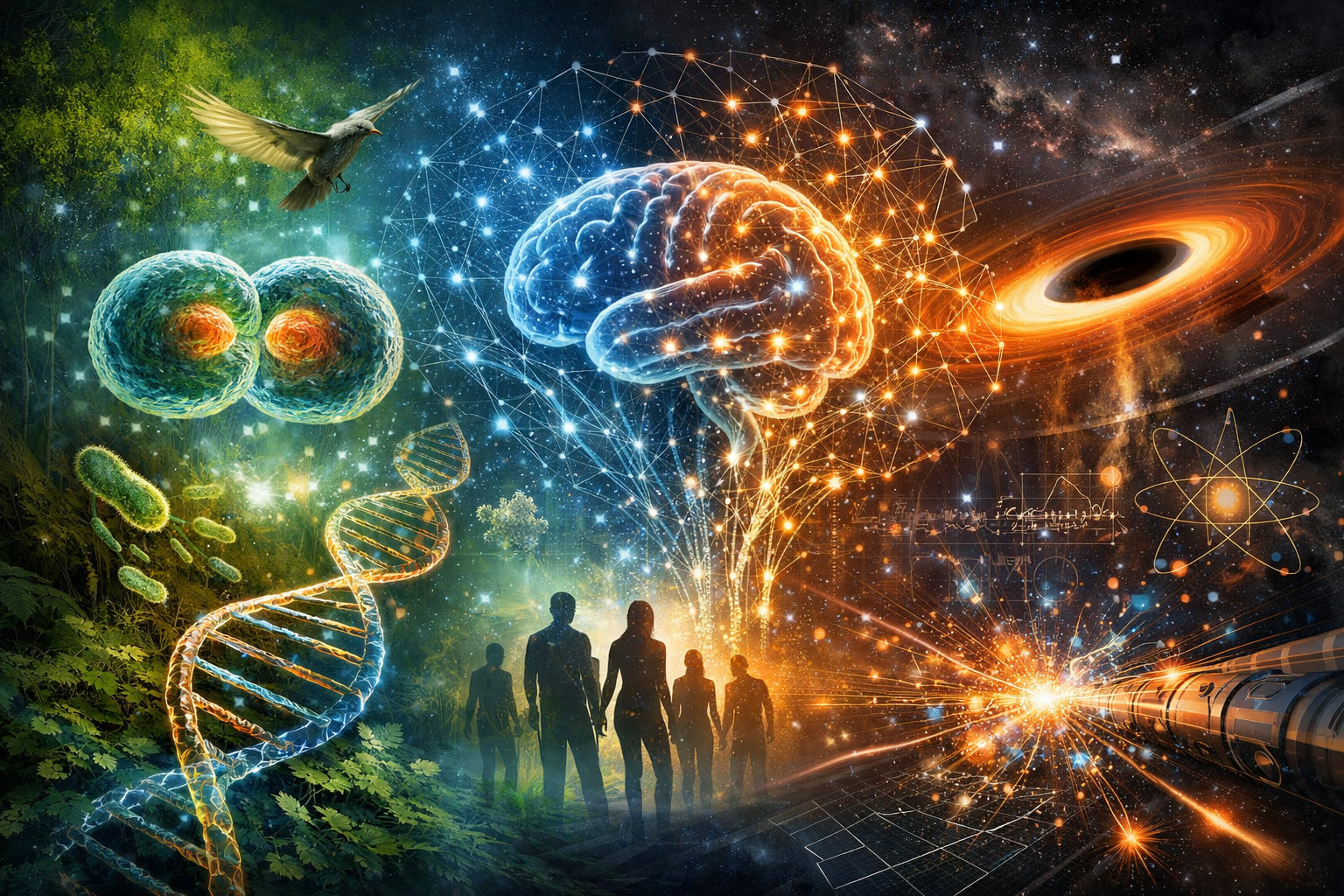
This piece is already sitting at the edge of a paradigm shift—and that’s where the interesting truths usually live
On an autumn morning in 2024, the world of physics blinked—hard. The Nobel Prize in Physics was announced, and it did not go to work on string theory, black holes, or exotic particles hiding in extra dimensions. Instead, it went to research that helped explain intelligence itself: artificial neural networks, learning systems, and the physics-inspired mathematics behind modern AI.
That moment felt small in the news cycle. But conceptually, it was seismic. It marked the quiet collapse of a centuries-old assumption: that physics is only about dead matter—rocks, atoms, forces—and that life, mind, and intelligence are secondary curiosities to be explained later, or by someone else.
Later has arrived. And physics can no longer ignore life.
————————
The Old Assumption: Matter Is Passive
For most of its history, physics has treated the universe as a grand clockwork. Atoms collide. Forces act. Energy flows downhill. Everything obeys timeless equations, indifferent to purpose, memory, or meaning.
This approach worked spectacularly well—for planets, projectiles, steam engines, and semiconductors. But it came with an unspoken assumption: matter itself is inert. Interesting things only happen when external forces push it around.
Living systems break this assumption.
A rock does not care about tomorrow. A bacterium does.
————————
What Makes Living Matter Different?
Living things do something profoundly strange from a physicist’s point of view: they use energy to resist equilibrium.
Left alone, matter tends to spread out, cool down, and fall apart. This is the Second Law of Thermodynamics (the rule behind why hot coffee cools and why buildings crumble). Life, however, swims upstream. Cells repair themselves. Bodies regulate temperature. Brains anticipate the future.
A single cell is not just a sack of chemicals. It is a self-maintaining process—a dynamic loop that senses, decides, corrects, and persists.
In plain English:
Dead matter reacts.
Living matter responds with intent-like behavior.
This is not poetry. It is measurable.
————————
Intelligence Is Not an Add-On — It Is a Physical Process
The Nobel-winning AI work made this impossible to ignore. Neural networks were inspired by brains, but their success revealed something deeper: learning itself can be described as a physical process.
Learning systems store information, minimize error, adapt to environments, and reorganize themselves over time. These are not metaphors. They are mathematically precise, energy-consuming, structure-building processes.
The same principles show up in biology:
- Brains minimize surprise (predictive processing).
- Cells regulate internal states (homeostasis).
- Immune systems learn patterns.
- Evolution stores information across generations.
Intelligence, whether biological or artificial, is not magic layered on top of physics. It is physics behaving differently when matter becomes organized, adaptive, and information-rich.
————————
Information Has Entered the Laws of Nature
Physics once revolved around mass, energy, space, and time. Today, another quantity refuses to stay in the sidelines: information.
Black hole research already hinted at this through the “information paradox.” Biology screams it even louder. DNA is not just matter; it is instruction. Neural connections are not just wiring; they are memory. Learning is not motion; it is information reshaping itself.
Living systems are best described as information engines—structures that use energy to acquire, preserve, and act on knowledge about the world.
This is why AI mattered to physics. It showed, experimentally and mathematically, that intelligence follows laws. Not mystical laws. Physical ones.
————————
Why This Changes Physics Itself
Physics has long searched for a “Theory of Everything.” But a theory that explains quarks and galaxies while ignoring life is no longer complete.
Living systems introduce new realities:
- History matters (a cell remembers stress; a brain remembers trauma).
- Purpose emerges (not conscious purpose, but goal-directed behavior).
- The future influences the present (prediction alters action).
These features were once dismissed as philosophical. Now they are modeled, tested, and built—sometimes in silicon.
The universe does not merely happen. In pockets of living matter, it learns.
————————
From Dead Matter to Dynamic Matter
The deepest shift is this:
Matter is not always passive.
Under the right conditions, matter becomes active, adaptive, and anticipatory. Life is not an exception to physics; it is a regime of physics—just as solid, liquid, and plasma are regimes.
The Nobel Prize did not say this out loud. But it whispered it clearly.
Physics can no longer pretend that intelligence is an afterthought. Life is not a side story in the universe. It is one of the universe’s most sophisticated behaviors.
And once you see that, the cosmos looks less like a machine—and more like a story that learned how to read itself.
Takeaway
————————
For centuries, physics advanced by reductionism: break the world into smaller and smaller pieces, understand the parts, and the whole will explain itself. This method gave us atoms, electrons, quarks—and astonishing power over nature. But living systems expose its limits. You can catalog every molecule in a cell and still miss what makes it alive. Life is not located in any single part; it emerges from interactions, feedback loops, and histories that unfold across time. This is the realm of complexity, where new behaviors appear that are not obvious from the ingredients alone—like consciousness emerging from neurons or intelligence arising from learning systems. Reductionism explains what things are made of; complexity explains what they do together. Modern physics is being forced to hold both truths at once. The universe is not only built from parts—it is shaped by patterns, processes, and relationships that only come into focus when life enters the frame.
————————
References
Anderson, P. W. (1972). More is different. Science, 177(4047), 393–396. https://doi.org/10.1126/science.177.4047.393
→ Classic paper establishing why reductionism alone fails to explain complex systems.
Ashby, W. R. (1956). An introduction to cybernetics. Chapman & Hall.
→ Foundational work on self-regulating, adaptive systems in both machines and organisms.
Barabási, A.-L. (2016). Network science. Cambridge University Press.
→ Explains how interactions, not parts, govern behavior in biological, social, and technological systems.
Bialek, W. (2012). Biophysics: Searching for principles. Princeton University Press.
→ Argues that life obeys physical laws, but at a higher organizational level than particles.
Friston, K. (2010). The free-energy principle: A unified brain theory? Nature Reviews Neuroscience, 11(2), 127–138. https://doi.org/10.1038/nrn2787
→ Shows how living systems actively minimize uncertainty, linking physics, biology, and intelligence.
Hopfield, J. J. (1982). Neural networks and physical systems with emergent collective computational abilities. Proceedings of the National Academy of Sciences, 79(8), 2554–2558. https://doi.org/10.1073/pnas.79.8.2554
→ A cornerstone linking statistical physics with learning and memory.
Mitchell, M. (2009). Complexity: A guided tour. Oxford University Press.
→ Accessible overview of emergence, adaptation, and why life resists simple reduction.
Nobel Prize in Physics. (2024). The Nobel Prize in Physics 2024. NobelPrize.org. https://www.nobelprize.org
→ Award recognizing foundational contributions to artificial neural networks and learning systems.
Schrödinger, E. (1944). What is life? Cambridge University Press.
→ Early recognition that living systems defy equilibrium physics through order and information.
Tononi, G. (2008). Consciousness as integrated information: A provisional manifesto. Biological Bulletin, 215(3), 216–242. https://doi.org/10.2307/25470707
→ Introduces information as a measurable physical property of living systems.
Walker, S. I., & Davies, P. C. W. (2013). The algorithmic origins of life. Journal of the Royal Society Interface, 10(79), 20120869. https://doi.org/10.1098/rsif.2012.0869
→ Frames life as a transition where information gains causal power over matter.
————————
Discover more from RETHINK! SEEK THE BRIGHT SIDE
Subscribe to get the latest posts sent to your email.