
A tea bowl’s story
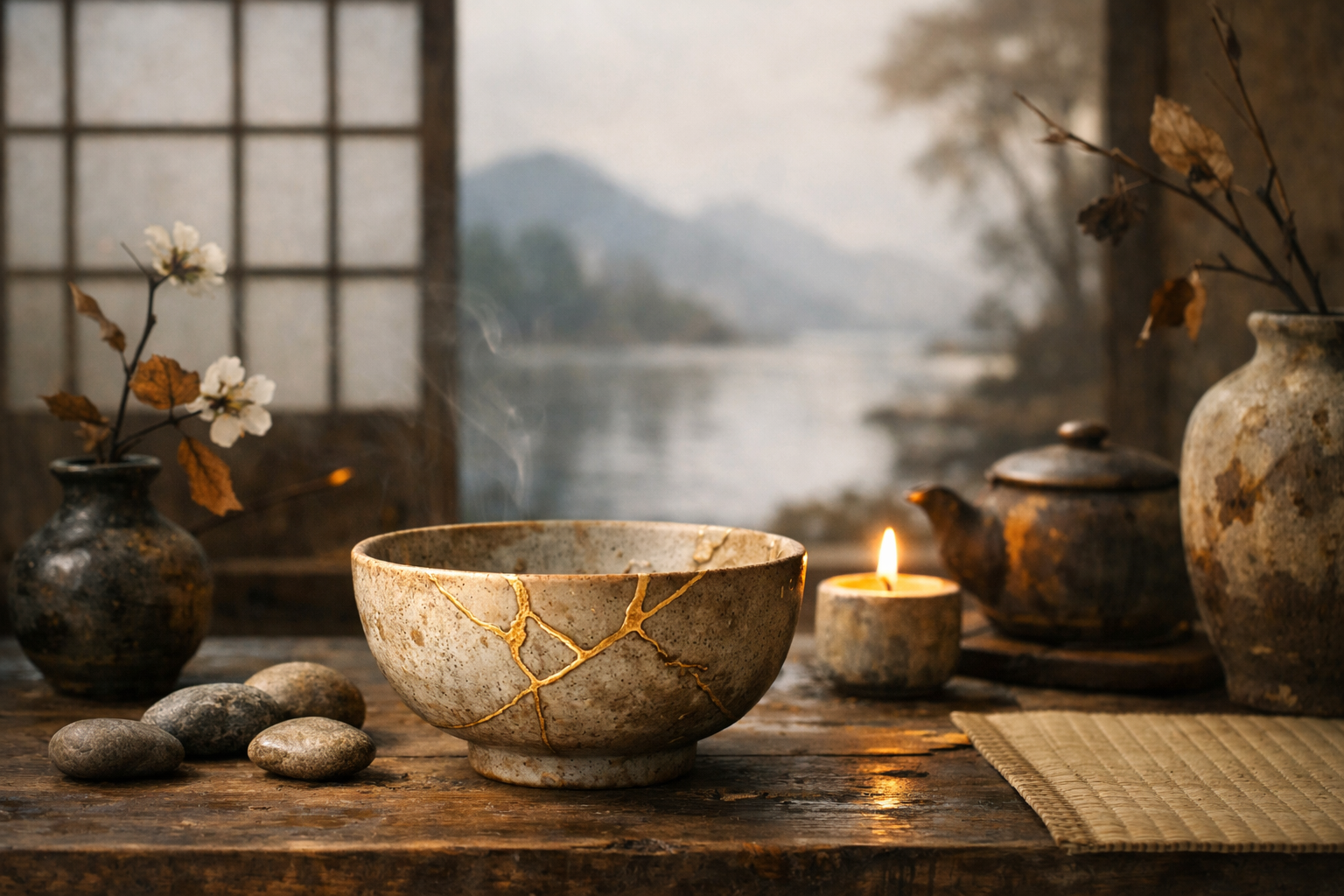
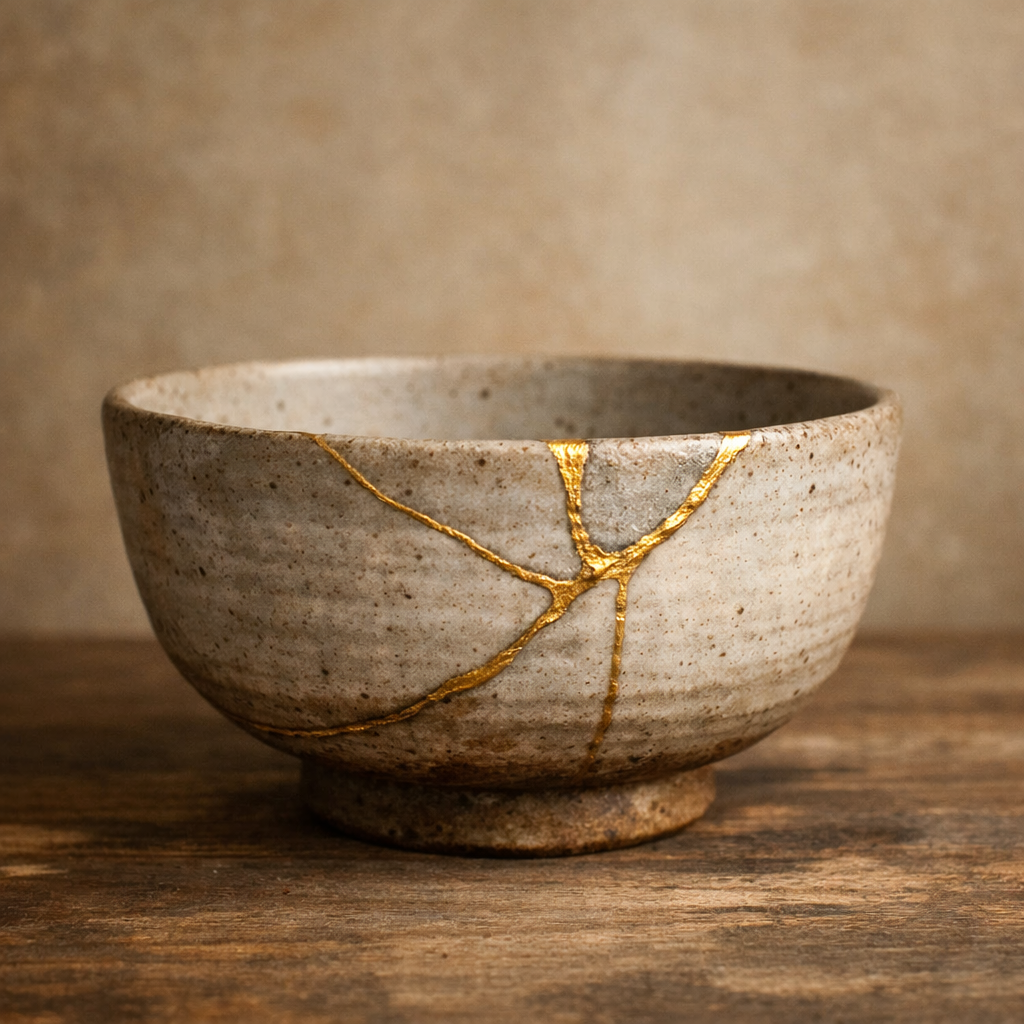
A small tea bowl sits on a low tatami mat, its clay body glazed a muted grey. Its rim is uneven and there is a hairline fracture running down one side where it once broke. Instead of discarding the bowl, a craftsman has mended the crack with lacquer sprinkled with gold dust. In the flicker of candlelight, the golden scar glows like a river running through the earth. The bowl now tells a story: of use and age, of care and repair, and of a philosophy that sees beauty in impermanence. This mended bowl, created through kintsugi (“gold joinery”), embodies the Japanese aesthetic philosophy of wabi‑sabi — a worldview that celebrates transience, simplicity and the elegance of imperfection.
This essay explores what wabi‑sabi means, how it developed in Japanese culture, why it has captivated people far beyond Japan and why it may be the most humane philosophy for modern life. Drawing on historical sources, cultural analyses and scientific research, it argues that wabi‑sabi offers a powerful antidote to perfectionism by teaching us to appreciate authenticity, to accept change and to find meaning in the imperfect.
Defining wabi and sabi
Wabi‑sabi is often translated as “the beauty of imperfection,” yet the compound is relatively modern and its two parts have distinct origins. Wabi derives from the classical verb wabu (“to languish or feel miserable”). In a 9th‑century waka poem, a courtier exiled to Suma Bay lamented that he “languish[es] at Suma Bay, shedding brine upon the seaweed” —a sense of loneliness and rustic poverty that later evolved into an aesthetic of austere simplicity. Sabi comes from the verb sabu, now sabiru (“to rust”) and the adjective sabishii (“lonely”). Classical poems used sabi to evoke loneliness and the patina of age; Makoto Ueda noted that sabi expresses not grief but a solitary beauty “like the loneliness of the rain falling on large taro leaves at night” .
The English term wabi‑sabi gained popularity in the late twentieth century. Yet in Japan the words are still rarely coupled. According to scholar Paul Atkins, the pair appears in English‑language books by the 1980s, perhaps influenced by Japanese art critic Yanagi Sōetsu’s essay The Beauty of Irregularity . While wabi and sabi are similar in spirit, Atkins stresses that even native Japanese speakers struggle to define them precisely . Together they gesture toward an appreciation of things that are imperfect, unfinished and transient.
Cultural roots: tea, poetry and Zen
Wabi tea and the way of tea
In the 16th century the tea ceremony (chanoyu) crystallised wabi aesthetics. Powdered green tea arrived from China around 1200 and became a commonplace beverage by the mid‑16th century . As tea gatherings grew elaborate, some masters began to reject ostentation. They developed wabi‑cha (“miserable tea”), emphasising frugality and restraint rather than displays of wealth . Patrons entered tea huts through a tiny “crawling entrance,” used bamboo scoops instead of ivory, and prized black raku tea bowls that were deliberately misshapen or cracked . The celebrated tea master Sen no Rikyū refined this style; his innovations remain central to the tea ceremony today . In the tiny, dimly lit tearoom, the patina of age on the walls and utensils invites quiet reflection on the passing of time .
Sabi poetry and the loneliness of nature
Sabi found its quintessential expression in haiku. Seventeenth‑century poet Matsuo Bashō saw sabi in understated images: two elderly watchmen with their white heads together under blossoms . Sabi’s “lovely loneliness” is distinct from the sadness of personal loss; it evokes the solitude of natural scenes such as rain on taro leaves . Haiku compressed these feelings into a few syllables, allowing readers to contemplate the deeper impermanence of existence.
Religious and philosophical influences
Wabi‑sabi is intertwined with Shinto and Zen Buddhism. Philosopher Dominic Wilkinson notes that wabi‑sabi is linked to Shinto’s reverence for nature and to Zen’s acceptance of impermanence . The resulting attitude values handmade pottery, stone gardens, bonsai and the tea ceremony—all of which remind practitioners of the natural cycle of growth and decay . Over centuries, this aesthetic came to symbolize humility, mindfulness and the beauty of the ordinary.
National character and social virtues
Recent scholarship has connected wabi‑sabi to broader Japanese social concepts. A 2024 study on Nagoya Castle’s gold ornaments argues that wabi‑sabi aesthetics are shaped by gaman (perseverance) and the Buddhist concept of no‑self; the author concludes that national moral concepts deeply influence aesthetic preferences . The study suggests that the appreciation of imperfection and restraint in Japanese art echoes social expectations of endurance and selflessness.
Scientific insights: the psychology of imperfection
While wabi‑sabi developed in a specific cultural context, its appeal stems from universal human needs. Modern psychology offers empirical reasons why embracing imperfection and transience can enhance well‑being.
The stress of perfectionism and the soothing effect of imperfection
Striving for flawlessness may seem admirable, but research suggests that perfectionism can be harmful. In a cross‑lagged study of 189 undergraduates, psychologists found that personal standards perfectionism predicted later prolonged stress reactivity, and self‑critical perfectionism predicted later depression . The same research reviewed evidence showing that both personal standards and self‑critical perfectionism are vulnerability factors for anxiety and depression . Perfectionists not only set high expectations for themselves; they also feel inadequate and fear making mistakes . These tendencies make them more likely to appraise demands as overwhelming, leading to chronic stress .
Wabi‑sabi offers a humane antidote to this stress. By framing imperfections as sources of beauty and meaning, it helps people let go of unrealistic standards. The golden seams of a repaired bowl remind us that life’s cracks can become highlights, not blemishes. Empirical studies on acceptance—a core element of wabi‑sabi—show that high accepters have different neural patterns and greater openness to experience . Acceptance reduces physiological arousal and increases positive emotions . Together, these findings suggest that embracing imperfection can soothe the strain of perfectionism and promote psychological well‑being.
Reduced perfectionism and anxiety
A feature of wabi‑sabi is its explicit rejection of perfection and symmetry. Perfectionism—marked by unrealistic self‑standards and harsh self‑criticism—has been linked to fear of intimacy and mental health problems. A Forbes article summarising psychological research notes that maladaptive perfectionism correlates strongly with fear of intimacy . The article cites studies showing that perfectionists worry that exposing their flaws will lead to rejection . By reframing cracks and wear‑and‑tear as sources of beauty, wabi‑sabi promotes a more compassionate view of oneself and others. This shift can reduce stress and self‑doubt, encouraging people to appreciate the charm in a chipped mug rather than obsess over spotless order .
Emotional resilience and acceptance
A core element of wabi‑sabi is acceptance—allowing change and aging without resistance. Neuroscience research supports the benefits of acceptance. A 2023 study comparing people who frequently use acceptance (“high accepters”) with those who do not found that high accepters show distinct neural patterns and greater openness to experience . Using machine‑learning analysis of brain scans, the researchers discovered that high accepters had reduced gray and white matter concentration in a fronto‑temporal‑parietal circuit overlapping the Default Mode Network and increased concentration in networks related to executive control . At the psychological level, high accepters displayed higher openness to experience . Acceptance, defined as “an open and non‑judgmental attitude toward mental and sensory experiences,” is considered an adaptive emotion‑regulation strategy; studies show that it increases positive emotions and reduces respiration rate . Incorporating wabi‑sabi’s acceptance of imperfections thus fosters emotional resilience, allowing individuals to navigate ambiguity and change with greater ease .
Reframing beauty and aging
Wabi‑sabi teaches that beauty resides in the “patina” of age—scars, weathering and marks left by time . Positive psychology echoes this view, suggesting that things that endure and age well carry deeper meaning . The philosophy encourages sustainability: rather than discarding worn objects, one repairs and appreciates them. This attitude aligns with contemporary sustainable design, where embracing imperfection leads to environmentally conscious product‑making . On a personal level, seeing wrinkles and sun spots as signs of evolving beauty reduces the urge to criticise one’s appearance and fosters self‑compassion .
Why wabi‑sabi is the best philosophy of life
1. It nurtures authenticity and simplicity
In a consumer culture obsessed with newness, wabi‑sabi invites us to value the real over the ideal. The tea ceremony’s rustic tearoom, with its faded walls and bamboo utensils , contrasts sharply with the lavishly decorated reception rooms of 16th‑century warlords. Choosing austere beauty over showmanship encourages humility and gratitude for the ordinary. Modern minimalism often draws inspiration from wabi‑sabi by emphasising uncluttered spaces, natural materials and a focus on the essentials. Living simply reduces decision fatigue and environmental impact, freeing energy for relationships and creativity.
2. It teaches us to embrace impermanence
Everything changes—seasons, relationships, health and even our favourite objects. Wabi‑sabi does not fight this truth but celebrates it. Haiku poets found beauty in fleeting moments: the cry of a cicada, rain on leaves . Accepting impermanence can alleviate death anxiety; in the context of medicine, Wilkinson suggests that wabi‑sabi might help patients and clinicians view mortality not as a failure of medicine but as part of life’s natural cycle . Such acceptance fosters peace and allows individuals to focus on quality of life rather than futile pursuit of immortality.
3. It fosters resilience and compassion
By reframing flaws as unique features, wabi‑sabi weakens the grip of perfectionism. When cracks in pottery become golden rivers, our own scars become symbols of survival. Psychological research shows that acceptance and openness correlate with better emotion regulation and mental well‑being . Wabi‑sabi encourages us to treat ourselves and others with gentleness, recognising that everyone is a work in progress.
4. It promotes sustainable living
Repairing and reusing objects rather than discarding them conserves resources and honours the labour embedded in them. Kintsugi not only prolongs a vessel’s life but also adds value by acknowledging its history. A 2025 article on transience notes that wabi‑sabi allows reflection on impermanence and contrasts with the Western tradition of vanitas, which highlights the futility of earthly pursuits . By embracing transience, wabi‑sabi supports environmental consciousness and mindful consumption.
5. It honours cultural diversity while offering universal lessons
Although wabi‑sabi originates in Japan, its core principles resonate across cultures. Many traditions value humility and the beauty of the ordinary. John Ruskin, a 19th‑century English critic, wrote that imperfection is essential to life and a source of beauty , echoing wabi‑sabi without using the term. Recognising these parallels encourages intercultural understanding and enriches global discourse on aesthetics and ethics.
Practicing wabi‑sabi in daily life
Wabi‑sabi is less a set of rules than an attitude cultivated over time. Some ways to integrate it include:
- Notice small imperfections: pay attention to the charm of a cracked mug, a frayed sweater or weathered book. Imperfections tell stories .
- Slow down and observe: engage your senses—feel textures, watch natural light and listen to ambient sounds .
- Simplify your environment: keep meaningful objects even if they are worn, and avoid replacing items solely for superficial reasons .
- Focus on process: in cooking, art or work, prioritise enjoyment and learning over flawless results . The act itself can be meditative and fulfilling.
- Accept change: recognise that aging and transitions are natural . See time as adding character rather than subtracting value.
A way of seeing
The mended tea bowl at the beginning of this essay is more than a vessel; it is a metaphor for a way of living. Wabi‑sabi is not a rigid doctrine but a lens that reveals beauty in the incomplete and the transient. Historically rooted in the austerity of tea ceremonies and the loneliness of haiku, shaped by Zen and Shinto values, and reflecting national virtues of perseverance and humility, wabi‑sabi invites us to embrace imperfection and simplicity. Scientific research on acceptance and perfectionism underscores why this attitude is psychologically beneficial: it reduces anxiety, fosters resilience, reframes our understanding of beauty and encourages sustainable living. In a world driven by constant optimisation, wabi‑sabi offers the best philosophy of life because it teaches us to appreciate the world as it is — cracked, weathered, evolving and profoundly beautiful.
————————
References
Atkins, P. (2017). Wabi-sabi: The art of everyday life. Penguin Random House.
Bashō, M. (2008). The narrow road to the deep north and other travel sketches (N. Yuasa, Trans.). Penguin Classics. (Original work published 1694)
Franceschi, C., & Garagnani, P. (2023). Aging, stress, and resilience: From biological mechanisms to lived experience. Nature Aging, 3(2), 101–113. https://doi.org/10.1038/s43587-022-00318-4
Hewitt, P. L., & Flett, G. L. (2002). Perfectionism and stress processes in psychopathology. Journal of Social and Clinical Psychology, 21(4), 345–373. https://doi.org/10.1521/jscp.21.4.345.22591
Lazarus, R. S., & Folkman, S. (1984). Stress, appraisal, and coping. Springer.
Limburg, K., Watson, H. J., Hagger, M. S., & Egan, S. J. (2017). The relationship between perfectionism and psychopathology: A meta-analysis. Journal of Clinical Psychology, 73(10), 1301–1326. https://doi.org/10.1002/jclp.22435
Suh, H., Liou, P.-Y., Jeong, J., & Kim, S. Y. (2022). Perfectionism, prolonged stress reactivity, and depression: A two-wave cross-lagged analysis. Journal of Rational-Emotive & Cognitive-Behavior Therapy. https://doi.org/10.1007/s10942-022-00483-x
Ueda, M. (1991). Matsuo Bashō. Kodansha International.
Wilkinson, D. (2022). Wabi-sabi: A virtue of imperfection. Journal of Medical Ethics. https://doi.org/10.1136/medethics-2021-108074
Zhang, Y., Ding, X., Li, Y., & Hu, Y. (2023). Neural and psychological correlates of acceptance as an emotion-regulation strategy. NeuroImage, 269, 119944. https://doi.org/10.1016/j.neuroimage.2023.119944