
The virtues we’ll need when we no longer need a job
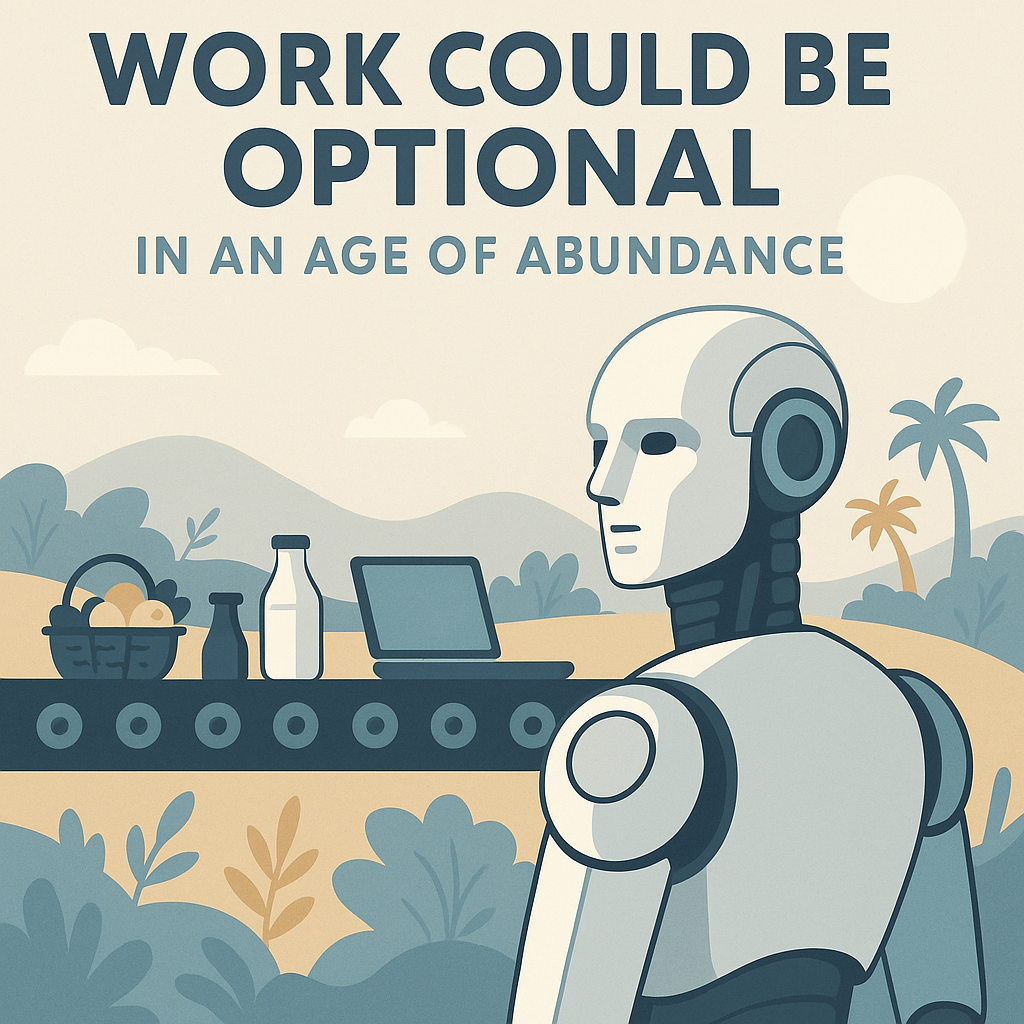
By the mid-2040s, if Elon Musk is even half right, billions of people could wake up in a world where human labor is no longer economically necessary in the old sense. Work, he suggests, might be “optional,” money “irrelevant,” and jobs more like hobbies than survival tools.
That sounds like utopia if you’re exhausted, dystopia if your sense of self is built on being needed, and structurally explosive if your entire economic system runs on scarcity and wages. To make sense of this, we have to braid three strands together:
- Musk’s specific prediction that work could be optional within 10–20 years.
- The logic and limits of a post-scarcity, AI-rich economy.
- The fragile human virtues that make life meaningful when “having a job” stops being the main story.
⠀
What emerges is not a simple yes/no on Musk’s forecast, but something stranger: a future where material work might indeed be optional for many, while moral and political work becomes unavoidable.
————————
1. Musk’s timeline: bold, partly plausible, deeply incomplete
Musk keeps returning to a similar claim: with advanced AI and humanoid robots, “you won’t have to work at all” in about 10–20 years, and work will be “optional” like choosing to play a sport or video game. He ties this to a vision of “universal high income” created by extreme automation and ultra-cheap goods and services.
A few things are worth disentangling here.
a) Technological plausibility
On the technology side, the prediction is no longer science fiction.
- Generative AI and automation are already projected to automate a large share of tasks: McKinsey estimates that by 2030, activities accounting for up to 30% of hours worked in the US could be automated, a trend that could grow through 2040 as adoption accelerates.
- Goldman Sachs has estimated that generative AI could expose the equivalent of 300 million full-time jobs to automation globally, mostly in richer economies.
So “AI and robots can do a huge fraction of work-like tasks by 2040” is not wild. That part is mainstream economics.
b) Economic and institutional lag
But moving from “AI could do the work” to “humans don’t have to work” requires at least three extra steps that Musk tends to hand-wave:
- Ownership and distribution: Who owns the automated infrastructure? If a small number of firms own the “machine that makes everything,” you can easily get massive output with mass poverty. Optional work only arrives if the gains are broadly redistributed: via UBI, social dividends, public ownership of key platforms, or similar mechanisms.
- Adoption and diffusion: Even if the tech exists, rollout is uneven. Some sectors and countries adopt quickly; others lag decades behind. History shows long tails: it took electricity and the internal combustion engine many decades to fully transform work.
- Political stability: Displacing a large share of jobs in 10–20 years without robust safety nets tends to produce populism, unrest, and backlash, not calm leisure.
⠀
Economic studies already reflect this caution. McKinsey, Goldman Sachs, and others see large productivity gains and big task displacement, but none conclude that work broadly becomes optional by 2045. They project higher productivity, shifting occupations, and transitional unemployment, not the death of work as such.
Musk is basically taking the upper bound of technological optimism and stapling onto it the upper bound of political competence. Historically, that combo is rare.
————————
2. Post-scarcity: capitalism’s awkward midlife crisis
To understand why “optional work” is so destabilizing, you have to look at what capitalism actually does.
Capitalism is very good at rationing scarce things via prices, wages, and profit. It is much worse at managing abundance. Under capitalism, you get income by selling scarce stuff: your labor, your skills, your land, your patents. If AI and robots can generate most goods and services at near-zero marginal cost, the core loop breaks:
- Firms can produce plenty with little human labor.
- Less labor demand means lower wages or fewer jobs.
- Lower wages mean people can’t buy all the wonderful cheap output.
- The system produces abundance that large groups can’t afford, creating a demand crisis.
Economists and futurists usually call the target state “post-scarcity,” not absolute abundance. In a post-scarcity world, basic needs and many wants can be met for everyone with minimal labor, while some things remain stubbornly scarce:
- Prime land, clean air, attention, status, rare materials, intimate human care.
So we get a weird hybrid:
- Abundance at the edges: food, manufactured goods, digital services, many forms of knowledge.
- Strategic scarcity at the core: control over the AI/robotic infrastructure, access to key raw materials and energy, governance, legitimacy.
In that setting, capitalism does what it always does: chases whatever remains scarce and profitable. That means even if solar, food, and AI assistants are almost free, the system will intensify competition over land, brand, attention, elite education, unique experiences, and political influence.
Which is why many thinkers argue that if automation keeps advancing, you either:
- Strongly enhance redistribution (UBI, negative income tax, social dividends, public stake in AI platforms),
- Expand public/commons ownership of core automated infrastructure,
- Or end up with a “post-scarcity core inside a hyper-scarcity shell”: basic material needs cheap, but access to power, meaning, and status brutally unequal.
So yes, work could become materially optional for many, but only if we rewire the rules around property, taxation, and social entitlements. That’s not a technological inevitability; it’s a political street fight.
————————
3. History’s pattern: abundance in one domain, crisis in another
We’ve done “sudden abundance” before, several times. And each time, the story is more complicated than “and then everyone chilled on the beach forever.”
a) Cheap energy
The shift from wood to coal to oil to electricity turned energy from a hard constraint into something seemingly abundant. This enabled industrialization, mass production, and urbanization.
But:
- Abundant energy led to more total consumption (Jevons-style effects), not less.
- New scarcities emerged: clean air, stable climate, geopolitical control over oil fields.
- Power concentrated around those who controlled the new infrastructure: mining firms, utilities, petro-states.
b) Cheap food
With the Green Revolution, high-yield crops, fertilizers, and irrigation turned famine from chronic to episodic in many regions. Calories became more abundant.
But again:
- New dependencies on fertilizers, fossil-fuel-based inputs, and fragile monocultures.
- Environmental scarcities: soil health, water, biodiversity.
- Persistent inequality between regions that could adopt the tech and those that couldn’t.
c) Cheap information
The printing press and then digital networks drove the marginal cost of copying information toward zero. Today, for many purposes, knowledge is “post-scarcity.”
But the bottleneck moved:
- From the scarcity of books to the scarcity of attention and interpretation.
- The new chokepoints are platforms, algorithms, and institutions that can curate, filter, and frame.
The meta-pattern: abundance in one layer creates pressure and scarcity in another. Coal abundance created a climate problem. Food abundance created an ecological problem. Information abundance created an attention and epistemic-trust problem.
So if AI creates an abundance of labor-like capability, we should immediately ask: where does scarcity migrate? Likely candidates are:
- Stable climate and safe ecological sinks for all that activity.
- Critical materials for data centers, batteries, and robots.
- Legitimacy: who has the right to steer the machine?
- Human capacities that machines can’t easily reproduce: deep trust, embodied care, thick wisdom.
Musk focuses mostly on abundance at the edge. The serious work is figuring out how to handle these new scarcities at the core.
————————
4. If work is optional, what becomes scarce is
meaning
Strip away the GDP talk and “universal high income” hype, and Musk’s forecast points to a more intimate question:
If you don’t have to work, why would you do anything at all?
Psychology and philosophy have been circling that question for a long time, and the answers are not reassuring for a lazy utopia.
Eudaimonic well-being research (the strand that looks at flourishing, not just pleasure) consistently finds that people need:
- Autonomy (feeling that you author your own life),
- Competence and mastery,
- Deep relationships and belonging,
- Purpose and contribution beyond the self.
Work, in its better forms, has been one of the main social containers for these needs. It gave us:
- A structured narrative (“I’m a teacher / builder / healer / craftsperson”).
- A field of skill and mastery.
- A recognized way to contribute to others’ lives.
Optional work threatens to hollow out those containers unless we consciously rebuild them. The risk is not idle leisure, but:
- Autonomy under siege: If AI systems are constantly recommending, nudging, and pre-choosing for us, we can easily lose the felt sense that our projects are really ours.
- Attention shredded: AI-optimized feeds compete to harvest our focus, undermining the capacity for deep work, long-term projects, or sustained contemplation.
- Courage and honesty atrophied: Frictionless comfort and hyper-personalized realities make it easier to avoid hard truths, conflict, and growth.
- Practical wisdom outsourced: When AI systems suggest careers, partners, investments, and health choices, we may stop learning how to deliberate well ourselves.
- Compassion and solidarity thinned out: Synthetic companions and echo chambers can replace messy, demanding human relationships.
So the paradox is sharp:
- Materially, AI can make instrumental work less necessary.
- Existentially, we may need more deliberate work than ever to stay sane and decent.
Optional employment risks becoming compulsory nihilism unless we cultivate certain virtues as if they were muscle groups we know will be underused by the environment.
————————
5. Reframing “work” for an AI-rich, abundant world
To make Musk’s “optional work” vision compatible with human flourishing, we need to untangle and rebuild the meaning of work itself. Three big shifts help.
a) From employment to contribution
In a wage-labor economy, “work” is mostly “paid activity that keeps you alive.” In a post-scarcity-leaning system, paid survival is no longer the main bottleneck; meaningful contribution is.
That contribution could take many forms:
- Mentoring and teaching in communities where AI is abundant but guidance is scarce.
- Care work across generations: not just childcare but eldercare, palliative care, and neighborhood-scale mutual aid.
- Stewardship of ecosystems and local commons.
- Arts, science, and philosophy pursued for their own sake, not because they pay rent.
A post-scarcity society that works psychologically will treat these activities not as “nice extras” but as core civic vocations, with status and institutional support.
b) From scarcity wages to shared dividends
Optional work requires that people can meet their needs without selling their labor power under duress. That implies some combination of:
- Universal basic income or social dividends funded by taxes on automated capital, data, and natural resource rents.
- Public, cooperative, or commons ownership stakes in AI and robotic infrastructure, distributing returns not just to shareholders but to citizens.
Technologically, an AI-rich economy looks like a huge “automaton” that turns energy, data, and materials into goods and services. The political question is:
Who owns the automaton, and how do its outputs flow back to human lives?
If the answer is “a small oligopoly, via financial assets,” then work won’t be optional for most people; it will just be harder to find and worse paid.
c) From identity as job title to identity as life project
One of the hidden scarcities in a post-work world is narrative. For centuries we have used jobs as shorthand for who we are: “doctor,” “lawyer,” “farmer,” “engineer.”
In a world where many of those roles are largely automated or radically transformed, new identity scaffolds are needed:
- “I’m someone who stewards this land/river/neighborhood.”
- “I’m someone who builds and maintains open-source tools for public benefit.”
- “I’m a mentor in this learning community.”
- “I’m part of a group exploring deep questions about mind, meaning, and cosmos.”
Those sound airy only because our current institutions don’t richly support them. In a healthy post-scarcity order, they would be as concrete as “I’m an electrician” is today.
————————
6. The virtues we’ll need when we no longer need a job
If we take Musk’s timeline as a provocation rather than a prophecy, it becomes a design brief:
Assume that by 2045 a large share of economically necessary labor can be done by AI and robots. What human capacities should we be training now so that this doesn’t collapse into chaos or numbness?
From both philosophy and psychology, a short list keeps recurring:
- Autonomy and self-authorship: the ability to notice when one is being nudged and to choose in line with considered values.
- Attentional integrity: the capacity to direct and sustain focus on meaningful projects in a distraction-rich environment.
- Honesty, courage, and authenticity: staying in contact with reality and with one’s own experience even when it hurts.
- Practical wisdom (phronesis): the judgment to balance competing goods and long-term consequences, not just chase short-term reward.
- Compassion and solidarity: seeing others as more than avatars, and acting from a sense of shared fate.
- Purpose and generativity: caring about long projects and future generations.
Protecting and cultivating these in an AI-saturated, abundance-tilted world means:
- Designing AI tools and platforms that respect agency, explain their goals, and allow genuine opt-out.
- Structuring education around deliberation, ethics, systems thinking, and cooperative skills, not just testable content.
- Investing in local, embodied communities where people do things together slowly: making, repairing, learning, caring.
- Treating time and attention as civic resources, not just ad inventory.
Optional work does not mean optional character. If anything, the less external necessity we have, the more internal architecture we need.
————————
7. So: will work really be optional by 2045?
If we mean “no one on Earth will need to work for their basic needs, and most jobs are hobbies”, Musk’s 10–20 year window is very optimistic.
Given what we know now:
- Technological capability to automate a huge fraction of tasks by 2045: plausible.
- Global political coordination, redistribution, and institutional reform on that timeline: uncertain at best.
- Human cultural adaptation to psychologically healthy “post-labor” identities: entirely up to us.
A more realistic picture is patchy and uneven:
- Some countries or cities will approach something like “optional work” for large segments of their population, supported by automation, social insurance, and strong institutions.
- Other regions will experience AI as a productivity boost for elites and a squeeze for workers, with long periods of instability.
- Within every society, new scarcities—attention, trust, meaning, ecological stability—will become the main axis of conflict.
Musk’s forecast is useful not as a bet, but as a diagnostic tool. If we take seriously the idea that material scarcity could be dramatically reduced in our lifetimes, then the central questions of economics and politics shift:
- From “How do we grow GDP?” to “How do we share and govern an automaton that can meet basic needs?”
- From “How do we create more jobs?” to “How do we ensure everyone can contribute meaningfully, with or without a job?”
- From “How do we compete in the labor market?” to “How do we protect the virtues that make a free, sane, decent life possible when compulsion weakens?”
Work may become optional in the narrow sense of survival. But the deeper work—of building institutions that can handle abundance, and of becoming the kind of humans who can live well when the world no longer demands their labor—will not be automated away. That work is not a bug to escape; it is the next chapter of what it means to be human in an age of brilliant machines.
References
Casey Handmer. (2020, November 14). Post-capitalism and post-scarcity. https://caseyhandmer.wordpress.com/2020/11/14/post-capitalism-and-post-scarcity/
Huta, V., & Ryan, R. M. (2010). Pursuing pleasure or virtue? The differential and overlapping well-being benefits of hedonic and eudaimonic motives. Journal of Happiness Studies, 11(6), 735–762. https://selfdeterminationtheory.org/SDT/documents/2010_HutaRyan_JOHS.pdf
Indian Express Tech Desk. (2025). Elon Musk predicts work will become optional due to AI in talk with Nikhil Kamath. Indian Express. https://indianexpress.com/article/technology/tech-news-technology/elon-musk-predicts-work-will-become-optional-due-to-ai-in-talk-with-nikhil-kamath-10394817/
Kelly, J. (2025, April 25). The jobs that will fall first as AI takes over the workplace. Forbes. https://www.forbes.com/sites/jackkelly/2025/04/25/the-jobs-that-will-fall-first-as-ai-takes-over-the-workplace/
Livingstone, C. (2023). Living in a post-scarcity society: How automation, AI & basic income could reshape the future. LinkedIn. https://www.linkedin.com/pulse/living-post-scarcity-society-how-automation-ai-basic-income-daniel
McLennan, A. K. (2023). The inflammation age: Acute inflammation helps heal the body, but chronic inflammation signals a paradigm shift. Aeon.
McKinsey Global Institute. (2023). Generative AI and the future of work: Impacts on jobs and productivity. McKinsey & Company.
Observatory of Educational Innovation. (2024). Human flourishing in the age of artificial intelligence. https://observatory.tec.mx/edu-news/human-flourishing-in-the-age-of-artificial-intelligence/
People Magazine Staff. (2025). Elon Musk suggests AI will make work optional and money irrelevant. People. https://people.com/elon-musk-suggests-ai-will-make-work-optional-and-money-irrelevant-11853603
PMCID: PMC3865980. (2013). Psychological well-being and its components. National Institutes of Health. https://pmc.ncbi.nlm.nih.gov/articles/PMC3865980/
PMCID: PMC5647812. (2017). Attention, emotion, and digital environments. National Institutes of Health. https://pmc.ncbi.nlm.nih.gov/articles/PMC5647812/
PMCID: PMC10769108. (2023). Eudaimonia and mental health. National Institutes of Health. https://pmc.ncbi.nlm.nih.gov/articles/PMC10769108/
PMCID: PMC10911315. (2024). AI, social connection, and mental health. National Institutes of Health. https://pmc.ncbi.nlm.nih.gov/articles/PMC10911315/
ScienceDirect. (2013). Historical transitions to abundance and Jevons dynamics. https://www.sciencedirect.com/science/article/abs/pii/S0048733313001522
ScienceDirect. (2024). Patterns of scarcity relocation in resource transitions. https://www.sciencedirect.com/science/article/pii/S0305750X25003018
TechRadar Staff. (2025). Elon Musk on the future of jobs and AI: My prediction is that work will be optional. TechRadar.
Teslarati Staff. (2025). Elon Musk predicts AI & robotics will make work optional within 20 years. Teslarati.
The AI Praxis. (2024). The automaton economy: The inevitable obsolescence of capitalism. https://www.theaipraxis.com/blog/the-automaton-economy-part-1-the-inevitable-obsolescence-of-capitalism
Times of India. (2025). Working will be optional in less than 20 years, says Elon Musk: 5 career trends to prepare for.
U.S. Department of Energy. (2019). Energy transitions: Lessons from history. OSTI. https://www.osti.gov/servlets/purl/1526033
Vox Editors. (2024). Economists debate the meaning of post-scarcity. Vox. https://www.vox.com/the-highlight/24065976/economists-post-scarcity-abundance-industrial-revolution-socialism-capitalism
Welcing, A. (2024). Post-scarcity collapse 2058. https://www.alexwelcing.com/articles/post-scarcity-collapse-2058
Wikipedia Contributors. (2025). Post-scarcity. Wikipedia. https://en.wikipedia.org/wiki/Post-scarcity
Yahoo Finance. (2025). Elon Musk says 10–20 years until work becomes optional. https://finance.yahoo.com/news/elon-musk-says-10-20-183701720.html
YouTube. (2024). Energy transitions and AI futures [Video]. YouTube. https://www.youtube.com/watch?v=hD3oDnropbs
YouTube. (2025). Elon Musk interview on optional work and AI [Video]. https://www.youtube.com/watch?v=MDLPXeb4pWY