
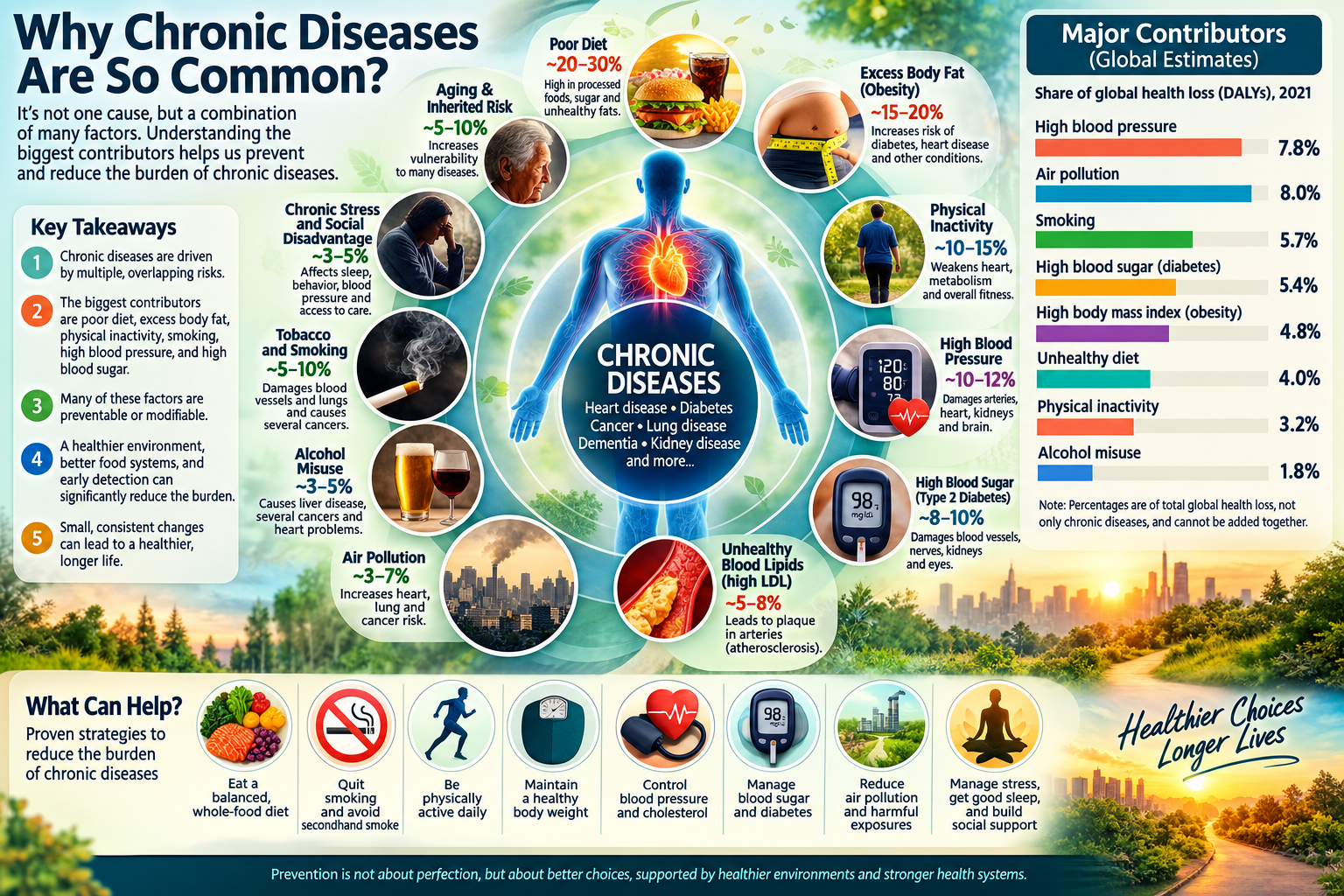
Heart disease, stroke, cancer, type 2 diabetes, chronic kidney disease, chronic lung disease, and dementia now account for much of the illness, disability, and premature death experienced around the world. Yet it would be misleading to say that one thing—sugar, obesity, stress, pollution, genetics, or lack of exercise—caused this epidemic.
Chronic disease usually develops through many influences acting together over years or decades.
A useful way to understand the problem is to think of it in four layers:
the environment we live in → the behaviors it encourages → changes inside the body → disease.
This distinction matters because otherwise we may mistake the final biological abnormality for the original cause.
The Four Layers of Chronic Disease
Layer 1: The world around us
At the broadest level are the conditions in which people are born, grow, work, eat, travel, and age.
These include food availability and marketing, tobacco and alcohol exposure, air pollution, education, income, working conditions, neighborhood design, healthcare access, and social inequality.
These are often called social, environmental, and commercial determinants of health.
They matter because human behavior does not occur in isolation. If inexpensive ultra-processed foods are everywhere, walking is unsafe, cigarettes are readily available, sleep is disrupted by shift work, and preventive healthcare is difficult to obtain, chronic disease becomes more likely across an entire population.
Layer 2: What we repeatedly do
The second layer consists of behavioral exposures.
The most important include:
- smoking and other tobacco exposure;
- poor-quality diet and excessive calorie intake;
- inadequate physical activity;
- harmful alcohol consumption;
- chronically insufficient sleep.
These exposures accumulate. A cigarette does not normally cause lung cancer tomorrow, and one unhealthy meal does not cause diabetes next week. The problem is repeated exposure multiplied by time.
Layer 3: What happens inside the body
Years of unfavorable exposures can produce measurable biological changes:
high blood pressure, high LDL cholesterol, insulin resistance, high blood glucose, excess visceral body fat, vascular injury, chronic inflammation, and loss of cardiovascular and muscular fitness.
These are particularly important because they are the bridge between lifestyle/environment and actual disease.
For example:
Unhealthy food environment → poor diet → excess visceral fat and insulin resistance → high blood glucose → type 2 diabetes → kidney, nerve, eye and cardiovascular complications.
Another pathway might be:
Smoking → vascular injury and inflammation → atherosclerosis → heart attack or stroke.
This is why simply saying that “obesity causes chronic disease” or “diet causes chronic disease” misses much of the biological chain.
How Much Does Each Factor Contribute?
There is no scientifically defensible universal percentage such as:
Diet 30% + inactivity 20% + pollution 10% + genetics 20% = 80%.
Human biology does not work that way.
Risk factors overlap and interact. Obesity can raise blood pressure and blood glucose. Physical inactivity can contribute to obesity and insulin resistance. Diet influences cholesterol, blood pressure, glucose and body weight simultaneously.
Therefore, attributable percentages frequently cannot be added together.
Nevertheless, the Global Burden of Disease studies give us a useful sense of scale by estimating how much global death and disability is associated with particular risks.
Among the largest measured global contributors are:
| Major risk | Approximate share of global health loss (DALYs), 2021 |
| Air pollution | ~8.0% |
| High systolic blood pressure | ~7.8% |
| Tobacco smoking | ~5.7% |
| High fasting blood glucose | ~5.4% |
| High body-mass index | ~4.8% |
| Dietary risks | ~4% |
| Low physical activity | ~3% |
| Harmful alcohol exposure | ~2% |
These numbers should be interpreted carefully. They refer broadly to global health loss rather than simply “percentage of chronic disease caused,” and estimates change depending upon population, methodology, disease, age, and year.
The more important message is the ranking and interaction of the risks, rather than treating the numbers as exact pieces of a pie.
The Major Drivers in Plain English
1. High Blood Pressure
High blood pressure is extraordinarily important because it can silently damage the body for decades.
The heart must pump against greater resistance, while arteries in the brain, heart, kidneys, and elsewhere experience continuing mechanical stress.
Over time this contributes to:
stroke, heart attack, heart failure, kidney disease, vascular dementia, and premature death.
The disturbing feature of hypertension is that a person may feel completely normal while substantial damage is occurring.
That makes blood-pressure detection and treatment one of the most powerful opportunities for chronic-disease prevention.
2. Poor Diet
Diet is not simply a question of body weight.
A poor dietary pattern can influence blood pressure, LDL cholesterol, blood glucose, liver fat, inflammation, gut physiology, and calorie balance.
Population risk tends to rise when diets contain too much sodium, refined carbohydrate, processed meat and energy-dense ultra-processed food while providing too little fruit, vegetables, legumes, whole grains, nuts, seeds, fiber and other minimally processed foods.
The important unit is therefore not a single “bad food.”
It is the dietary pattern maintained over years.
3. Excess Body Fat—Especially Visceral Fat
Body weight alone does not tell the whole story.
Fat stored deep around abdominal organs—visceral fat—is metabolically active. Excess visceral fat is strongly associated with insulin resistance, type 2 diabetes, fatty liver disease, cardiovascular disease and several cancers.
At the population level, increasing obesity has therefore become an important amplifier of chronic disease.
But obesity should not be reduced to personal discipline. Genetics, food environment, medications, sleep, socioeconomic conditions, endocrine biology and physical activity all influence body weight.
4. High Blood Sugar and Insulin Resistance
Insulin resistance can develop for years before diabetes is diagnosed.
Eventually the body’s ability to keep glucose within a healthy range may fail.
Persistently elevated glucose can injure blood vessels and nerves throughout the body, contributing to:
heart disease, stroke, kidney failure, neuropathy, retinal damage and other complications.
This is one reason type 2 diabetes should not be viewed merely as a “sugar disease.” It is a systemic metabolic disorder affecting multiple organs.
5. Smoking
Few preventable exposures have caused as much disease as tobacco.
Cigarette smoke contains numerous toxic and carcinogenic substances and contributes to:
lung cancer, COPD, heart disease, stroke and many other cancers and vascular disorders.
Smoking also illustrates an important principle of public health: chronic disease prevention is not achieved only by asking individuals to behave differently.
Taxes, smoke-free environments, advertising restrictions, cessation treatment and public education have all played major roles in reducing tobacco-related disease.
6. Physical Inactivity
The human body evolved to move.
Muscle contraction helps regulate glucose metabolism, insulin sensitivity, vascular function, mitochondrial activity, balance, bone strength and cardiovascular fitness.
Regular movement therefore influences far more than calorie expenditure.
The opposite is also true: prolonged inactivity gradually reduces physiological reserve.
This becomes particularly important with aging, when loss of muscle and cardiorespiratory fitness can accelerate frailty and loss of independence.
7. Air Pollution
Air pollution deserves more attention than it commonly receives.
Fine particulate matter can penetrate deep into the lungs and influence inflammation and vascular biology throughout the body.
Long-term exposure is associated not only with respiratory illness and lung cancer but also with cardiovascular disease and stroke.
Unlike diet or exercise, however, pollution cannot be solved principally through individual willpower.
It requires environmental and public-policy solutions.
8. Alcohol
The relationship between alcohol and health has often been oversimplified.
Higher alcohol exposure clearly increases the risk of liver disease, injuries, hypertension and several cancers.
From a population-health perspective, alcohol therefore contributes meaningfully to preventable disease, even though its total burden is smaller than that of several leading metabolic and tobacco-related risks.
9. Sleep, Stress and Social Conditions
Sleep and chronic psychological stress deserve attention, but their population effects are harder to assign a simple percentage.
Insufficient sleep can adversely affect appetite regulation, glucose metabolism, blood pressure and mental health.
Persistent stress can influence autonomic and hormonal systems and can indirectly change eating, smoking, alcohol consumption, exercise and sleep.
But an important distinction is needed:
stress should not be blamed for every chronic disease.
Its effects depend greatly on duration, severity, coping resources and the individual’s biological and social circumstances.
What About Genetics?
Genes matter enormously for individuals but explain less of the modern epidemic than is sometimes assumed.
Human genes did not radically change during the few generations in which obesity and type 2 diabetes became widespread.
What changed much faster was the environment interacting with those genes.
A useful formulation is:
Genes load the biological possibilities; environment and behavior strongly influence which possibilities become reality.
Some people inherit very high susceptibility to particular diseases. Others remain relatively protected despite similar exposures.
This explains why two people with apparently similar lifestyles can have very different health outcomes.
Aging: The Largest Background Risk
Aging deserves its own category.
Age is one of the strongest risk factors for cancer, cardiovascular disease, dementia, diabetes, kidney disease and many other chronic disorders.
As societies become older, chronic disease prevalence naturally increases.
But aging should not be confused with inevitability.
A 75-year-old with well-controlled blood pressure, healthy cholesterol, good glucose regulation, preserved muscle, physical activity and no smoking history can have a very different risk profile from another person of the same chronological age.
Modern medicine therefore increasingly distinguishes chronological age from the biological processes that determine resilience and vulnerability.
The Central Idea: Chronic Disease Is a Network
Perhaps the most important lesson is that chronic diseases should not be imagined as separate boxes.
They form an interconnected network.
Consider this sequence:
Poor food environment
↓
Poor dietary pattern
↓
Visceral fat accumulation
↓
Insulin resistance
↓
High blood glucose
↓
Vascular damage
↓
Diabetes + heart disease + kidney disease + stroke
Now add smoking, inadequate exercise, high blood pressure, poor sleep, air pollution, aging and inherited susceptibility.
The risks begin interacting with one another.
That is much closer to how chronic disease actually develops.
Where Should Prevention Focus?
The encouraging consequence of this network model is that improving one factor can influence several diseases simultaneously.
Stopping smoking lowers cardiovascular, pulmonary and cancer risk.
Lowering blood pressure protects the heart, brain and kidneys.
Improving diet can affect blood pressure, cholesterol, glucose and body composition.
Physical activity improves cardiovascular fitness, insulin sensitivity, muscle strength, mobility and mental health.
Controlling LDL cholesterol reduces atherosclerotic cardiovascular risk.
Detecting diabetes early can prevent or delay damage to kidneys, nerves, eyes and blood vessels.
And population policies that improve food quality, reduce tobacco exposure, control pollution and expand access to preventive healthcare can influence millions of people at once.
The Bigger Lesson
The chronic-disease epidemic is neither purely a medical problem nor simply a failure of personal responsibility.
It is the result of an ancient human biology encountering a rapidly transformed environment.
We have created societies in which calories are abundant, movement is optional, sleep can be sacrificed, tobacco and alcohol can be commercially promoted, people can remain sedentary for most of the day, and millions live long enough for decades of accumulated biological damage to become visible.
Medicine often meets this process at its final stage—with a diagnosis.
Public health must intervene much earlier.
The most effective strategy is therefore not to search for one miracle food, supplement, drug or longevity molecule. It is to reduce the major risks simultaneously and throughout life:
do not smoke; maintain healthy blood pressure, LDL cholesterol and glucose; remain physically active; preserve muscle; eat a predominantly high-quality minimally processed diet; avoid excessive body fat; sleep adequately; limit harmful alcohol exposure; reduce pollution where possible; and detect disease early.
The deepest shift is conceptual:
Chronic disease does not usually begin when symptoms appear.
A heart attack may happen in minutes, but the arterial disease behind it may have been developing for forty years.
Type 2 diabetes may be diagnosed on Tuesday, but insulin resistance may have been evolving for a decade.
Dementia may become visible late in life while some of the processes contributing to vulnerability began much earlier.
Therefore, the real battleground against chronic disease is not merely the hospital.
It is the decades before the hospital is needed.
One further improvement would make this more scientifically useful: instead of one generic percentage chart, I would add a disease-by-disease matrix showing how strongly smoking, diet, obesity, hypertension, glucose, LDL, inactivity, pollution, genetics and aging contribute separately to heart disease, stroke, diabetes, cancer, dementia, kidney disease and COPD. That avoids the misleading impression that the same percentages apply to every chronic disease.