
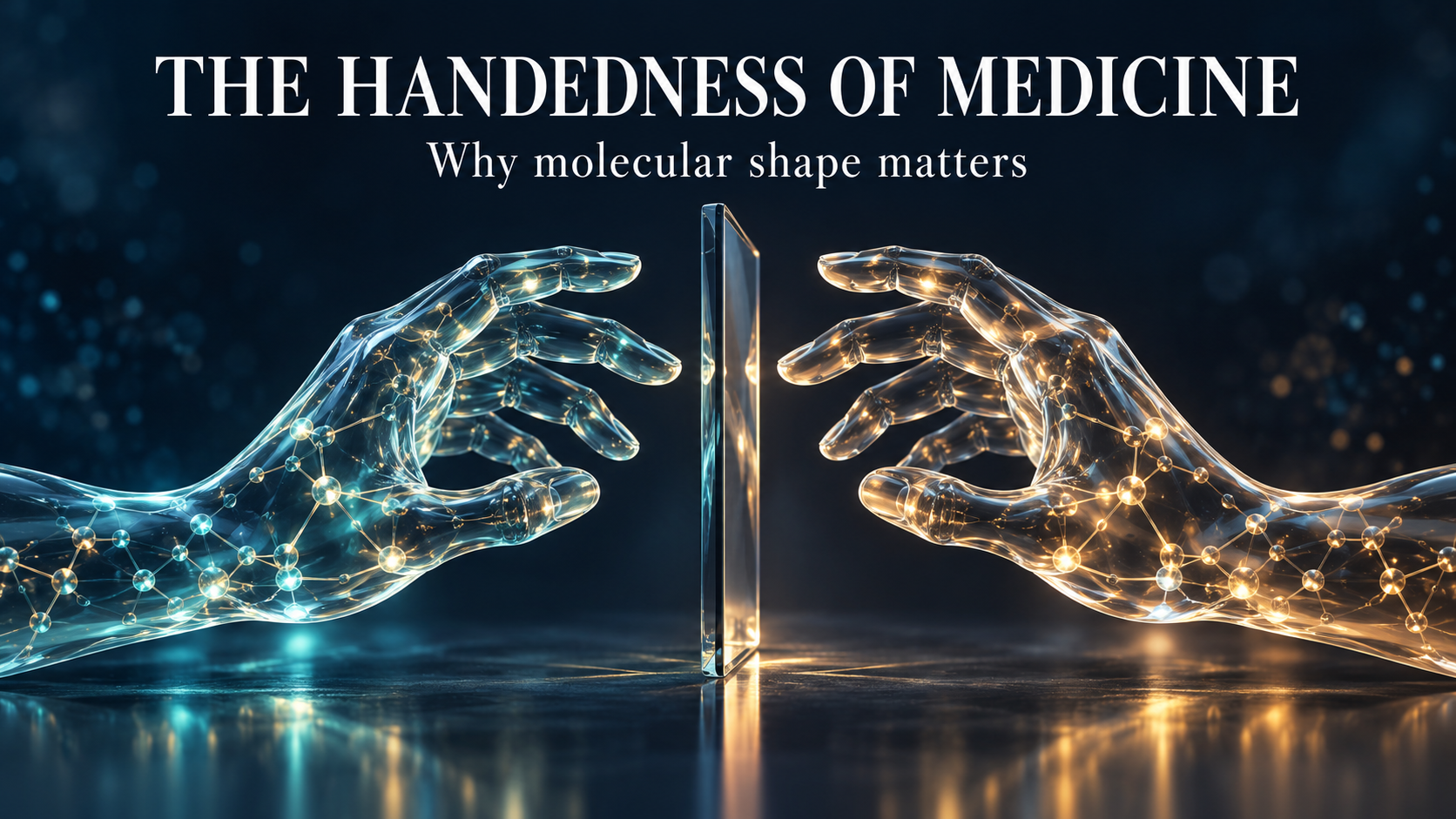
How molecular shape changes drug action and what chemists can control
A perfectly made glove can still fit badly if it belongs on the other hand. Its material and size may be correct; its shape is the problem. Something similar can happen when a drug meets a protein inside the body. Two molecules may contain exactly the same atoms, joined in the same order, yet interact differently with the living structures they encounter.
The difference is molecular handedness, or chirality. Hold your hands in front of you with both palms facing forward. They are mirror images, but you cannot rotate one until every part matches the other. Molecules with this property also have mirror partners. Chemists call a pair of these partners enantiomers. A formula written on a label cannot, by itself, tell the whole story of their three-dimensional arrangement.
This matters because a body is a collection of shaped molecular structures. Enzymes carry out chemical reactions; receptors receive signals. A drug’s effect often begins when it binds to one of these proteins. Its handedness can change the strength or position of that binding.[1]
It is tempting to imagine every pair as a helpful molecule and an evil twin. Biology is more varied. One form may be more active, both may have useful effects, or one may produce an unwanted effect. Neither left nor right is a universal mark of safety. Each pair must be investigated.[1]
The challenge begins in the laboratory. A reaction with no influence favouring one handed form often makes equal amounts of both. This is a racemic mixture. Chemists can separate the forms afterward, or design a reaction that preferentially produces the one they want. That second approach, asymmetric synthesis, has become a central tool for controlling molecular structure.[2]
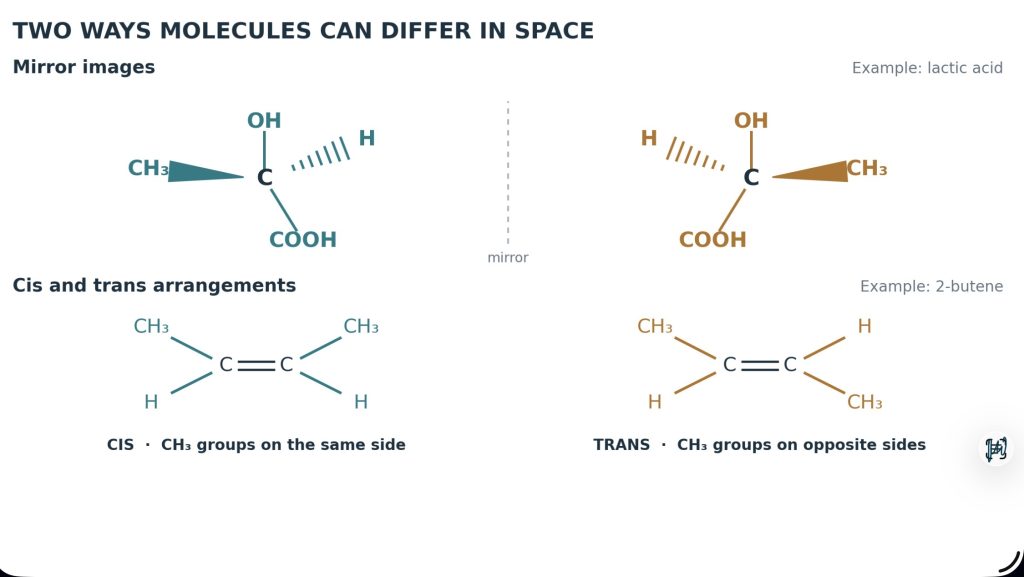
Figure 1. Mirror-image forms differ in handedness. Cis/trans forms differ around a double bond. Solid wedges point toward the reader; hashed wedges point away. Examples are chosen for clarity; the lower pair is not resveratrol.
The 2026 Nobel Prize in Chemistry, awarded to Henri B. Kagan and Kenso Soai, recognises discoveries within this field: nonlinear effects and autocatalysis in asymmetric organic synthesis. Their work showed how small biases in handedness can be amplified until one form dominates.[2]
A catalyst is a substance that speeds a reaction without being consumed overall. A chiral catalyst can favour the formation of one mirror image by making one route through the reaction easier than the other. Think of a shaped guide that helps a machine assemble a component in a particular orientation.
Kagan and his colleagues found that a catalyst’s initial imbalance need not set the limit on the product’s purity. Under suitable conditions, a modest excess of one handed component in a catalyst mixture can lead to a much larger excess in the product. This disproportionate response is a nonlinear effect. It revealed that the way catalyst components associate with one another can strongly influence which product forms.[3]
Soai’s research introduced a reinforcing process. The product of his reaction helps generate a catalyst that preferentially makes more product of the same handedness. As the reaction proceeds, a small initial excess can grow. This is asymmetric autocatalysis: the chemical product helps accelerate its own formation. Fresh starting materials supply the matter needed to make each new molecule.[4]
These discoveries offer powerful principles for designing and understanding reactions. They do not amount to one universal recipe that produces either version of every drug on command. Each manufacturing process still requires its own chemistry, purification and quality control.
The work also reaches beyond medicine. Life uses strikingly consistent molecular handedness: the chiral amino acids that build our proteins overwhelmingly belong to the L family. How did this preference emerge? Soai’s experiments demonstrate a mechanism by which an initially slight imbalance can become dominant. They offer a model for part of the puzzle, without proving which sequence of events occurred on the early Earth.[4]
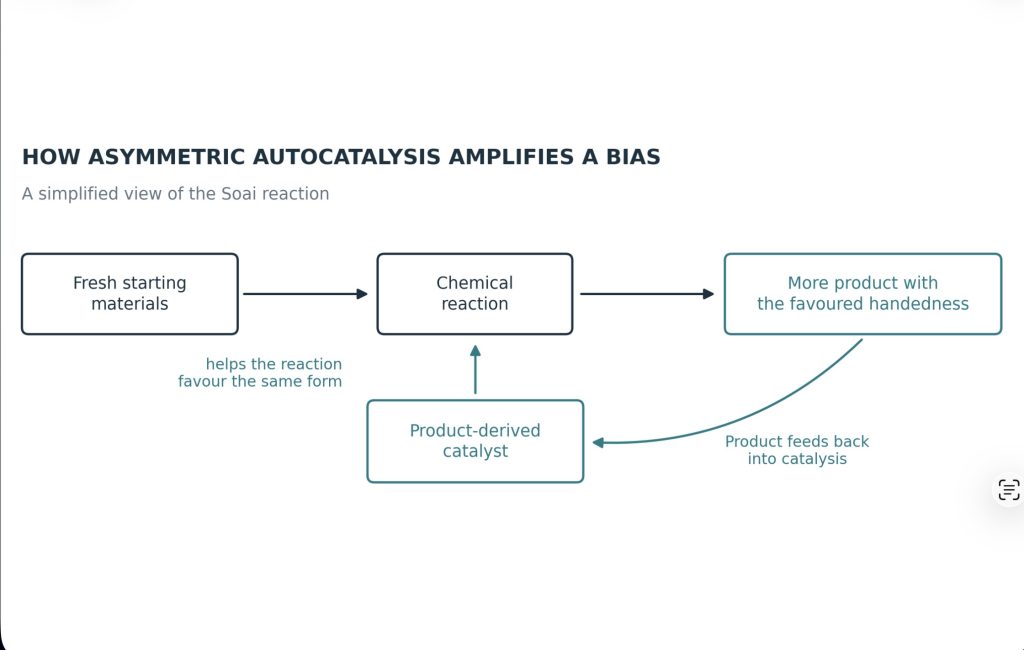
Figure 2. In the Soai reaction, product contributes to the catalyst that favours its own handedness. Fresh starting materials remain necessary. Autocatalysis alone does not always amplify chirality. Schematic based on Soai et al. [4].
Chemical control becomes especially important when a molecule can change after entering the body. Thalidomide provides a devastating example. Used as a sedative and for pregnancy-related nausea, it caused severe birth defects. Its mirror forms have different biological activities, but the story cannot be reduced to keeping a harmless version and discarding a dangerous one.
Research in humans showed that thalidomide’s forms rapidly convert into one another. Administering only the supposedly safer form would therefore not have prevented the tragedy. The structure placed in a tablet and the structures present later in a patient’s body are both part of the safety question.[5]
A different lesson comes from resveratrol, the plant compound often discussed in connection with brain health and ageing. It exists in cis and trans forms. These are not mirror images. Their difference concerns the positions of groups around a carbon–carbon double bond: in one arrangement, the relevant groups lie on the same side; in the other, on opposite sides. Both handedness and cis/trans geometry belong to the broader study of spatial molecular structure, but they should not be confused.
A 2022 study investigated how resveratrol’s forms interact with tyrosyl-tRNA synthetase, abbreviated TyrRS. This enzyme helps cells use the amino acid tyrosine to build proteins. The researchers also examined its involvement in DNA repair and nerve-cell survival. In cultured rat neurons, cis-resveratrol supported TyrRS and protective repair processes, while higher concentrations of trans-resveratrol reduced TyrRS and produced damage. The study also examined human Alzheimer’s brain tissue.[6]
These findings identify a possible biological mechanism. They do not establish that cis-resveratrol prevents dementia, or that ordinary doses of trans-resveratrol supplements damage the human brain. Cells exposed directly to a substance in a dish experience different conditions from those inside a person, where absorption, metabolism and tissue exposure all matter.
The proposal that different resveratrol forms explain inconsistent clinical results remains a hypothesis. A randomised trial in people with Alzheimer’s disease found no significant benefit on several cognitive and clinical measures, although it was not large enough to settle effectiveness conclusively. The laboratory findings justify further investigation; they do not settle the treatment question.[7]
Even the naming systems require care. The capital letters D and L describe structural relationships; they do not by themselves specify which way a substance rotates polarised light. That optical behaviour is described using plus and minus signs. A chemical label must be understood before a biological conclusion can be drawn from it.[8]
For drug developers, the practical questions are precise. Which form produces the intended effect? Does it convert into another form? How much reaches the target tissue, and which breakdown products appear along the way? Controlling molecular handedness makes these questions easier to investigate. The aim is a medicine whose identity is controlled in the factory and whose effects are understood in the people who take it.[1]
Sources
[1] US Food and Drug Administration. Development of New Stereoisomeric Drugs. Guidance, 1992. Read source
[2] The Nobel Prize. The Nobel Prize in Chemistry 2026. Award citation and scientific background. Read source
[3] Puchot, C., et al. (1986). Nonlinear effects in asymmetric synthesis. Examples in asymmetric oxidations and aldolization reactions. Journal of the American Chemical Society, 108, 2353–2357. Read source
[4] Soai, K., Shibata, T., Morioka, H., & Choji, K. (1995). Asymmetric autocatalysis and amplification of enantiomeric excess of a chiral molecule. Nature, 378, 767–768. Read source
[5] Eriksson, T. (1997). Pharmacokinetics of the enantiomers of thalidomide. Doctoral thesis, Lund University. Read source
[6] Jhanji, M., et al. (2022). Cis- and trans-resveratrol have opposite effects on histone serine-ADP-ribosylation and tyrosine induced neurodegeneration. Nature Communications, 13. Read source
[7] Turner, R. S., et al. (2015). A randomized, double-blind, placebo-controlled trial of resveratrol for Alzheimer disease. Neurology, 85, 1383–1391. Read source
[8] IUPAC Gold Book. Fischer–Rosanoff convention and optical activity. Definitions of structural configuration and optical rotation. Read source