
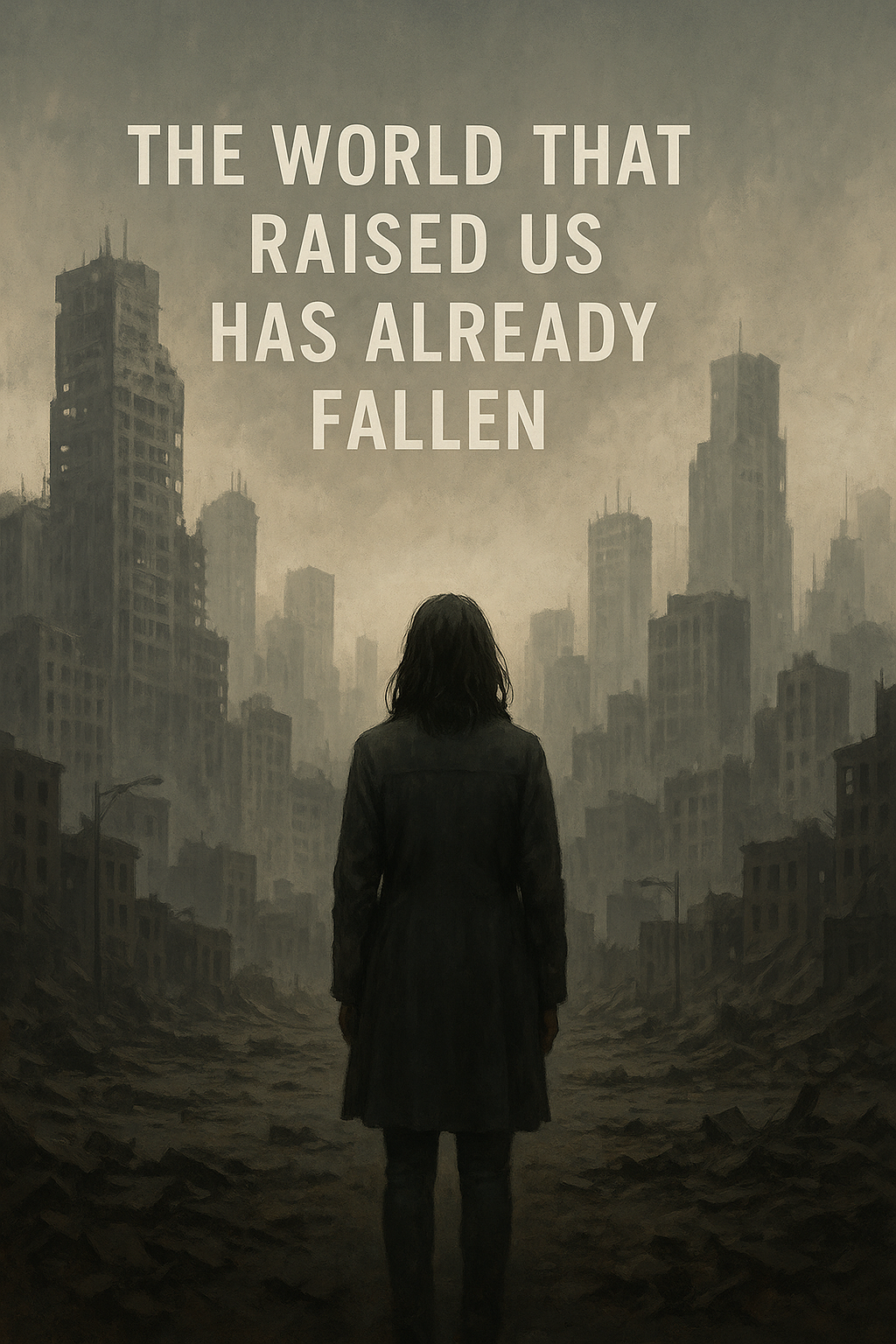
There is a ghost with its hands on our shoulders.
Not a ghost from mythology, but from memory—the memory of a world that trained us, tamed us, and then vanished without bothering to leave a forwarding address. We still dress for it each morning, perform our tiny rituals at its altar, and whisper its catechisms under our breath. We do not yet understand that what we’re faithful to is already dead.
Its name is simple: the Last Economy—the final version of a grand system that once promised meaning, dignity, and belonging if only we obeyed long enough and worked hard enough. For a while that promise glittered, like light on broken glass. It was never true, but it was convincing. It was never real, but it was real enough.
Now, stripped of its illusions, it is nothing but a beautiful corpse.
The Machine That Raised Us
Before we knew our own names, the system enrolled us in its apprenticeship.
They called it school, but school was only the costume. Underneath pulsed a vast, humming machine built to sand down the rough edges of childhood, to convert wildness into obedience, imagination into compliance.
We learned to sit in perfect lines, as if preparing to be filed.
We learned to wait for permission to speak, to move, to wonder.
We learned that curiosity belonged only in the designated box on the timetable.
We learned that our humanity could be broken into data points—grades, ranks, standardized scores—like livestock being weighed before auction.
This was not education.
This was domestication.
The model came from 19th-century Prussia, where it was designed to manufacture two products: obedient soldiers and compliant factory workers. It was never about discovering ourselves. It was about dissolving ourselves enough to fit into the cogs of a machine that needed bodies more than minds.
And it worked.
We emerged on schedule, clutching diplomas instead of destinies, already conditioned to believe that our lives would be justified only by our usefulness to the economy.
The Myths That Milked Our Youth
The Factory School prepared us for the myths of the Last Economy—myths we swallowed whole because everyone else was swallowing them, too.
We believed that exhaustion was evidence of virtue.
We believed that hard work guaranteed fairness, that the successful earned everything and the struggling deserved nothing.
We believed that loyalty would be reciprocated, that institutions cared about the humans who maintained them.
We believed that credentials were a passport to stability.
We believed that infinite growth on a finite planet was simply common sense.
We believed that the game was fair because the rules were printed in textbooks.
These myths were not accidental.
They were the software that synchronized millions of human beings into a single industrial organism—an empire of schedules and supply chains that bent nature itself to human will.
And yes, it gave us marvels.
We tunneled under oceans, built cities that scraped the clouds, translated the genome into a language we could edit. For a moment, the myths felt vindicated.
But the bill arrives for every miracle.
The Price We Paid in the Currency of the Soul
To keep the machine alive, we mortgaged our humanity.
We surrendered our time—not just hours but decades—pouring our brightest energy into tasks that left no imprint on the world and offered no nourishment to the heart. We traded meaning for metrics, purpose for productivity.
We surrendered our relationships.
We became ghosts in our own homes, too drained to parent with tenderness or partner with patience. We migrated away from the people who shaped us in search of opportunities that rarely materialized.
We surrendered our health.
Our bodies stiffened in ergonomic chairs, our sleep eroded under fluorescent lights, our minds frayed in the friction between survival and despair. Pills numbed what purpose should have healed.
We surrendered our dreams—quietly, apologetically.
First the small ones, then the sacred ones.
A book unwritten.
A garden unplanted.
A self unlived.
Worst of all, the myths stole our imagination.
We forgot how to picture a life that wasn’t rented out by the hour.
The Collapse Without a Funeral
The Last Economy didn’t fall. It faded.
It decayed the way old stars do—still shining long after their hearts have gone dark. We mistook the lingering glow for durability.
But the foundations were already gone.
Jobs became unstable.
Institutions became predatory.
Degrees became debts.
Homes became investments for others.
Technology became surveillance.
Automation became unemployment in slow motion.
We had built abundance and still somehow expanded scarcity. We had designed machines that could eliminate human drudgery, and instead they eliminated humans.
The system cracked.
But we kept showing up, as if shame and fear were the glue that held our days together.
What Comes After the Age That Has Ended
We stand ankle-deep in the rubble of a world we were trained to want, whispering prayers for its resurrection. But the future is pressing at the edges of our vision, knocking softly, patiently, waiting for us to stop grieving long enough to listen.
A new world is not guaranteed.
But the raw materials for one are everywhere.
A society where education nurtures rather than narrows.
An economy that measures value in flourishing instead of output.
Work that expresses purpose instead of purchasing permission to live.
Technology that liberates rather than disciplines.
Time reclaimed as the original currency of a meaningful life.
What has been missing is permission:
the permission to imagine we deserve better,
the permission to stop worshipping a machine that no longer works,
the permission to let a dead world remain dead.
We have mistaken obedience for stability and routine for destiny.
Yet beneath the rubble, something alive is stirring.
We are haunted, yes. But ghosts fade when the living move forward.
The machine has collapsed under its own contradictions.
We have not.
And that simple fact—fragile, stubborn, miraculous—may be the first true sentence we’ve spoken in a generation.
The requiem is ending.
Something else is beginning.
Discover more from RETHINK! SEEK THE BRIGHT SIDE
Subscribe to get the latest posts sent to your email.