
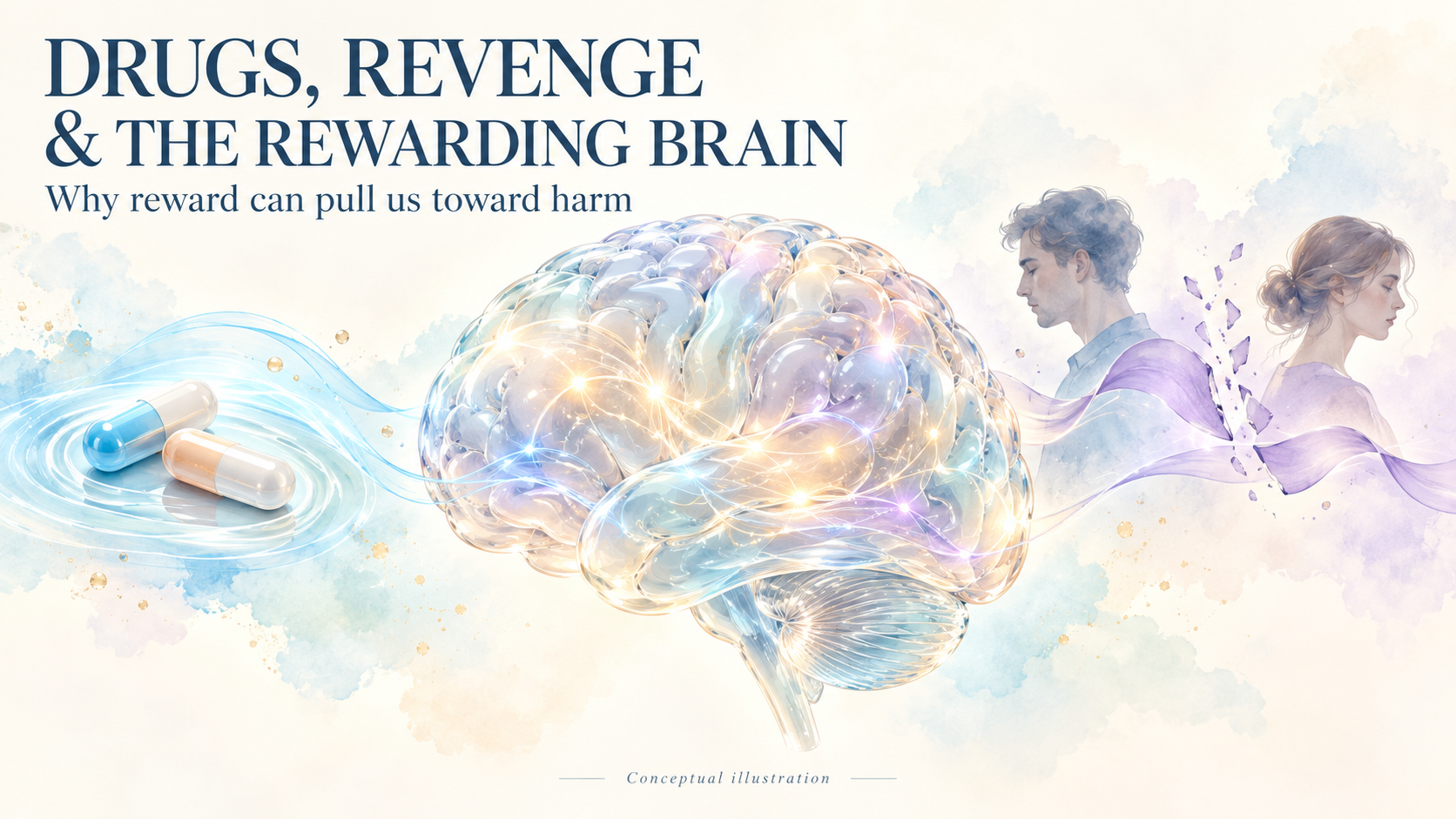
Decades of brain scans reveal it hijacks the same circuits as heroin. The antidote is free, legal, and hiding in plain sight.
Imagine the person who hurt you most. The boss who stole your credit. The ex who betrayed you. The stranger who wronged someone you love. Now imagine them suffering. If a warm current runs through you—just for a second—you are not evil. You are human.
You are also, according to a growing body of neuroscience, an addict.
Not addicted to a substance. Addicted to revenge.
In a Slate article that has quietly unsettled readers, Yale researcher James Kimmel Jr. lays out the case: revenge is not just an emotion, a moral failing, or a plot device. It is a behavioral addiction with the same neurobiological signature as drug dependence. And it may be the deadliest addiction in human history.
The numbers are staggering. The mechanism is elegant. The antidote is already inside your skull.
Your Brain on Revenge
More than 60 neuroscientists worldwide have spent decades scanning brains while people experience injustice, humiliation, betrayal, and the urge to retaliate. Their findings are remarkably consistent.
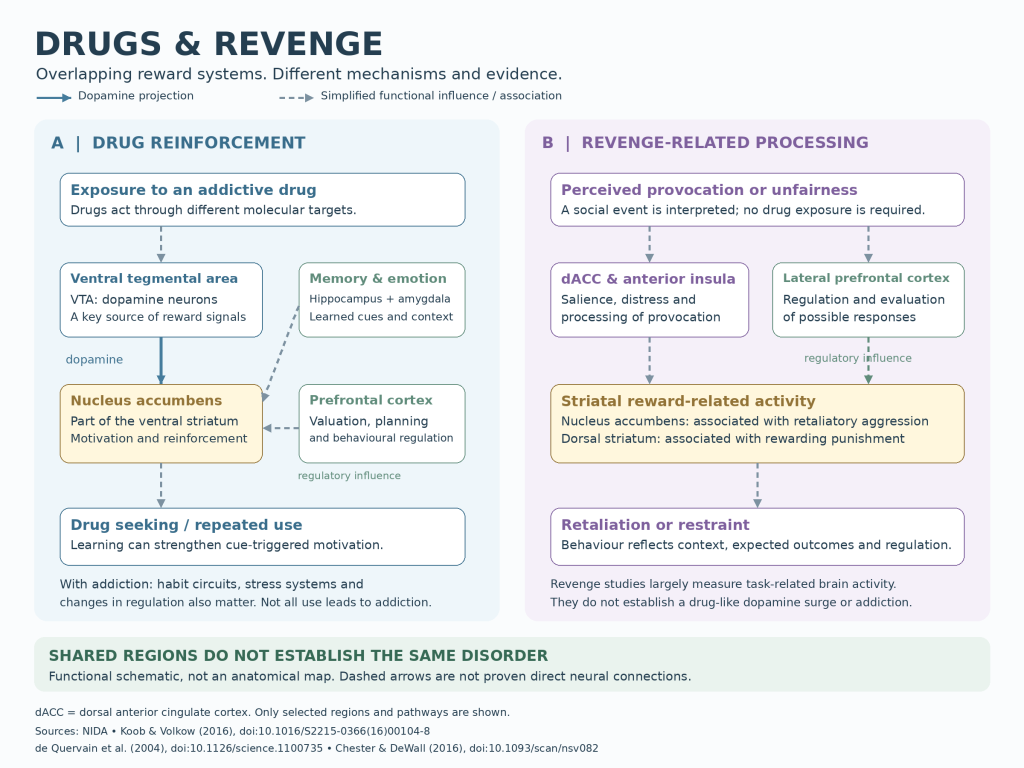
When you feel wronged, the anterior insula—a region that processes pain—lights up. The brain does not neatly separate physical pain from social pain. A broken bone and a broken promise can activate overlapping circuitry. The wound feels real because, in neurological terms, it is.
Then comes the craving. The nucleus accumbens, central to reward and addiction, begins to hum. The dorsal striatum, which helps cement habits, starts to encode the pursuit of payback. Dopamine surges. You feel a pull, a hunger, a promise: If I hurt them, I will feel better.
And you might—briefly. Hurting those who hurt us can produce genuine pleasure. It is an evolved response, a way to rebalance the pain of victimization. But the relief is fleeting. The pain returns, often worse. The craving deepens. The prefrontal cortex—the part of the brain responsible for self-control and long-term thinking—gets hijacked or inhibited.
That is the common definition of addiction: the inability to resist a powerful urge despite devastating consequences.
For a heroin addict, the fix is a needle. For a revenge addict, the fix is another person’s suffering. And the only way to get it is to hurt the people who hurt you—or their proxies.
The dealer is your memory. The drug is your grievance.
A Graveyard of Fixes
History, viewed through this lens, looks less like a story of ideals and more like a long, bloody relapse.
Ancient Rome staged revenge as public entertainment: offenders fed to wild beasts, gladiators forced to kill, crucifixions lining the roads. Medieval Europe tortured and burned alleged heretics and witches. Hitler, Stalin, and Mao together presided over roughly 102 million deaths, with an estimated 38.5 million murdered because they were perceived as having wronged the leaders or their nations.
One analysis of the top 20 human atrocities found that 19 were driven by compulsive revenge-seeking. The estimated death toll: 336 million people.
We rarely call it addiction. We call it justice, honor, retribution, national security. But the brain does not care what we call it. It only knows the loop.
Modern data tell the same story. The World Health Organization estimates that violence-related injuries kill about 1.25 million people every year. The CDC’s National Violent Death Reporting System finds that the most common circumstance of violent death is an argument that escalated—often in pursuit of revenge. FBI and Secret Service studies of mass shooters repeatedly find a personal grievance at the center.
We treat addiction with compassion and violence with punishment. But if violence is often revenge addiction, punishment alone is like jailing a heroin addict without offering treatment.
The Antidote We Ignore
Here is where the science gets strange, hopeful, and almost too simple.
Forgiveness—real forgiveness, not forgetting, not condoning, not reconciliation—appears to be a neurological intervention.
In fMRI studies, researchers asked people to simply imagine forgiving someone who had wronged them. They did not have to tell the person. They did not have to excuse the act. They did not have to put themselves in danger again. They just had to practice forgiveness in their own minds.
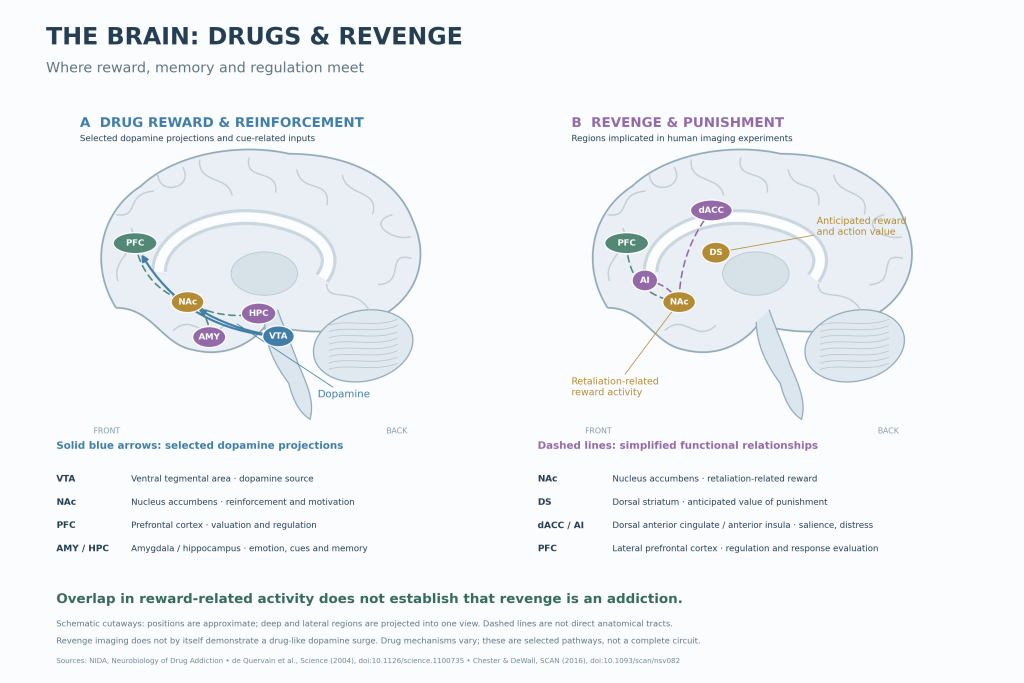
The scans showed something remarkable. The anterior insula—the pain center—deactivated. The nucleus accumbens and dorsal striatum—the craving and habit centers—quieted. The prefrontal cortex—the seat of self-control—came back online.
Forgiveness does not erase the wound. It stops the infection.
It is free. It requires no prescription. It has no side effects except, perhaps, peace. And unlike most treatments for addiction, it can be used as often as needed, in any setting, without anyone else’s cooperation.
That last part matters. Revenge requires a target. Forgiveness requires only you.
How to Take the Cure
Kimmel, recognizing how hard forgiveness can be, created something called the Nonjustice System. It is a structured way to put your grievance on trial. You play every role: victim and prosecutor, defendant and defense attorney, judge and jury, warden, and finally the judge of your own life.
You ask: What sentence would actually serve me? What would free me? What do I want my life to be about?
In his research, participants who used the method reported decreased desires for revenge, increased benevolence, and a surprising sense of empowerment. Not because they let someone off the hook, but because they took themselves off the hook.
You do not have to use his method. You can start smaller. When the craving for payback rises, name it: This is my brain on revenge. Delay. Breathe. Write the letter you will never send. Remind yourself that forgiveness is not saying what happened was okay. It is saying, I will not let it live in my brain rent-free.
And if you are in danger, forgiveness does not mean staying. Report abuse. Seek shelter. Press charges. Leave. You can forgive and still protect yourself. You can forgive and still pursue justice. Forgiveness is not a doormat. It is a lock on the door of your own mind.
The Choice
Revenge is a poison that tastes like medicine. It promises relief and delivers addiction. It has killed more people than every drug combined, and it is hiding in plain sight—in arguments, feuds, politics, and wars.
Forgiveness is the antidote. Not because it is nice. Because it is neuroscience. Because it works. Because it is the only way to break the loop without creating new victims.
The next time the craving hits—and it will—do not ask, How do I make them pay?
Ask, How do I get free?
The world’s deadliest addiction has a cure. It has been in your brain all along.
Take it.