
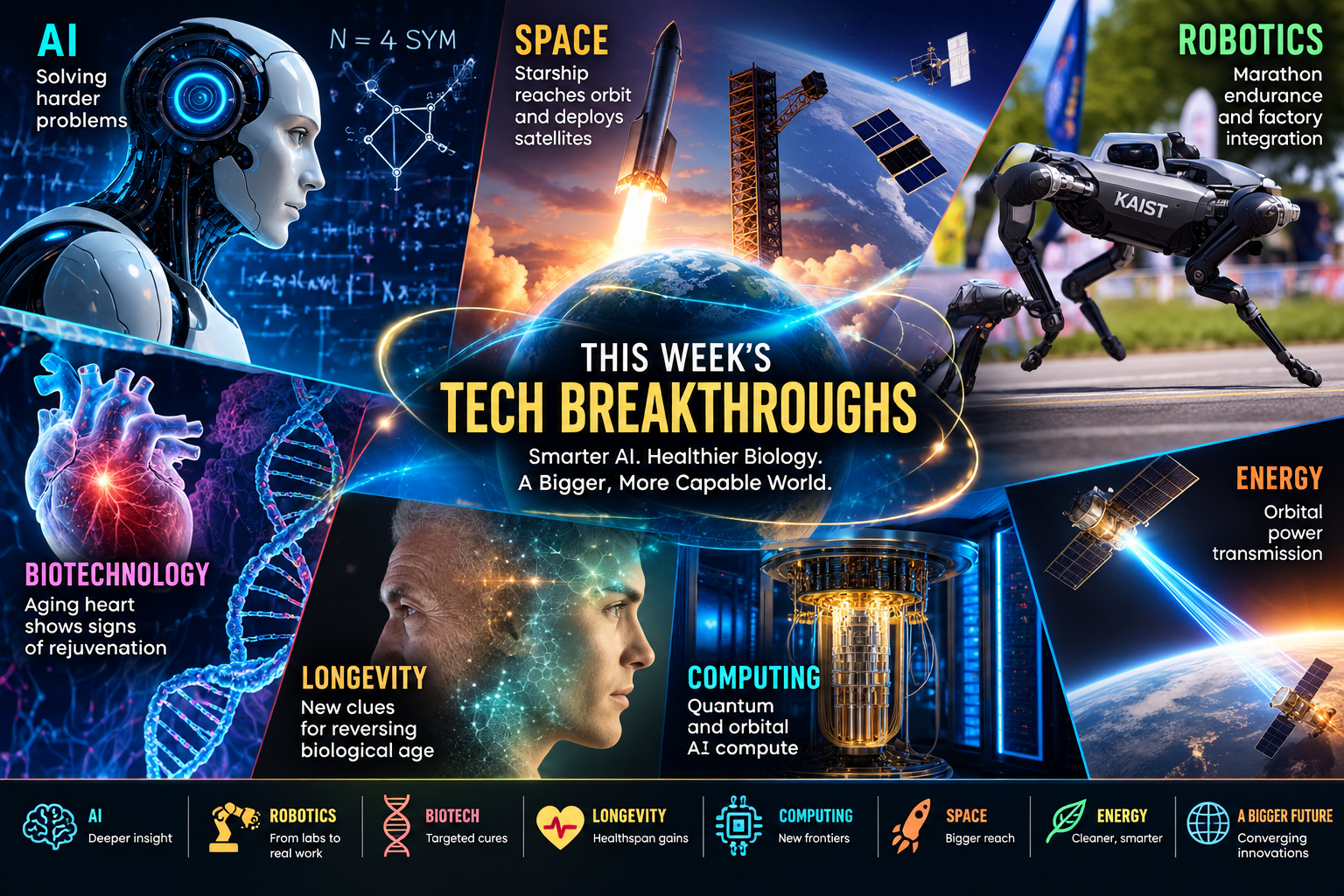
This week produced a more interesting mix than the previous few weeks. The strongest signals were AI beginning to perform frontier scientific calculations, a major Starship milestone, unusually efficient legged robotics, and early evidence that a transplanted organ can biologically adapt to its new host.
1. AI crossed an important boundary in theoretical physics
Anthropic reports that Claude completed a nine-loop six-particle scattering-amplitude calculation in planar N=4 super-Yang–Mills theory, exceeding the previous eight-loop result. The calculation was performed with relatively little human supervision, using two independent approaches, and physicist Lance Dixon subsequently checked the result.
Why it matters: this is more significant than another benchmark score. An AI system completed a difficult, multi-step research computation that previously required specialist physicists and substantial manual work.
But don’t call it “AI discovered new physics.” The model used established mathematical techniques and a highly structured problem. N=4 super-Yang–Mills is also a simplified theoretical model, not the Standard Model of particle physics. The real threshold will be crossed when AI formulates a genuinely new physical conjecture, derives it, and the conjecture survives experimental or independent theoretical validation.
Assessment: ★★★★☆ Genuine AI-science milestone, but not autonomous scientific discovery yet.
2. Starship achieved its first orbital satellite deployment
On September 28, SpaceX’s Starship completed its 14th test flight, reached orbit and deployed 26 next-generation Starlink V3 satellites. This is an important transition from demonstrating the vehicle to demonstrating what the enormous vehicle is actually intended to transport.
The larger objective is rapid reuse. A very large reusable launcher could eventually make orbital infrastructure dramatically cheaper and enable much larger satellite constellations.
The caveat is crucial: reaching orbit and deploying satellites is only one part of Starship’s intended architecture. The difficult milestones still include reliable recovery of the ship, rapid turnaround, orbital refueling, and eventually routine high-frequency launches.
Assessment: ★★★★★ Major spaceflight milestone; full Starship economics remain unproven.
3. A robot dog completed a marathon on one battery
KAIST’s RAIBO2 completed the 42.195-km Sangju Marathon in 4 hours 19 minutes 52 seconds, using about 1,280 Wh from a 2,016-Wh battery. Its measured cost of transport was about 0.25, below the reported human benchmark of 0.37.
The significance isn’t that a robot can run a marathon. It is energy efficiency.
The researchers combined lightweight mechanical design, improved motor electronics, reinforcement learning for efficient locomotion, and regenerative energy recovery on downhill sections. The result was roughly three times the range of previous quadruped designs.
There is a major limitation: RAIBO2 was remotely controlled during the race. It demonstrated endurance, not autonomous navigation.
Assessment: ★★★★☆ Genuine robotics/energy-efficiency advance, but not autonomous robotic intelligence.
4. An old human heart appears to become biologically younger in a young recipient
This is potentially the week’s most interesting longevity-related observation, although it is very early.
A Harvard-led study examined heterochronic heart transplants—hearts transferred between donors and recipients with substantial age differences. In mice, transplanted hearts shifted their molecular aging characteristics toward the recipient’s age. The researchers then found a similar pattern in human transplant patients: DNA-methylation and gene-expression measures of the grafted heart were more strongly associated with the recipient’s age than the donor’s.
In simplified terms:
old heart + young body → molecular features move younger
young heart + old body → molecular features move older
The proposed mechanism involves systemic signals and particularly mitochondrial/metabolic pathways.
This is fascinating for aging biology because it strengthens the idea that aging is not entirely locked inside each cell’s history. The organism’s systemic environment can influence tissue aging.
But this is emphatically not evidence that we have discovered a human rejuvenation treatment. The human dataset is small, the work is a preprint and not yet peer reviewed, and “younger biological age” measured by molecular clocks is not the same as longer life or restored organ function.
Assessment: ★★★★☆ Important geroscience clue; far too early to call rejuvenation.
5. Humanoid robotics moved from demonstration toward factory integration
Boston Dynamics opened its Robotics Metaplant Application Center inside Hyundai’s Georgia manufacturing complex. Atlas robots are now being trained on actual manufacturing tasks such as parts logistics and sequencing. Hyundai says it intends eventually to deploy 25,000 Atlas robots across Hyundai and Kia facilities and establish U.S. production capacity of 30,000 robots annually.
This is more important than another humanoid video because it tests whether humanoids can operate within real industrial workflows.
However, the 25,000 figure is a future corporate deployment target, not 25,000 robots currently working in factories. Atlas is still being trained, and component assembly is not planned until later.
Assessment: ★★★☆☆ Genuine commercialization effort, but the scale claims should not be mistaken for present capability.
6. Orbital power transmission is approaching its first serious test
Star Catcher is preparing an orbital demonstration of wireless power transmission between separate spacecraft. The idea is to collect solar energy on one satellite and beam usable power to another, potentially allowing satellites to receive additional power without substantially enlarging their own solar arrays.
This could become important if satellite constellations become increasingly compute-heavy. A satellite running AI inference requires substantially more power than a conventional communications or imaging spacecraft.
But the atmospheric demonstration record is not equivalent to successful orbital operation. The hard part is maintaining precise beam alignment between rapidly moving spacecraft and doing so safely and efficiently.
Assessment: ★★★☆☆ High-potential space-energy experiment; orbital economics remain speculative.
Longevity: what I would not overinterpret
The transplanted-heart study is the only development this week that I would put into the serious geroscience-watch category. It supports a broader hypothesis:
The biological age of a tissue may be partly determined by the environment in which that tissue lives.
That connects intriguingly with research on systemic aging, inflammation, mitochondrial signaling, extracellular vesicles and the earlier parabiosis literature.
But we should resist the leap from:
“systemic environment changes molecular age”
to:
“young blood can rejuvenate humans.”
Those are very different propositions.
The first has increasing experimental support. The second remains unproven clinically.
The 5 stories I would watch next
1.
Starship recovery and rapid reuse
The next decisive question is not whether Starship can reach orbit. It is whether SpaceX can make the enormous vehicle recoverable, rapidly reusable and economically routine. That is where Starship could fundamentally change space economics.
2.
AI’s next scientific step
The nine-loop calculation is important precisely because it reveals the current boundary. AI can now execute sophisticated known mathematics. The next threshold is new hypothesis generation: can AI find something humans did not already know to look for?
3.
The transplanted-heart aging phenomenon
The critical next steps are peer review, larger cohorts, longitudinal follow-up and mechanistic experiments. If independent studies reproduce the phenomenon across heart, liver, kidney and other tissues, systemic control of biological aging becomes a much more compelling therapeutic target.
4.
Humanoid robots in actual production
Watch productive hours per day, human intervention rate, failure rate, maintenance cost and cost per task. Those metrics matter far more than the number of robots a company says it plans to manufacture.
5.
Orbital power and computing
The convergence of space + solar power + AI computation is becoming a genuine technological theme. Google is already testing orbital AI hardware, while Star Catcher is testing orbital power distribution. These are still experiments, but together they point toward a possible future architecture in which some data processing occurs off Earth.
My signal-versus-hype ranking
| Development | Evidence | My assessment |
| Starship orbital satellite deployment | Real flight milestone | 🟢 Major breakthrough |
| Claude nine-loop physics | AI result independently checked | 🟢 Important AI-science advance |
| RAIBO2 marathon | Peer-reviewed Nature result | 🟢 Real robotics advance |
| Old heart → younger molecular age | Human + animal, but preprint | 🟡 Very promising clue |
| Atlas factory program | Real deployment/testing | 🟡 Early commercialization |
| Orbital power beaming | Pre-operational demonstration | 🟡 Promising experiment |
| “AI has discovered new physics” | Not yet demonstrated | 🔴 Overstatement |
| “Old hearts prove human rejuvenation” | Not established | 🔴 Overstatement |
The deeper pattern
Three technological trajectories are beginning to converge:
AI is becoming capable of doing parts of science → robotics is acquiring physical competence → biotechnology is revealing that biological state is more environmentally plastic than previously assumed.
The important question for the next decade may therefore not be which technology wins, but what happens when these three capabilities begin reinforcing one another: AI discovers biological mechanisms, robotics performs experiments autonomously, and increasingly programmable biology provides new ways to alter aging and disease.
That is a much more consequential trajectory than any individual weekly gadget or model release.