
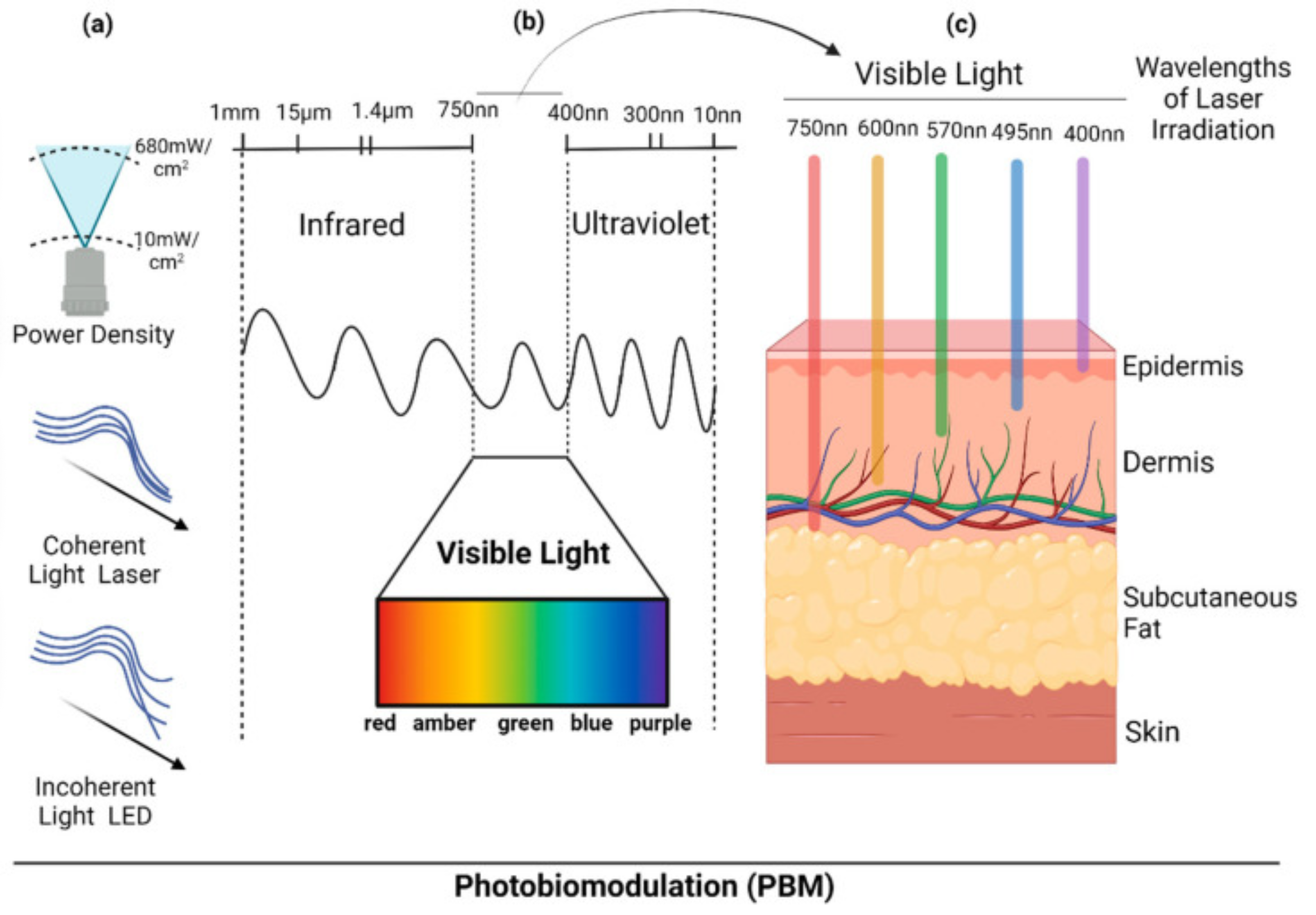
We normally think of light as something that allows us to see. Biology tells a more interesting story: photons can reset clocks, alter hormones, change mitochondrial behavior, destroy abnormal cells, stimulate repair—or damage DNA. Medicine is only beginning to learn how to prescribe this ancient environmental signal.
For billions of years before tablets, injections or surgery existed, life had another way of receiving instructions from the environment: light.
Every sunrise announced that it was time to become active. Every sunset signaled a change in metabolism and behavior. Seasonal changes in daylight told organisms when to reproduce, migrate, hibernate or flower. Ultraviolet radiation altered chemistry in exposed tissues. Long before nervous systems evolved, cells were already responding to photons.
This raises an intriguing question:
Could light be thought of as a biological nutrient—or perhaps an “information vitamin”?
Not literally. A vitamin is a chemical substance the body must obtain in small quantities. A photon supplies energy rather than molecular building material. But as a metaphor, “information vitamin” captures something important: the body requires an appropriate light environment to organize some of its physiology.
And different colors of light do not necessarily say the same thing.
The body does not merely receive light. It reads it.
A photon can influence biology only if something absorbs it. The absorbing molecule is called a chromophore.
Different chromophores respond preferentially to different portions of the electromagnetic spectrum.
Among them are:
- opsins, including melanopsin in specialized retinal cells;
- retinal, the vitamin-A-derived molecule coupled to opsins;
- flavins and porphyrins;
- melanin;
- bilirubin;
- hemoglobin;
- mitochondrial molecules, including the proposed red/NIR photoacceptor cytochrome-c oxidase;
- and, at longer infrared wavelengths, water itself.
This creates something resembling a biological keyboard.
A blue photon may activate one molecular system.
A red photon may be absorbed by another.
An ultraviolet photon may initiate still another chemistry.
But wavelength alone is not the message. The full “sentence” is:
wavelength × intensity × duration × timing × tissue × physiological condition
The same light that is beneficial at one dose can be ineffective—or harmful—at another.
That is why the future of light medicine will depend less on phrases such as “red light is good for you” and more on something resembling pharmacology.
Blue light: telling the brain that daytime has arrived
One of the best-established examples involves melanopsin, an opsin found in intrinsically photosensitive retinal ganglion cells.
These cells are particularly responsive around the blue-cyan portion of the spectrum, near 480 nanometers. Instead of primarily creating visual images, they send information about environmental illumination to the brain’s master circadian clock, the suprachiasmatic nucleus.
The pathway is approximately:
morning light → melanopsin system → brain clock → circadian synchronization → sleep/wake timing, melatonin and alertness
This explains why the timing of light is as important as its color.
Bright light in the morning can advance and strengthen the biological day.
Strong light late at night can tell the same clock:
“Daytime has not ended yet.”
It may delay melatonin secretion and shift sleep later. Human research confirms that nonvisual effects of light depend on spectrum, intensity, duration and timing. (PubMed)
This principle has already become medicine. The US National Institute of Mental Health describes morning bright-light therapy as a mainstay treatment for winter-pattern seasonal affective disorder, commonly using a 10,000-lux UV-filtered light box for roughly 30–45 minutes. Importantly, this is evidence for appropriately administered bright light, not evidence that everyone should stare at intense blue LEDs. (National Institute of Mental Health)
Here light is not supplying fuel.
It is supplying time.
Blue-green light: a medicine that changes a molecule
Perhaps the clearest demonstration that photons can behave almost like a drug is neonatal jaundice.
Some newborns accumulate too much bilirubin. High concentrations can become dangerous to the developing nervous system.
Medicine treats this with carefully controlled blue-to-blue-green light, approximately 460–490 nm.
The light is absorbed by bilirubin and changes its molecular configuration into forms that the baby’s body can eliminate more readily.
The American Academy of Pediatrics recommends narrow-spectrum blue LED phototherapy centered around this range when clinically indicated. (AAP Publications)
Notice what has happened.
No conventional drug molecule was administered.
A photon struck another molecule and changed its chemistry.
The AAP has even described light as the “active agent” in phototherapy and noted that the concept resembles pharmacotherapy: irradiance becomes analogous to concentration, while exposure time contributes to dose. (AAP Publications)
That may be the most useful way to think about medical light:
photons can sometimes function as molecular interventions.
Blue light and skin: promising, but dose matters
Human skin contains several opsins, including OPN3. Experiments using cultured cells and human skin models suggest that blue light can influence keratinocyte differentiation and aspects of wound repair.
In an ex-vivo human wound model, blue-light exposure was associated with faster wound closure and increased OPN3 expression. Silencing OPN3 altered some of the cellular responses, suggesting that an opsin-mediated mechanism may be involved. (PubMed)
That sounds exciting—but here is where light biology becomes complicated.
Higher doses of blue light can reduce keratinocyte proliferation and migration rather than enhance them. Reviews of blue-light wound studies describe a biphasic pattern in which relatively low doses may stimulate biological responses while greater exposure can inhibit them. (PubMed)
So the biological instruction is not:
blue = healing.
It is closer to:
a particular amount of blue light, delivered to a particular tissue under particular circumstances, may produce a particular response.
That distinction separates photomedicine from wellness marketing.
Red and near-infrared light: talking to stressed cells?
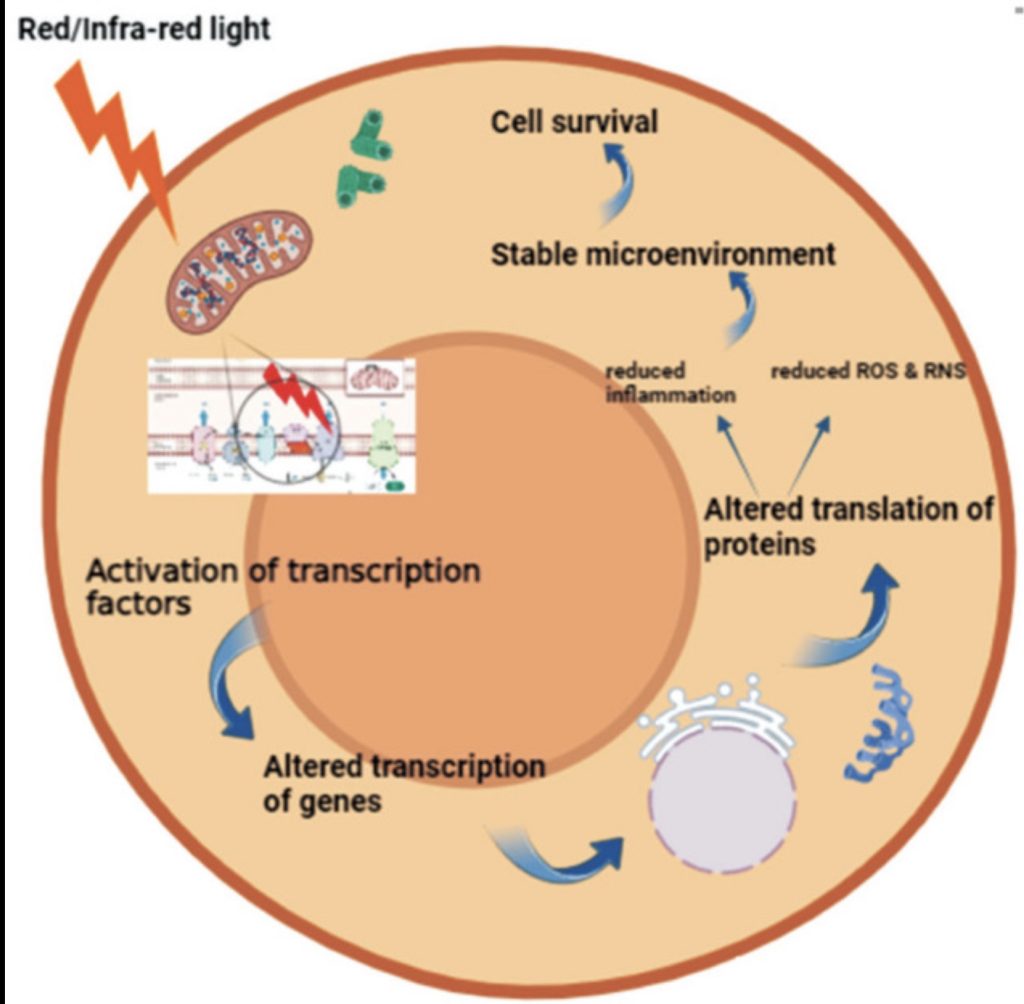
Move toward approximately 600–1,000 nm and something different happens.
Red and near-infrared wavelengths penetrate biological tissue more effectively than blue light, although penetration remains highly dependent on wavelength, tissue composition and dose.
This range is used in photobiomodulation, or PBM.
The leading mechanistic model proposes that red/NIR photons interact with mitochondrial and cellular photoacceptors. Cytochrome-c oxidase—complex IV of the mitochondrial respiratory chain—is frequently proposed as an important target.
Downstream effects reported experimentally include alterations in:
mitochondrial membrane potential
ATP production
nitric oxide
reactive oxygen species
calcium signaling
gene transcription
inflammatory pathways
cell survival and repair
But an important scientific qualification is needed: although cytochrome-c oxidase is the dominant hypothesis, it is probably not the entire mechanism, and some researchers have challenged whether it can explain all PBM effects. Opsins, ion channels and extracellular molecules may also participate. (PubMed)
PBM therefore should not be reduced to the popular claim:
“Red light charges your mitochondria.”
The actual biology is considerably richer—and less settled.
Where red and near-infrared therapy has become clinically serious
Photobiomodulation has been investigated for an enormous range of disorders. The evidence is uneven.
One of its strongest clinical applications is surprisingly specific: preventing or reducing oral mucositis caused by cancer treatment.
Oral mucositis can make eating and swallowing extremely painful during radiotherapy, chemotherapy and stem-cell transplantation.
MASCC/ISOO evidence-based guidelines support PBM in defined oncology settings. A 2026 systematic review of 15 randomized trials involving 868 adults reported generally favorable effects on severe mucositis, pain and supportive-care requirements, while also emphasizing substantial variation between treatment protocols. (PubMed)
A more recent meta-analysis involving 30 randomized trials and 1,748 patients with head-and-neck cancer found a substantially lower risk of severe oral mucositis with PBM, although not every measured outcome improved. (PubMed)
This is an important lesson.
The scientifically defensible statement is not:
“Red light heals everything.”
It is:
certain red/NIR treatment protocols have clinically meaningful evidence for particular indications.
For neurological disease, dementia, depression, athletic performance and systemic “anti-aging,” research remains much more preliminary, heterogeneous or indication-specific. Promising mechanisms should not be confused with established clinical outcomes. (PubMed)
Ultraviolet light: medicine and mutagen in the same photon
Ultraviolet light demonstrates better than anything else why “more light” cannot mean “more health.”
UVB radiation initiates vitamin D3 synthesis in human skin by photochemically transforming 7-dehydrocholesterol. (PubMed)
Controlled ultraviolet phototherapy is also an established dermatological treatment. Narrowband UVB is used for disorders including psoriasis, where it can suppress excessive immune activity and slow abnormal skin-cell proliferation. (American Academy of Dermatology)
Yet UV radiation also damages DNA.
The World Health Organization identifies ultraviolet radiation as a major cause of skin cancer and describes both acute DNA damage and long-term carcinogenic effects. (World Health Organization)
That apparent contradiction contains one of photobiology’s deepest principles:
A signal can be therapeutic within one biological window and harmful outside it.
Medicine therefore does not prescribe “UV exposure” casually.
It prescribes a specific wavelength band, dose, schedule and indication while trying to minimize cumulative injury.
Light can even become a precision weapon
There is another ingenious strategy called photodynamic therapy.
Instead of asking naturally occurring cellular molecules to absorb the light, physicians first administer a photosensitizing compound.
The compound preferentially accumulates or becomes activated in the target area. Then light of an appropriate wavelength strikes it, generating reactive molecular species that damage abnormal cells.
An FDA-approved example combines topical aminolevulinic acid with blue-light illumination to treat certain actinic keratoses, precancerous skin lesions. (FDA Access Data)
Conceptually:
drug alone → relatively inactive
light alone → insufficient
drug + correct light → therapeutic reaction
This foreshadows a much larger field of medicine in which physicians may someday control biological processes spatially and temporally with light.
What does each part of the spectrum seem to “say”?
| Light | Important biological target/action | Established or investigated uses | Evidence |
| Blue/cyan ~460–490 nm | Melanopsin/circadian system | Circadian entrainment; bright-light treatment of winter SAD | Strong for circadian biology; supported clinically for SAD |
| Blue-green ~460–490 nm | Bilirubin photochemistry | Neonatal jaundice | Established clinical treatment |
| Blue ~400–470 nm | Opsins, flavins, porphyrins; oxidative signaling | Wound healing, antimicrobial/skin applications | Preliminary to moderate; highly dose-dependent |
| Red ~620–700 nm | Cellular/mitochondrial photoacceptors | Photobiomodulation, especially selected supportive-care uses | Supported for some indications; mixed for many others |
| Near-infrared ~700–1,100 nm | Mitochondrial/ion-channel and other proposed mechanisms | PBM, deeper-tissue applications, neurological research | Promising but indication-dependent |
| UVB ~280–315 nm | DNA, 7-dehydrocholesterol and other chromophores | Vitamin D production; narrowband-UVB dermatology | Established biology/therapy, but carcinogenic exposure risk |
| UVA ~315–400 nm | Multiple skin chromophores, oxidative pathways | Selected dermatological phototherapies, often with photosensitizers | Established for defined uses; cumulative risks matter |
The table reveals why the blanket question “Does light therapy work?” is almost meaningless.
It is like asking:
“Does medicine work?”
Which medicine? Which dose? For which disease? Delivered where? For how long?
The larger implication: light may become a new therapeutic language
Once we recognize light as biological information, several possibilities open.
1. Medicine may prescribe
timing
as carefully as chemistry
A drug is usually described by dose.
Light requires at least another dimension: time of day.
Bright light at 8 a.m. and the same light near midnight can send opposite circadian messages.
Future prescriptions may therefore specify:
wavelength + irradiance + duration + body site + circadian time.
2. Buildings themselves may become health interventions
Hospitals, nursing homes, schools, offices and houses are usually illuminated for visual convenience.
But our retinas are simultaneously measuring those environments for biological time.
The modern person can receive too little strong daytime light while receiving too much artificial light at night—the reverse of the environment in which human circadian biology evolved.
Future architecture may deliberately provide:
strong biologically appropriate daytime illumination → gradually warmer/dimmer evening lighting → darkness during sleep.
Light design could become part of preventive medicine rather than interior decoration.
3. Photomedicine could become personalized
Age changes the eye’s transmission of short wavelengths. Skin pigmentation alters optical absorption. Tissue depth changes photon delivery. Genetics can influence photoreceptor biology. Disease can alter mitochondrial and inflammatory states.
Two people exposed to exactly the same lamp therefore do not necessarily receive exactly the same biological dose.
Eventually, wearable sensors could measure personal light exposure and combine it with sleep, circadian and physiological data to adjust lighting dynamically.
4. Light may control drugs rather than replace them
Photodynamic therapy already demonstrates this principle.
The next generation goes further: researchers are developing molecules whose shape or activity can be changed by particular wavelengths.
Instead of exposing the entire body to a drug, one could imagine:
administer drug → illuminate only diseased tissue → activate drug locally → switch it off when illumination stops.
That could transform one of pharmacology’s oldest problems: how to affect the diseased tissue without affecting everything else.
But there is a danger in turning photobiology into mythology
The excitement surrounding red-light panels, infrared helmets and “mitochondrial rejuvenation” devices has moved much faster than clinical evidence.
Three mistakes recur.
First: a plausible mechanism is presented as proof of clinical benefit.
Increasing ATP or changing an inflammatory biomarker in cultured cells does not prove that a device prevents dementia, reverses aging or heals chronic disease.
Second: wavelength is discussed without dose.
Photobiological responses are often biphasic. Too little may do nothing; an intermediate exposure may help; greater exposure may inhibit or damage.
Third: all devices are treated as equivalent.
Two devices marketed as “red light therapy” can differ greatly in wavelength distribution, irradiance, distance from tissue, beam geometry and total delivered energy.
Light therapy therefore deserves the same skepticism we apply to drugs.
The question should always be:
What wavelength? What dose? What tissue? What indication? What human trial? What clinical outcome?
Perhaps “information vitamin” is not such a strange metaphor after all
Food tells the body what materials are available.
Temperature tells it how much heat must be conserved.
Gravity tells bones and muscles how much structural support is required.
And light tells biology something different:
where we are in the planetary cycle.
Morning light says wake.
Evening darkness says prepare for night.
Seasonal light says the world is changing.
Blue-green photons can transform bilirubin.
UVB can initiate vitamin D chemistry.
Controlled UV can restrain inflammatory skin disease.
Red and near-infrared photons may alter cellular signaling and repair in particular therapeutic settings.
Light is therefore neither simply a nutrient nor merely illumination.
It is better understood as one of biology’s oldest information channels.
And modern photomedicine suggests a remarkable possibility: after thousands of years of treating disease mainly with chemicals and surgery, medicine is beginning to learn how to prescribe photons themselves.
Perhaps the medicine of the future will not ask only:
“Which molecule should we give?”
It may also ask:
“Which wavelength should this cell receive, at what intensity, for how long—and at what moment in its biological day?”
That would represent a profound shift: from using light simply to see the body to using light to speak to it.